By CA Sangam Kumar Aggarwal
The Indian direct tax framework has entered a significant new phase with the implementation of the Income-tax Act, 2025, with effect from 1 April 2026. Replacing the Income-tax Act, 1961, which governed India’s direct taxation system for more than six decades, the new legislation aims to simplify tax provisions, reorganise statutory language and make tax compliance more structured and accessible.
The transition is not merely a change in legislation or section numbering. It also requires taxpayers, Chartered Accountants, tax practitioners and businesses to adapt their compliance systems, accounting processes, tax documentation and reporting procedures.
One of the most important aspects of this transition is understanding which Act applies to a particular financial year, assessment year or tax transaction.
1. Effective date and applicability of the new legislation
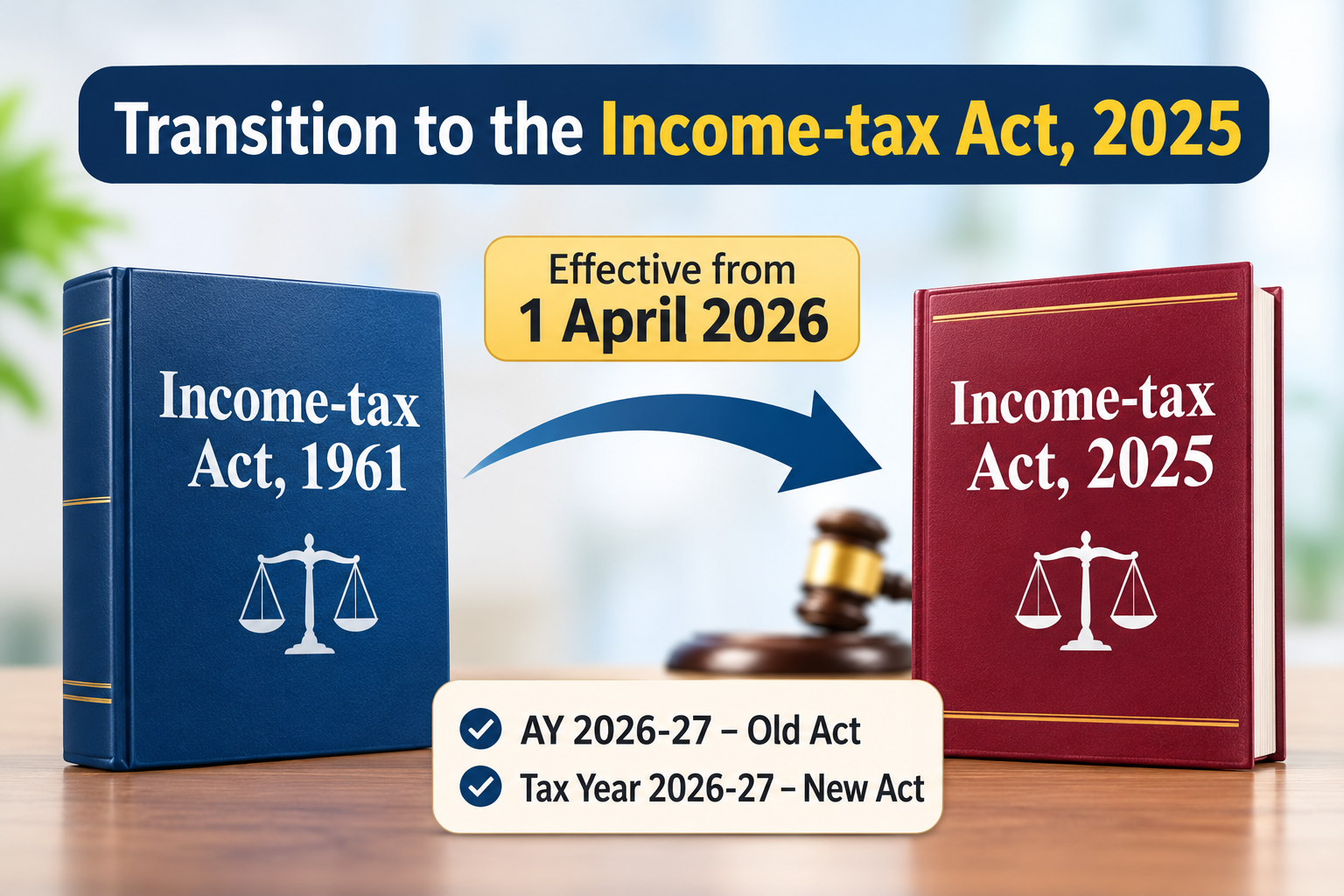
The Income-tax Act, 2025 came into force on 1 April 2026, along with the Income-tax Rules, 2026. The new legislation replaces the earlier Act and introduces a revised statutory structure with simplified language, reorganised provisions and updated compliance forms.
The transition, however, does not mean that the Income-tax Act, 1961 has become irrelevant for all purposes from 1 April 2026. Its provisions continue to govern tax matters relating to tax years beginning before that date, in accordance with the repeal and savings provisions under Section 536 of the new Act. Income Tax India+1
2. Assessment Year versus Tax Year – Understanding the transition
One of the most significant changes introduced by the new legislation is the replacement of the traditional concepts of Previous Year and Assessment Year with a single concept of Tax Year.
Under the Income-tax Act, 1961, income earned during a financial year was generally assessed in the subsequent assessment year. The new legislation simplifies this terminology by referring to the year in which income is earned as the Tax Year.
The practical distinction is as follows:
| Particulars | Applicable legislation |
|---|---|
| FY 2025-26 | Income-tax Act, 1961 |
| AY 2026-27 | Income-tax Act, 1961 |
| FY 2026-27 | Income-tax Act, 2025 |
| Tax Year 2026-27 | Income-tax Act, 2025 |
Accordingly, the income earned during FY 2025-26 will continue to be reported in the return for AY 2026-27 under the old Act, even though the return may be filed after 1 April 2026.
On the other hand, income earned from 1 April 2026 onwards will be governed by the new Act and reported for Tax Year 2026-27. Income Tax Department+1
3. Impact on TDS and TCS compliance
The transition has particular significance for deductors and collectors responsible for TDS and TCS compliance.
Under the new Act, the TDS provisions have been reorganised, with provisions relating to deduction of tax on salaries primarily covered under Section 392 and other specified payments covered under Section 393. TCS provisions are covered under Section 394.
An important point is that the applicability of the old or new provisions depends on the earlier of the date of credit or payment.
For example:
- Professional fees credited on 31 March 2026 but paid on 15 April 2026 will attract TDS provisions under the Income-tax Act, 1961.
- Professional fees credited on 5 April 2026 will be governed by the corresponding provisions of the Income-tax Act, 2025.
Therefore, businesses must carefully identify the applicable statutory provision while deducting tax and filing quarterly TDS returns. Income Tax Department+1
4. Changes in prescribed forms and reporting requirements
The Income-tax Rules, 2026 introduce revised and renumbered forms to align with the provisions of the new legislation.
Tax professionals should not assume that the forms prescribed under the old Act will automatically remain applicable to transactions governed by the new Act.
The Income Tax Department has also provided official form-mapping utilities to help taxpayers identify corresponding forms under both legislations.
Some important areas requiring attention include:
- Income-tax return forms and related schedules.
- TDS/TCS statements and certificates.
- Tax audit reports and prescribed audit forms.
- Applications for exemptions and registrations.
- Statements, declarations and other statutory compliances.
The Income Tax Department’s e-filing portal has separate facilities for forms under the Income-tax Act, 1961 and the Income-tax Act, 2025. Income Tax Department+1
5. Continuation of pending assessments and litigation
Another important aspect of the transition is the treatment of pending assessments, reassessments, appeals and other proceedings.
Section 536 of the Income-tax Act, 2025 contains repeal and savings provisions to ensure continuity of existing proceedings. Consequently, assessments and appeals relating to earlier assessment years will not become invalid merely because the old Act has been repealed.
For instance, an appeal relating to AY 2022-23 or AY 2024-25 will continue to be governed by the relevant provisions of the Income-tax Act, 1961, even if the appellate proceedings take place after 1 April 2026.
This provision is particularly relevant for Chartered Accountants and tax practitioners handling ongoing income-tax litigation. Income Tax Department+1
6. Practical challenges for taxpayers and tax professionals
Although the objective of the new legislation is simplification, its implementation requires careful planning and updating of existing compliance systems.
Businesses and tax professionals should focus on the following:
- Section mapping: Update accounting software, tax computation templates and legal documentation with the corresponding provisions of the new Act.
- TDS/TCS compliance: Ensure that the correct statutory provisions and applicable table references are quoted in quarterly returns.
- Form mapping: Identify the revised forms applicable to the relevant Tax Year.
- Tax audit: Update audit checklists, reporting formats and tax audit documentation.
- Litigation management: Maintain proper identification of proceedings governed by the old Act and those arising under the new legislation.
- Professional training: Familiarise accounting and compliance teams with the revised provisions, rules and terminology.
7. Conclusion
The introduction of the Income-tax Act, 2025 marks a major milestone in the evolution of India’s direct tax administration. While the new legislation aims to simplify the law and improve ease of compliance, the transition period requires greater attention to statutory applicability, reporting requirements and procedural continuity.
For Chartered Accountants, tax practitioners and businesses, the immediate priority should be to understand the distinction between the two Acts and ensure that the correct provisions are applied to the relevant financial years and transactions.
The success of this transition will depend not merely on the simplification of tax legislation but also on its effective implementation, proper interpretation and accurate compliance by taxpayers and professionals.