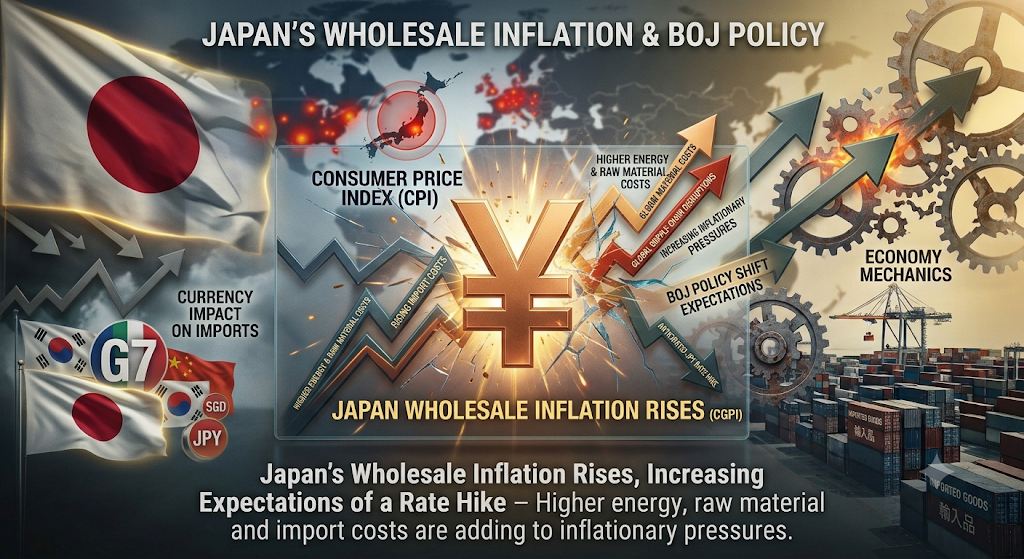
Higher Energy, Raw Material and Import Costs Are Adding to Inflationary Pressures
Japans economy is under growing pressure as wholesale prices keep rising prompting expectations that the Bank of Japan (BOJ) might raise interest rates again in the coming months. Higher energy prices increasing raw material costs, a weaker yen and ongoing global supply-chain disruptions are all pushing up business expenses across industrial sectors.
According to the data from the Bank of Japan released on November 12 2026 Japans Corporate Goods Price Index (CGPI) rose by 7.1% compared to the same period last year, in October. This marks a pace than the revised 6.8% growth seen in September and surpasses the 6.5% that economists had expected.
This upward trend shows how hard it is to keep inflation in check in an economy that depends heavily on imported energy and industrial inputs. It also strengthens the view that Japanese policymakers may need to keep adjusting policy to support long-term price stability.
Wholesale Inflation Accelerates Across Key Industries
I notice that the latest wholesale inflation figures show that rising input costs are affecting a range of Japanese industries. Petroleum and coal products recorded a 15.9 percent price increase in October while chemical products rose by 15.5 percent. Prices of plastic products increased by 14.1 percent showing production costs linked to industrial raw materials.
Non-ferrous metal prices also remained elevated increasing by 31.7 percent compared with the year. Meanwhile electricity, gas and water prices rose by 15.8 percent adding pressure to manufacturing and operating expenses.
These developments suggest that inflationary pressures are extending beyond energy markets and affecting the industrial supply chain. Businesses involved in manufacturing, construction, transportation, electronics and consumer goods are facing procurement and production costs. I see that every segment of industries from petroleum and coal products, to chemical products, plastic products, non-ferrous metal prices and even electricity, gas and water prices feels the squeeze. The impact is felt by manufacturing, construction, transportation, electronics and consumer goods businesses.
Energy Prices and Geopolitical Uncertainty Add Pressure
One of the reasons Japans wholesale inflation is going up is the rise in international energy prices. I see that tensions in the Middle East have made it unclear how much oil will be available and how it will travel, which has driven up costs related to energy.
Japan is especially vulnerable to energy price fluctuations because it relies heavily on imported fossil fuels to satisfy its domestic energy needs.
When crude oil and petroleum prices rise they directly raise the cost of transportation, electricity generation, logistics and manufacturing. I notice that those higher costs can then be passed on to businesses and consumers in the form of prices for finished products and services.
In addition the rise in prices of petrochemical feedstocks is pushing up production costs, for industries that make plastics, synthetic materials, packaging and industrial chemicals.
Weak Yen Makes Imports More Expensive
Currency depreciation is another factor that is helping to create higher prices in Japan. When the Japanese yen is weak compared to major currencies it makes imported items more expensive. This includes things like materials, machines and energy products that are brought into Japan.
The price of imports in yen went up by 24.8% compared to the same time last year. This shows how much the value of the yen affects the cost of things that come from countries.
When the yen is weaker it helps companies that sell goods abroad because their products become cheaper for people in other countries to buy.. This also makes it harder for companies that need to buy things from other countries. These businesses now have to pay more for the products they bring in.
Small and medium-sized companies are especially affected because they don’t have power to negotiate better prices. They may not be able to handle the costs of buying materials and parts from, outside Japan.
Bank of Japan Faces Growing Pressure to Raise Interest Rates
The acceleration, in inflation has drawn more attention to Bank of Japan policy choices. After years of very loose monetary conditions Bank of Japan has slowly moved toward normalising interest rates as inflation settles more firmly into the economy.
Bank of Japan currently keeps its policy interest rate at 1.25 percent. Many economists now expect Bank of Japan to raise the rate to 1.50 percent at the December 17–18 policy meeting.
Policymakers must still check whether rising wholesale prices are turning into consumer inflation and stronger domestic demand. Bank of Japan cannot assume that higher wholesale costs will automatically boost household spending.
Governor Kazuo Ueda has repeatedly emphasised how important it is for Bank of Japan to keep underlying inflation sustainably near the 2 percent target.
Impact on Japanese Businesses and Consumers
Higher wholesale prices can cause problems for Japans domestic economy. When energy, transportation, labor and materials get more expensive manufacturers often see their profit margins shrink. This makes it harder for them to stay profitable.
Companies that cannot pass these costs along to customers may end up cutting back on investments. They might delay expanding their operations or hold off on hiring workers. Some businesses may raise their prices to cover the costs but that puts more pressure on everyday households.
Japanese consumers could face prices for things like food, household items, transportation and utility bills. If inflation keeps climbing than wages people may start spending less. This can reduce consumer demand.
The real impact will depend on how companies handle rising costs. It also depends on whether wages go up to keep people buying. Stronger wages can help support demand and ease the strain, on the economy.
Global Economic Implications
Japans inflation developments also have implications for financial markets. As one of the worlds economies and a major international investor shifts in Japanese monetary policy can affect global capital flows, bond markets and foreign-exchange valuations.
Higher Japanese interest rates could make domestic investments more appealing. This might lead some investors to move capital toward assets. Such movements can impact borrowing costs and influence how funds flow across major financial markets.
Emerging economies and international businesses will also watch the yen’s performance closely. This is especially true for those with trade and investment ties, to Japan.
The Worldonomics Times Views
Japans growing wholesale inflation shows how much global energy markets, changes in money values and political problems around the world are affecting the countrys economic health. Even though higher prices for producers don’t always mean prices for consumers ongoing costs can slowly affect the whole economy.
The Bank of Japan has a job ahead: keeping inflation in check without hurting the countrys economic recovery. A smart and balanced plan for interest rates will be very important, for keeping the system stable and pushing for lasting growth.
For companies getting better at running their operations finding new places to get supplies using technology that saves energy and making their supply chains stronger will become more and more important.
Ultimately Japans economic outlook will depend on Japans ability to manage cost pressures while Japan builds stronger domestic demand and sustainable wage growth. I think the next steps are a test. The coming months will be crucial, in determining whether recent price rises lead to another money policy change and how effectively Japan navigates this changing environment.