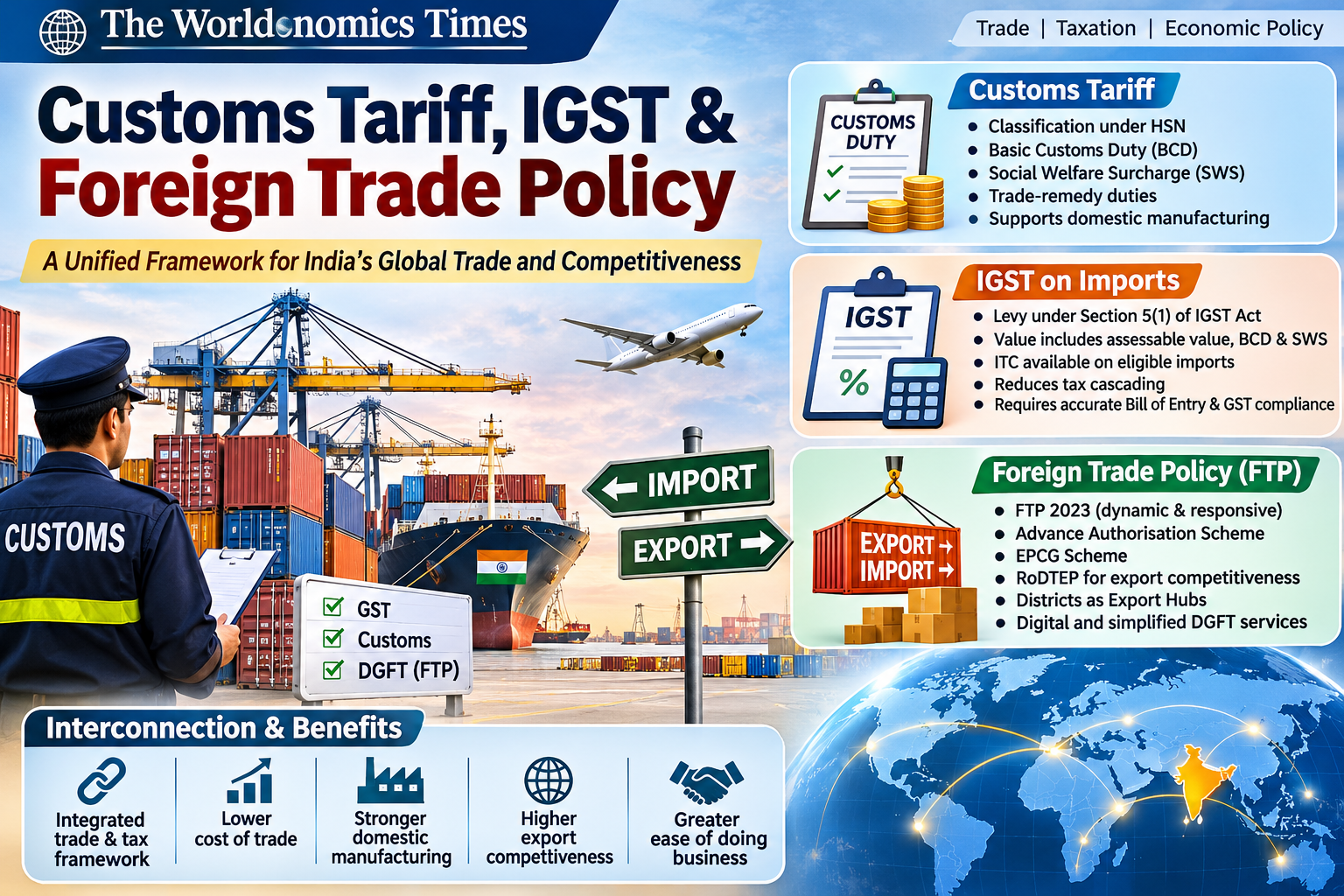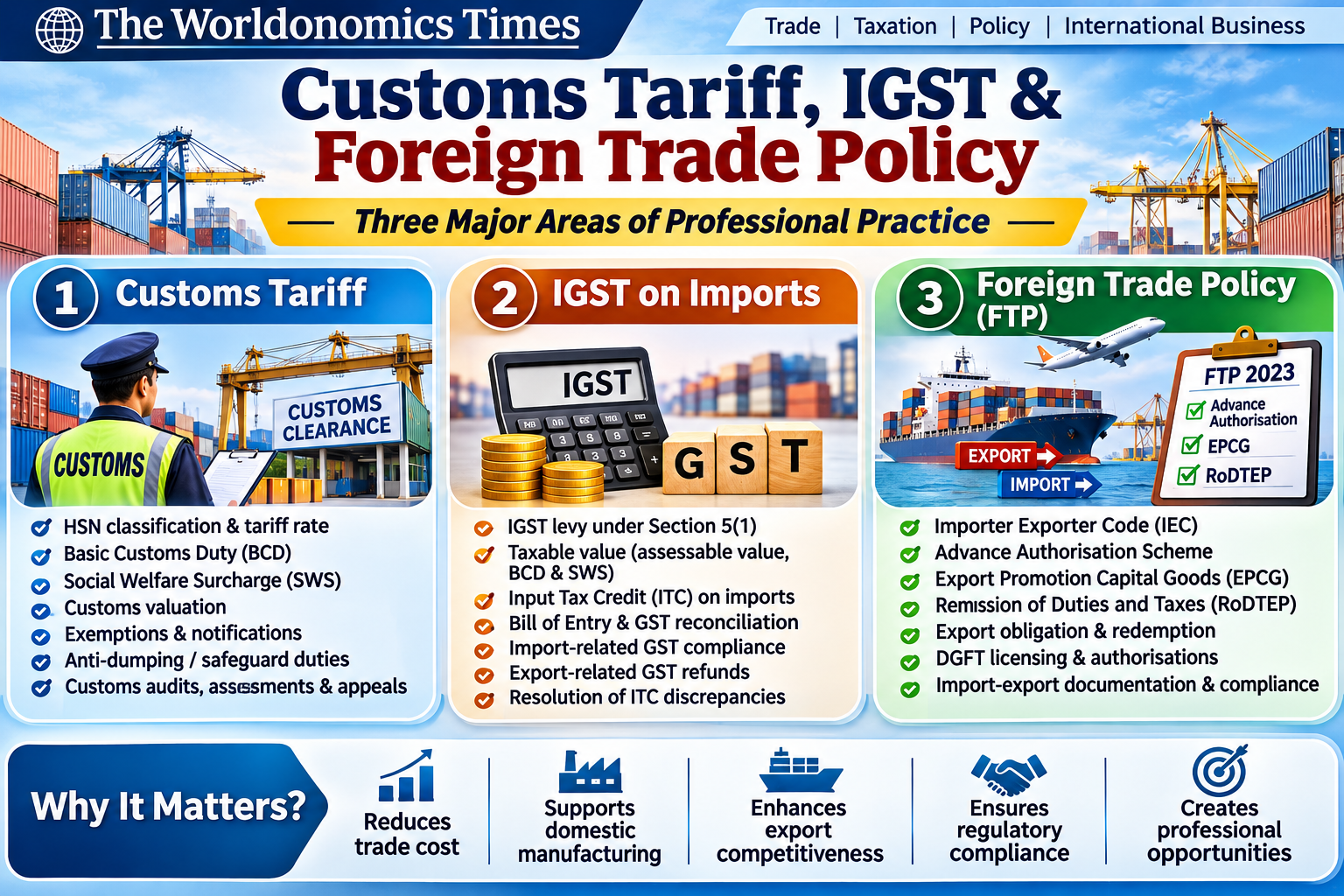
Three Major Areas of Professional Practice
India’s international trade framework offers significant professional opportunities in three interconnected areas: Customs Tariff, Integrated Goods and Services Tax (IGST), and Foreign Trade Policy (FTP). These areas play a vital role in import-export operations, taxation, regulatory compliance and international business development.
1. Customs Tariff
Customs Tariff is a fundamental component of India’s international trade and indirect taxation system. Governed primarily by the Customs Tariff Act, 1975, and the Customs Act, 1962, it regulates the duties applicable to imported and exported goods.
Major areas of professional practice include:
- Customs tariff classification and HSN identification.
- Basic Customs Duty (BCD) calculation.
- Social Welfare Surcharge (SWS).
- Customs valuation and assessable value determination.
- Customs exemptions and notification analysis.
- Anti-dumping and safeguard duties.
- Customs audits, assessments and appeals.
Professionals can assist importers and manufacturers in determining the correct classification, identifying applicable exemptions and managing customs compliance.
2. Integrated Goods and Services Tax (IGST)
IGST on imports connects India’s customs framework with its GST taxation system. Under Section 5(1) of the IGST Act, 2017, IGST is levied on imported goods in accordance with the Customs Tariff Act, 1975.
Important areas of professional practice include:
- IGST calculation on imported goods.
- Determination of the taxable value for import IGST.
- Input Tax Credit (ITC) on import IGST.
- Bill of Entry and GST return reconciliation.
- Import-related GST compliance.
- Export-related GST refunds.
- Identification and resolution of ITC discrepancies.
Professionals can help businesses optimise eligible tax credits, minimise compliance errors and maintain accurate import-related GST records.
3. Foreign Trade Policy (FTP)
Foreign Trade Policy provides the regulatory and promotional framework for India’s international trade. The Foreign Trade Policy 2023, effective from 1 April 2023, focuses on export promotion, trade facilitation, digitalisation and improving India’s global competitiveness.
Important areas of professional practice include:
- Importer Exporter Code (IEC) registration.
- Advance Authorisation Scheme.
- Export Promotion Capital Goods (EPCG) Scheme.
- Remission of Duties and Taxes on Exported Products (RoDTEP).
- Export obligation monitoring and redemption.
- DGFT licensing and authorisations.
- Import-export documentation and compliance.
- SCOMET policy and export controls.
Professionals can advise exporters and manufacturers on export incentives, duty exemptions, authorisation management and fulfilment of regulatory obligations.
Customs Tariff: Regulating International Trade
The Customs Tariff Act, 1975, read with the Customs Act, 1962, forms the foundation of India’s customs duty framework. Customs duties serve multiple purposes, including revenue generation, protection of domestic industries, regulation of imports and implementation of trade policy objectives.
Imported goods are classified under the Harmonised System of Nomenclature (HSN), which determines the applicable tariff classification and rates of duty. Correct classification is critical because errors may result in additional duty demands, penalties, interest and litigation.
Customs tariff policy also plays a strategic role in supporting domestic manufacturing through initiatives such as Make in India and Atmanirbhar Bharat. Tariff rationalisation is important to prevent inverted duty structures and excessive input costs.
IGST on Imports: Integrating Customs and GST
Under the GST framework, imports of goods are treated as inter-State supplies. IGST is generally collected at the customs clearance stage.
For example, consider imported goods with an assessable value of ₹10 lakh, BCD of 10%, SWS of 10% of BCD and IGST of 18%.
| Particulars | Amount |
|---|---|
| Assessable value | ₹10,00,000 |
| BCD at 10% | ₹1,00,000 |
| SWS | ₹10,000 |
| Value for IGST | ₹11,10,000 |
| IGST at 18% | ₹1,99,800 |
| Total import taxes | ₹3,09,800 |
Eligible import IGST may be claimed as Input Tax Credit, subject to applicable GST provisions and documentation requirements.
Foreign Trade Policy 2023: Promoting Export-Led Growth
FTP 2023 provides a framework for strengthening India’s export ecosystem. Its important schemes include Advance Authorisation, EPCG and RoDTEP.
These initiatives support duty-efficient imports of production inputs and capital goods, while providing remission of eligible embedded taxes on exported products.
The policy also promotes Districts as Export Hubs and digital DGFT services to improve accessibility and simplify export procedures.
Challenges and the Way Forward
Indian businesses continue to face challenges involving tariff classification disputes, customs valuation, changing duty rates, documentation requirements and export obligation compliance.
Better coordination between CBIC, DGFT and GST authorities, together with digital integration and simplified procedures, can reduce compliance costs.
Professionals, including Cost and Management Accountants, have an important role in customs cost analysis, import tax planning, export incentive evaluation and regulatory advisory.
Conclusion
Customs Tariff, IGST and Foreign Trade Policy collectively form the backbone of India’s international trade taxation and regulatory framework. Their effective implementation can strengthen domestic manufacturing, improve export competitiveness, reduce tax inefficiencies and enhance India’s integration with global value chains.