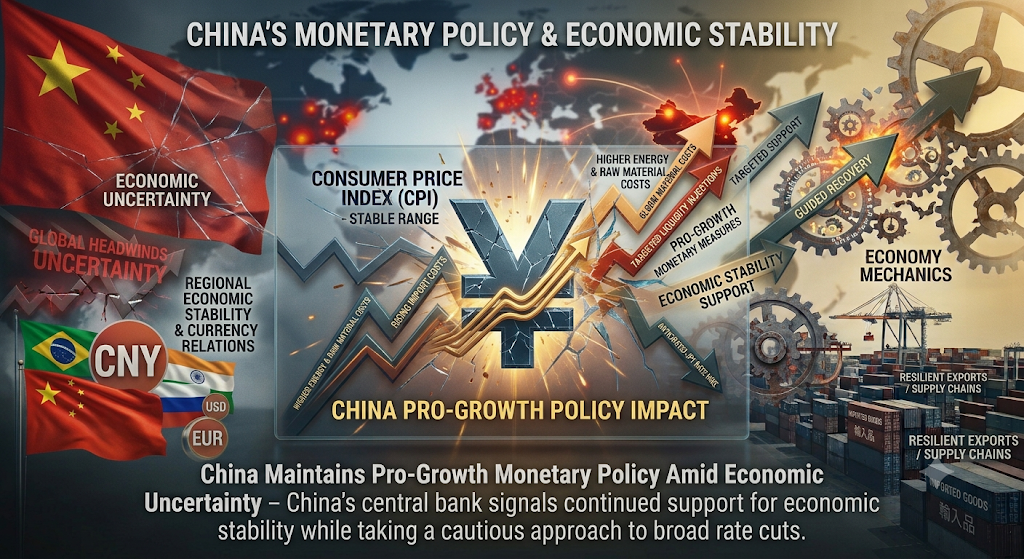
China’s Central Bank Signals Continued Support for Economic Stability While Taking a Cautious Approach to Broad Rate Cuts
Chinas central bank is staying focused on a money policy that supports growth as the largest economy deals with its own economic problems and a difficult global situation. The Peoples Bank of China (PBOC) has said it will keep helping with stability support for people spending money and confidence in the financial markets.. The bank is being careful about lowering interest rates too much.
In the recent third-quarter money report, published on November 11 2026 the central bank promised to make better use of tools that help the economy during bad times keep enough money in the system and make it easier for companies and families to get loans. Still the words used show that officials are being more careful about doing money tricks. This is because they are worried about keeping the system safe making sure banks make enough money and whether lowering rates actually works.
The way the policy is going shows that China is trying to grow the economy while also being careful, with money. This is happening at a time when people are not spending much the housing market is having trouble and the outside world is not very stable. All of these things are affecting how the economy is doing.
People’s Bank of China Reinforces Its Growth Commitment
The PBOC has repeated its promise to keep a monetary policy that helps sustainable economic growth. Its newest guidance stresses flexibility, targeted interventions and the effective use of policy instruments.
Of using only big cuts, in interest rates the PBOC plans to change the timing, intensity and shape of monetary help as domestic and international economic conditions shift.
The PBOC also said that liquidity will stay very accommodative to back the economy. This plan aims to make sure that businesses, small and medium‑sized enterprises can get affordable financing.
The priority areas are innovation, infrastructure development, domestic consumption and private‑sector investment.
Why China Is Taking a Cautious Approach to Rate Cuts
China still has challenges to deal with. The central bank does not want to lower benchmark lending rates much. There are reasons for this cautious approach.
One reason is the health of banks. If lending rates keep going down the gap between what banks earn on loans and what they pay on deposits gets smaller. This could hurt their profits. Make them less stable.
Another point is that lowering rates may not help the economy enough. If companies and people are not ready to borrow or spend cutting interest rates might not lead to economic growth. The effect could be weak or even absent.
China also wants to avoid much risk in financial markets. It is trying to keep banking and bond markets stable. That means it does not want spikes, in lending or risky investments.
Because of these concerns the central bank has been sending signals that it prefers actions. Of big rate cuts it is looking at more precise support tools. This approach aims to help the economy without causing instability.
Domestic Consumption and Property Market Remain Key Challenges
I think weak domestic demand remains a worry for China’s economic policymakers. While manufacturing and export sectors are holding steady household consumption and private investment have not bounced back in a way.
The long slowdown in the property market has also shaken consumer confidence and household wealth. Falling property values and uncertainty, about real estate developers have led households to keep savings instead of spending more on extras.
To tackle these problems policymakers are working to make credit easier to get and to push investment into sectors.
The PBOC has put demand at the top of its list showing that monetary policy will work more closely with other government plans to boost household consumption and business confidence.
Targeted Financial Support for Businesses and Strategic Industries
An important feature of Chinas monetary approach is its focus on structural and targeted financing instruments.
The central bank plans to strengthen support for businesses, private enterprises, technological innovation and infrastructure development. These measures aim to direct resources to sectors that can create jobs boost productivity and help build long-term economic competitiveness.
Technology-related industries, such, as manufacturing, artificial intelligence, semiconductors and digital infrastructure are still top priorities.
Targeted lending facilities can help solve financing problems in areas without causing too much liquidity to flow across the whole financial system.
This approach also shows China’s economic strategy—improving industrial competitiveness while reducing reliance on older ways of economic growth.
International Economic Conditions Influence China’s Policy Decisions
Chinas monetary policy is being shaped more and more by what happens in the economy. When interest rates change in economies like the United States it can affect how money moves in and out of China. These shifts can influence the value of the yuan and impact how confident investors feel.
When interest rates in China are very different from those in countries it often leads to capital flowing across borders. This can create pressure on the Chinese yuan especially when foreign investors want to move their money to where returnsre higher.
Because of this the Peoples Bank of China or PBOC has made it clear that keeping the exchange rate stable is important. At the time it wants the yuan to respond naturally to supply and demand in the market. This balance helps avoid movements that could disrupt trade and investment.
Global trade tensions, political uncertainty and changes in the prices of oil, metals and other commodities also make the job harder for policymakers. These factors can cause economic shocks that affect inflation, growth and financial markets.
To keep things steady the central bank uses monetary conditions. It manages how much money is available, in the system carefully. This helps support growth while reducing the risk of financial bubbles or instability. The goal is to keep the economy running smoothly without creating much risk in the financial system.
Implications for Global Markets and Emerging Economies
Chinas monetary policy decisions matter a lot for financial markets. This is because China is a player in manufacturing, trade and the global consumption of raw materials. When China supports its economy with measures it can boost demand for things, like industrial raw materials, energy, machinery and manufactured goods. This helps countries that export these commodities.
If China takes a careful approach and avoids big rate cuts the short-term impact of its stimulus may not be as strong. That means the global demand boost could be slower or more limited.
For emerging economies Chinas policy direction stays very important. Trade, investment and supply chains all depend on Chinas choices. Countries that trade a lot with China will keep an eye on how Chinese consumption changes, how much industry invests and how the yuan moves in value.
The Road Ahead: Balancing Growth With Financial Stability
The central bank is likely to keep using targeted financing programmes, liquidity management and structural reforms to support activity.
Relying only on monetary measures may not be enough to fix deeper structural issues. These include household confidence, problems in the property sector and uneven private investment.
A lasting recovery will need both fiscal and monetary policies to work together. It will also require household consumption, better business confidence and ongoing investment, in productive industries.
The Worldonomics Times Views
Chinas newest money rules show a way of dealing with uncertain times. Of making big drops in interest rates the central bank in China seems to be trying to keep enough money moving around while also making sure that the money goes to parts of the economy that can help it grow in a lasting way.
This plan understands that getting the economy back on track isn’t about making loans cheaper. People need to feel more confident about spending jobs need to stay steady companies need to invest in ways and the housing market needs to be healthier to bring the economy back to life.
For the rest of the world how China handles money will keep having an effect on what people buy what factories make, how trade moves and how people feel about investing.
In the end China has to keep growing without making the financial system riskier. Whether this money plan works will depend on how the people, in charge can balance helping the economy now with making sure the financial system stays strong and the economy changes in the right way.