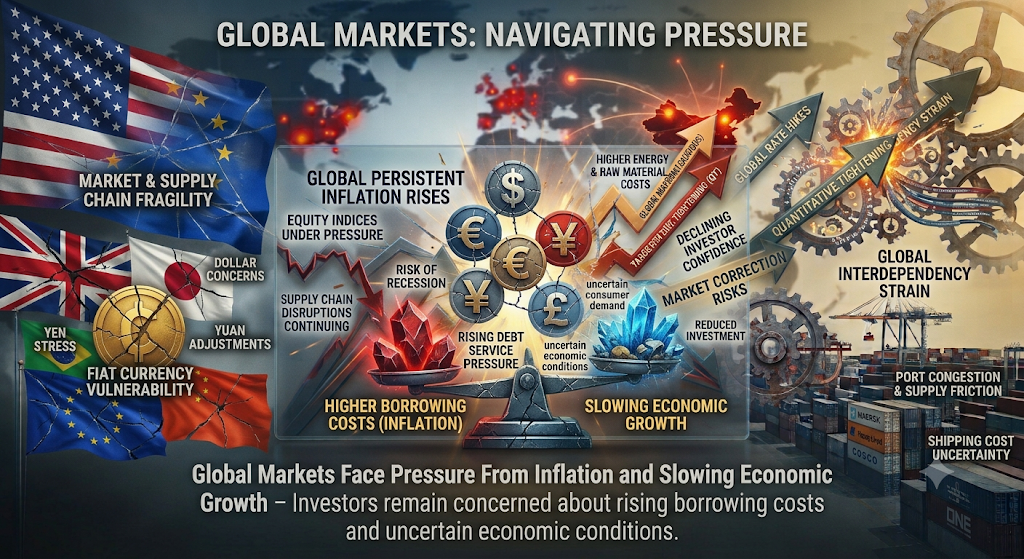
Investors remain concerned about rising borrowing costs and uncertain economic conditions.
Global financial markets are facing renewed uncertainty as persistent inflation, elevated borrowing costs and signs of slowing economic growth create challenges for investors. Although several economies have demonstrated resilience in the face of geopolitical tensions and higher energy prices, concerns are increasing that economic momentum could weaken further while inflation remains difficult to control.
The combination of slower growth and persistent price pressures is creating a complicated environment for central banks, businesses and financial markets. Investors are closely monitoring economic data, government bond yields and monetary policy decisions to assess the direction of global markets in the months ahead.
Inflation Continues to Challenge the Global Economy
Inflation remains one of the most important concerns influencing market sentiment. Higher energy, food, transportation and production costs are putting pressure on households and businesses across several regions. Even when commodity prices decline temporarily, the impact of earlier increases can continue to affect consumer prices and operating expenses.
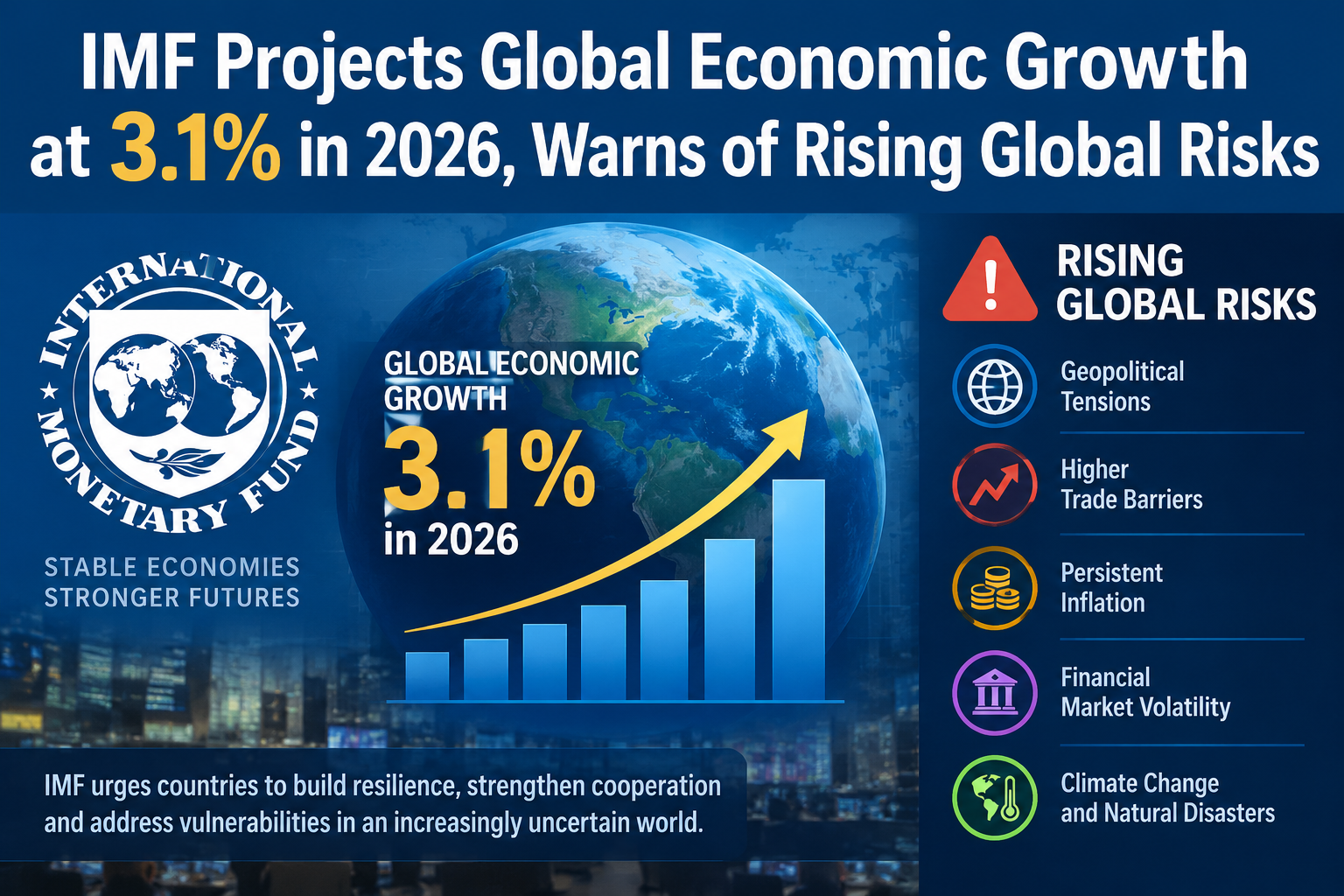
The International Monetary Fund’s October 2026 World Economic Outlook projects global headline inflation at 4.7% in 2026, before easing to 4.1% in 2027. It also forecasts global economic growth of 3.1% in 2026. These projections highlight the difficulty of achieving stable prices while maintaining economic expansion.
Energy markets remain a significant source of uncertainty. Geopolitical tensions and disruptions to important supply routes can quickly increase the cost of oil and natural gas. Such increases affect not only energy bills but also manufacturing, logistics, agriculture and international trade. Economies that depend heavily on imported energy are particularly vulnerable to these developments. <Cite refs={[“turn953860search0″,”turn953860search7”]}/>
Rising Borrowing Costs Put Pressure on Markets
Higher borrowing costs are another major factor weighing on global financial markets. Government bond yields have increased in several major economies, reflecting concerns about inflation, public debt and the future direction of interest rates.
When bond yields rise, governments face higher costs when financing their debt, while businesses may find it more expensive to borrow for expansion and investment. Consumers can also experience the impact through higher mortgage rates, car loans and credit-card costs.
The increase in long-term borrowing costs is particularly important for equity markets. Higher interest rates can reduce the present value of future corporate earnings, putting pressure on stock valuations. Companies with significant debt or businesses that depend on external financing may face additional challenges.
Recent market developments have reinforced these concerns. Reuters reported in early November that rising government borrowing costs, weaker European economic data and uncertainty surrounding inflation were weighing on investor confidence. The report also highlighted pressure on technology shares as concerns about the sustainability of high valuations increased. <Cite refs={[“turn953860news32″,”turn953860search6”]}/>
Slowing Economic Growth Raises Further Concerns
While inflation remains elevated, economic growth is showing signs of moderation in several regions. Higher prices reduce household purchasing power, while expensive credit can discourage consumption, investment and business expansion.
The OECD’s September 2026 interim economic outlook projects global GDP growth of 2.9% in 2026 and 3.0% in 2027. It identifies higher interest rates, weaker real income growth and continued price pressures as important constraints on economic activity.
Growth prospects also differ across regions. The United States continues to receive support from technology-related investment, although consumer spending and real income growth face pressure. European economies remain exposed to energy costs and weaker demand, while China faces the challenge of sustaining economic momentum amid domestic and international uncertainties. Emerging markets must also manage currency volatility, external financing costs and exposure to commodity price movements. <Cite refs={[“turn953860search4″,”turn953860search7”]}/>
Central Banks Face Difficult Policy Decisions
Central banks are operating in a challenging environment. If inflation remains persistent, policymakers may need to maintain restrictive monetary conditions or consider further interest-rate increases. However, tighter monetary policy can also slow economic activity and increase financial pressure on households, businesses and governments.
This creates a difficult balancing act. Cutting interest rates too early could allow inflationary pressures to strengthen again, while keeping rates elevated for too long could weaken investment, employment and consumer demand.
Investors are therefore paying close attention to inflation reports, employment figures, economic growth estimates and central bank communications. Any indication of a change in monetary policy expectations can influence bond yields, currencies, equity prices and capital flows across international markets.
Investors Adopt a More Cautious Approach
Uncertainty surrounding inflation and growth is encouraging investors to reassess their portfolios and risk exposure. Equity markets may experience greater volatility as market participants evaluate corporate earnings, financing costs and future economic conditions.
Government bonds, currencies, commodities and defensive sectors are also receiving close attention as investors seek to manage uncertainty. However, no asset class is completely insulated from market risks, particularly when inflation, interest rates and geopolitical developments are moving in unpredictable directions.
Businesses are also adjusting their strategies. Companies may delay major investments, manage expenses more carefully and strengthen cash positions to prepare for potentially weaker demand and higher financing costs.
The Road Ahead for Global Markets
The outlook for global markets will depend on whether inflation begins to moderate consistently and whether economic growth can remain resilient. A sustained reduction in energy and commodity prices could ease pressure on consumers and businesses, while greater geopolitical stability may improve investor confidence.
However, renewed supply disruptions, higher government borrowing costs or weaker-than-expected corporate earnings could intensify market uncertainty. The possibility of persistent inflation alongside slowing growth remains a significant risk for policymakers and investors.
The Worldonomics Times Views
Global markets are entering a period in which economic resilience will be tested by the combined impact of inflation, higher borrowing costs and slowing growth. Investors should avoid relying solely on short-term market movements and instead focus on economic fundamentals, corporate financial strength and long-term risk management.
For policymakers, maintaining price stability without unnecessarily damaging economic activity will remain a central challenge. Governments must also address fiscal vulnerabilities and support productive investment while avoiding measures that could add to inflationary pressure.
The coming months will be important in determining whether the global economy can achieve a more balanced recovery. Until clearer signs emerge, cautious investment decisions, disciplined financial management and close monitoring of economic developments are likely to remain essential for navigating an uncertain global market environment.