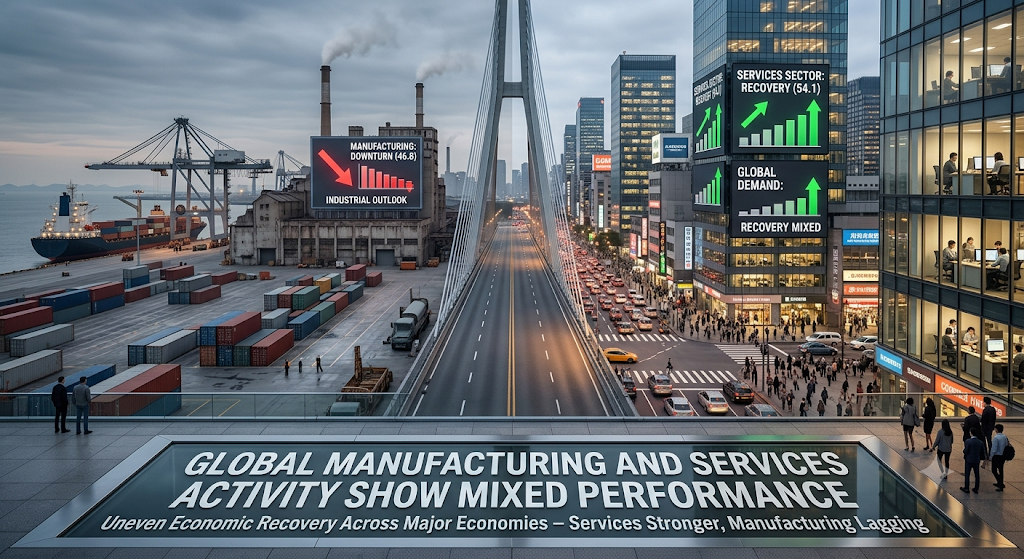
Manufacturing and services indicators suggest uneven economic recovery across major economies.
Global economic activity continues to demonstrate resilience, but the recovery remains uneven across manufacturing and services industries. Recent business surveys indicate that factories are maintaining expansion in several major economies, while services activity is growing at different rates amid changing consumer demand, higher operating expenses and geopolitical uncertainty.
The latest Purchasing Managers’ Index (PMI) reports for October 2026 suggest that global economic growth remains positive, although momentum has moderated. Strong demand for artificial intelligence infrastructure, advanced electronics and industrial equipment is supporting manufacturing in selected economies. Meanwhile, services businesses are benefiting from consumer spending and digital transformation, but higher prices and tighter financial conditions are creating challenges.
These developments highlight the differences between national economies and sectors, making the global recovery more complex than a simple pattern of expansion or contraction.
Global Manufacturing Maintains Expansion
Global manufacturing activity continued to expand in October, although growth slowed slightly compared with September.
According to the J.P. Morgan Global Manufacturing PMI compiled by S&P Global, the manufacturing index declined from 53.0 in September to 52.6 in October. Despite the moderation, the reading remained above the 50-point threshold for the fifteenth consecutive month, indicating continued expansion.
Manufacturing output increased across consumer, intermediate and investment goods. Intermediate goods producers recorded the strongest growth, supported by demand from industrial and technology-related industries.
New orders and export business also continued to improve. However, supply-chain delays, capacity constraints and higher input costs are creating pressure for manufacturers.
The National Association of Manufacturers reported on November 9 that the global manufacturing expansion remained broad-based, although business confidence was relatively weak because of uncertainty surrounding international trade, energy prices and geopolitical developments.
United States Shows Strength Across Key Industries
The United States remains one of the stronger-performing major economies, with manufacturing and services activity continuing to expand.
According to the Institute for Supply Management (ISM), the US Manufacturing PMI increased to 55.5 in October from 54.5 in September. Production and new orders improved, indicating continued demand for industrial goods.
The services sector also remained in expansion territory. The ISM Services PMI registered 54.5 in October, compared with 54.9 in September. Although growth moderated, the reading represented the sector’s twenty-eighth consecutive month of expansion.
Financial services, transportation, information technology, retail and professional services contributed to activity. However, slower new orders and persistent input-cost pressures indicate that businesses are operating in a challenging environment.
The continued expansion of AI-related infrastructure is also supporting demand for advanced computing equipment, semiconductor products and related industrial services.
European Manufacturing Recovery Remains Uneven
Manufacturing conditions across Europe have improved, but differences between individual economies remain significant.
The eurozone Manufacturing PMI stood at 52.7 in October, slightly below September’s 52.9. This represented the ninth consecutive month of expansion and indicated that industrial activity continued to recover.
Germany recorded stronger manufacturing performance, supported by industrial investment and demand for equipment. However, France and Italy remained below the 50-point threshold, highlighting continued weakness in parts of southern Europe.
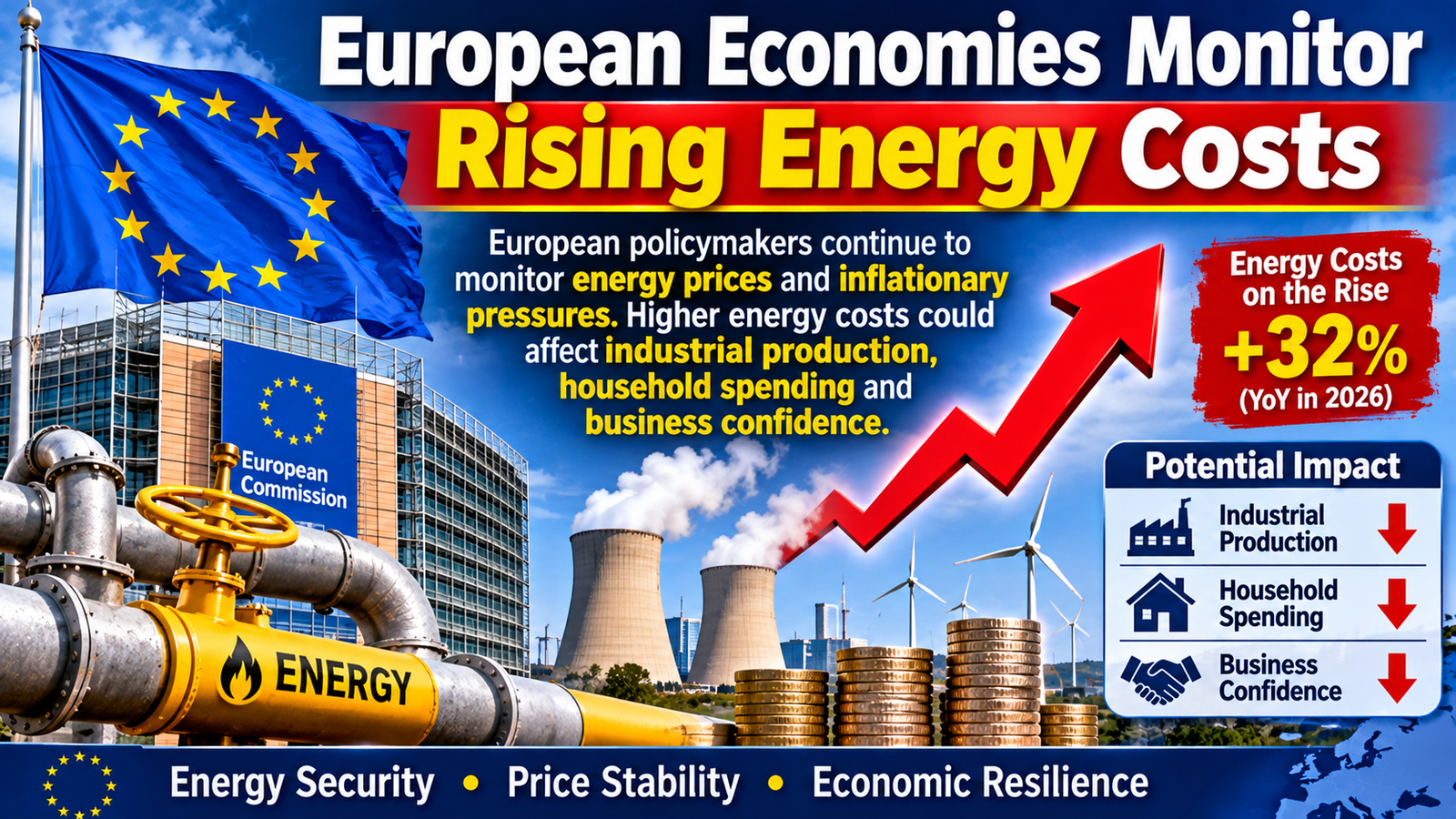
Higher energy costs and supply-chain disruptions remain important concerns for European manufacturers. Businesses are facing increased expenses for electricity, transportation and industrial inputs, which could affect production decisions and competitiveness.
The services sector also faces challenges from inflation and cautious consumer spending. Although tourism, financial services and professional activities continue to support economic activity, the recovery remains sensitive to household purchasing power and borrowing costs.
Asian Economies Record Different Growth Patterns
Asia continues to play an important role in global manufacturing, particularly through semiconductor production, electronics, industrial machinery and technology-related exports.
India remained among the stronger-performing manufacturing economies in October, supported by domestic demand and industrial activity. Indonesia and Thailand also recorded comparatively strong factory growth.
However, manufacturing momentum moderated in several other Asian economies, including China, Japan, South Korea and Taiwan. Higher input costs, weaker demand in selected industries and supply-chain uncertainty contributed to the slowdown.
China’s manufacturing performance remains particularly important because of its influence on international trade and industrial supply chains. Changes in Chinese factory output can affect commodity demand, export markets and manufacturing activity across neighbouring economies.
Japan, meanwhile, continues to benefit from demand for advanced semiconductors and precision machinery. Nevertheless, higher production costs and uncertainty surrounding international trade remain concerns for businesses.
Services Sector Continues to Support Economic Activity
The services sector remains a major source of economic growth and employment across developed and emerging economies.
Industries such as banking, telecommunications, tourism, healthcare, retail, logistics and information technology contribute significantly to national output. Their performance is closely linked to consumer confidence, household income and business investment.
The October US services PMI of 54.5 indicates that activity continued to expand, although the pace moderated slightly. New orders also slowed, suggesting that some businesses are experiencing more cautious demand conditions.
At the global level, the J.P. Morgan Global Composite PMI Output Index declined from 54.3 in September to 53.2 in October. The index remained comfortably above 50, but the decline indicated that overall business activity had lost some momentum.
S&P Global estimated that the October reading was consistent with annualised global GDP growth of approximately 2.9%. This suggests that the global economy remains on an expansionary path, even as differences between countries and industries become more visible.
Inflation and Geopolitical Uncertainty Create Risks
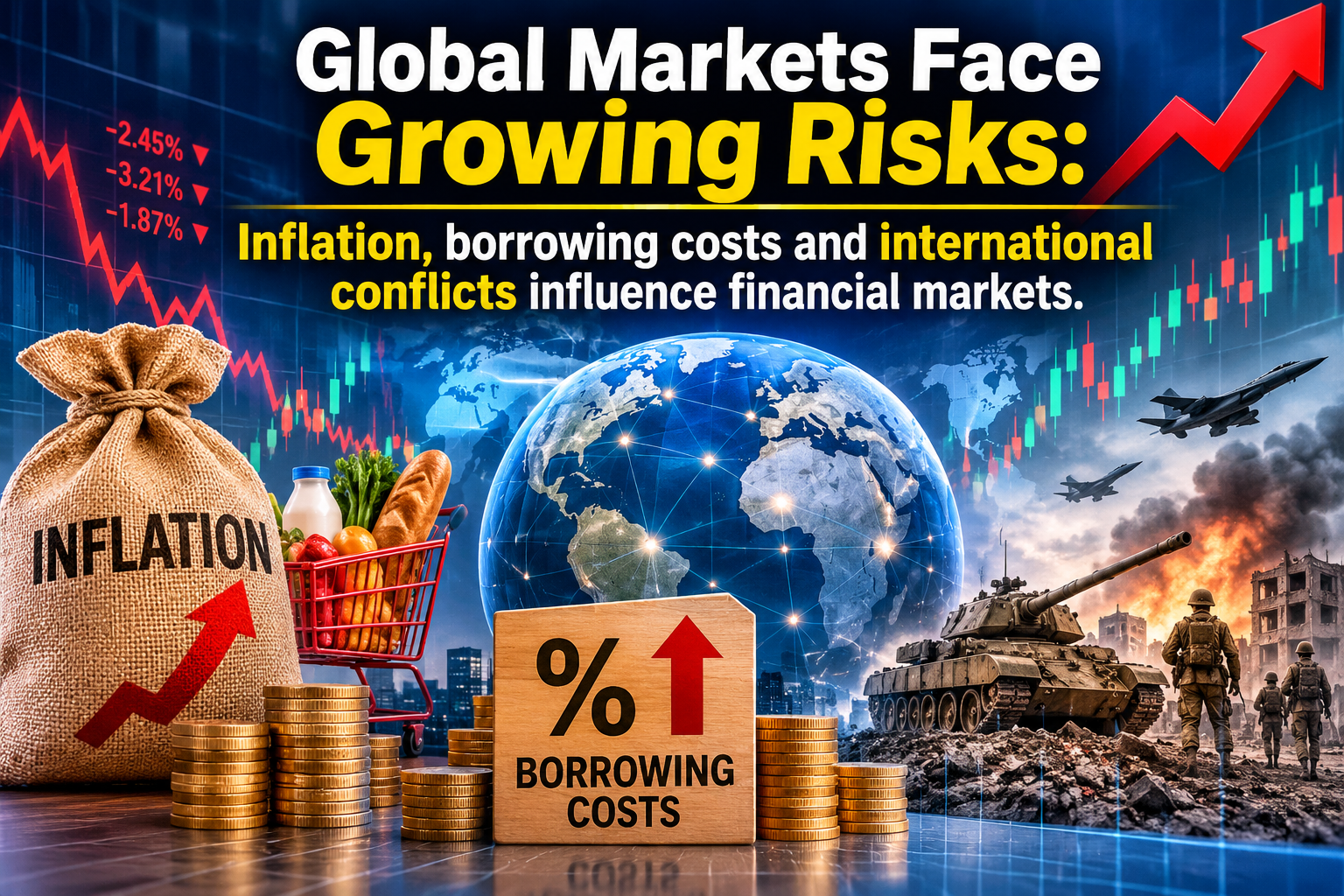
Rising input costs are becoming an important challenge for both manufacturing and services businesses.
Higher energy prices, transportation expenses and raw-material costs can reduce profit margins and encourage companies to increase prices. Manufacturers are particularly exposed to supply-chain disruptions, while service providers face higher labour, rental and technology expenses.
Geopolitical tensions are adding further uncertainty by affecting international shipping, commodity markets and business confidence.
Central banks must also consider these developments when setting monetary policy. If higher production and service costs contribute to persistent inflation, interest rates may remain elevated for longer, potentially weakening investment and consumer demand.
The combination of moderate growth and persistent inflation therefore creates a difficult environment for businesses and policymakers.
The Road Ahead for the Global Economy
The outlook for manufacturing and services will depend on the strength of consumer demand, international trade conditions, energy prices and business investment.
Manufacturing could receive further support from technology infrastructure, automation, defence-related spending and industrial modernisation. Services activity may benefit from digital transformation, tourism and expanding demand for professional and financial services.
However, continued geopolitical uncertainty, high operating costs and restrictive financial conditions could limit the pace of expansion.
Businesses will need to improve productivity, diversify suppliers and manage costs carefully. Governments should focus on infrastructure investment, workforce development and policies that encourage sustainable industrial and service-sector growth.
The Worldonomics Times Views
The latest manufacturing and services indicators demonstrate that the global economy is continuing to expand, but the recovery remains uneven across countries and industries. Strong manufacturing demand in technology-oriented sectors is providing support, while some traditional industries continue to struggle with high costs and weaker orders.
The services sector remains an important source of economic resilience, although moderating business activity and persistent inflation require careful monitoring.
Governments should strengthen industrial competitiveness, improve supply-chain resilience and support investment in technology and infrastructure. Central banks must remain attentive to inflation without unnecessarily restricting economic growth.
For investors and businesses, monitoring sector-specific indicators will be essential. A country showing strong manufacturing performance may still experience weakness in services, employment or consumer demand.
Ultimately, sustainable global growth will depend on balanced expansion across both manufacturing and services. The ability of major economies to manage inflation, strengthen business confidence and adapt to changing international conditions will determine the strength of the next phase of economic recovery.