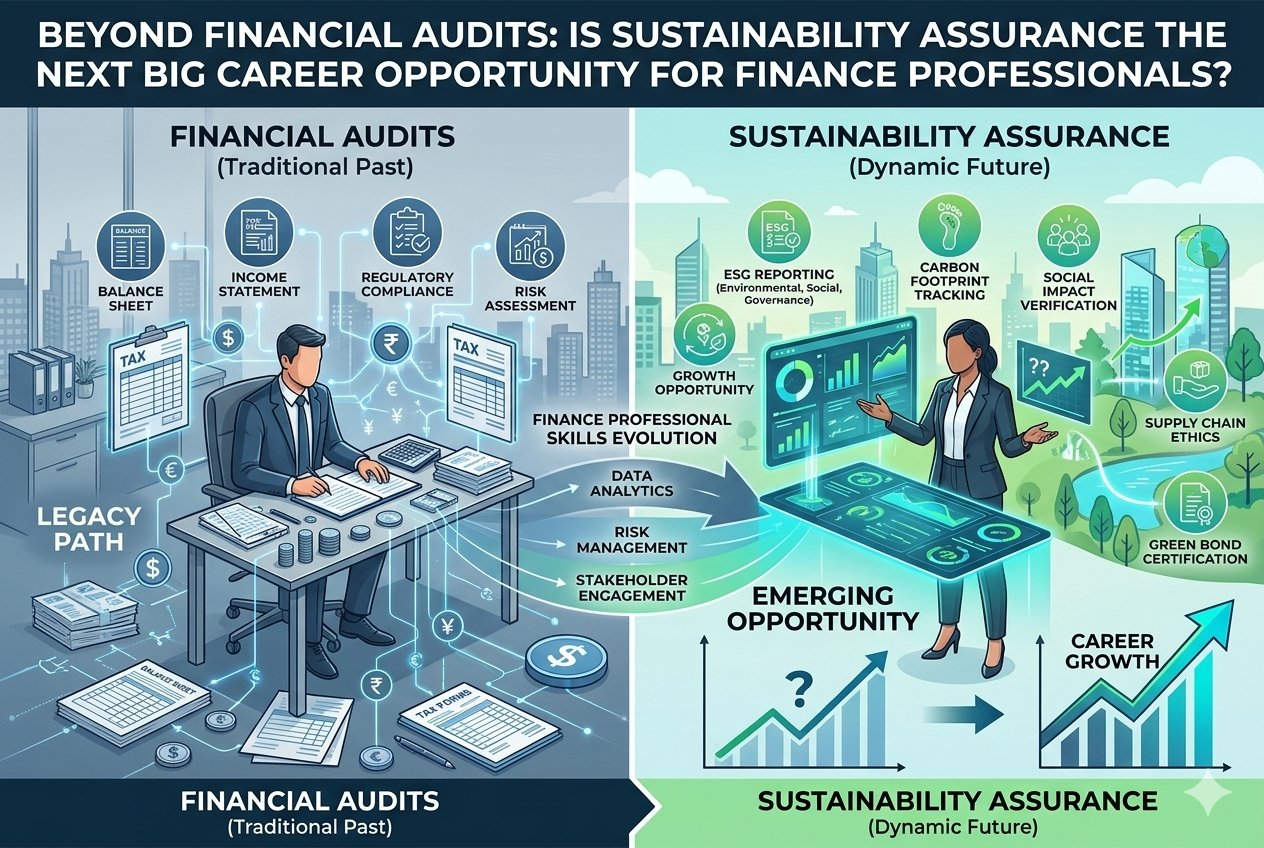
As businesses face growing expectations around ESG disclosures, the role of audit and assurance professionals is expanding beyond traditional financial statements.
For decades, auditing has been closely associated with financial statements, accounting records, internal controls and regulatory compliance.
But the business environment is changing.
Today, investors, regulators, lenders and other stakeholders want to understand more than a company’s profitability. They also want to know how businesses manage environmental risks, social responsibilities and corporate governance.
This shift is creating a new professional opportunity: Sustainability Assurance.
1. What Is Sustainability Assurance?
Sustainability assurance involves independently evaluating the reliability and credibility of information disclosed by an organisation about its environmental, social and governance (ESG) performance.
This may include information relating to:
- Greenhouse gas emissions.
- Energy and water consumption.
- Waste management.
- Employee welfare and workplace practices.
- Diversity and inclusion.
- Corporate governance and business ethics.
The objective is to provide stakeholders with greater confidence that sustainability information is supported by appropriate evidence and reliable reporting processes.
2. A Significant Development: ICAI Issues SSA 5000
In September 2026, the Institute of Chartered Accountants of India (ICAI) issued SSA 5000 – General Requirements for Sustainability Assurance Engagements.
The standard establishes a consistent, principles-based framework for sustainability assurance engagements and is aligned with the international ISSA 5000 framework, with India-specific provisions.
It addresses important aspects such as:
- Engagement acceptance and continuance.
- Independence and quality management.
- Planning and materiality.
- Risk assessment and collection of evidence.
- Evaluation of misstatements.
- Preparation of assurance reports.
The standard becomes effective for sustainability assurance engagements relating to periods beginning on or after 1 April 2027.
This is an important development in strengthening India’s sustainability reporting and assurance ecosystem.
3. Why Does This Matter to Finance Professionals?
Sustainability reporting is no longer simply a communication exercise for companies. It increasingly involves measurable information, reporting systems, risk assessment and independent verification.
This creates opportunities for professionals with knowledge of:
Accounting and financial reporting: Understanding reporting frameworks, documentation and disclosure requirements.
Audit and assurance: Evaluating evidence, testing information and identifying reporting inconsistencies.
Cost and management accounting: Analysing energy costs, resource utilisation, operational efficiency and environmental expenditure.
Corporate law and compliance: Understanding regulatory requirements and governance responsibilities.
Data analytics: Examining large datasets and identifying unusual trends or inconsistencies.
The combination of financial knowledge and sustainability expertise could become an important professional advantage.
4. What Skills Will Future Assurance Professionals Need?
The future of auditing will require a combination of traditional professional skills and emerging technical capabilities.
| Skill | Why it matters |
|---|---|
| Financial reporting | Understanding disclosures and reporting frameworks |
| Audit methodology | Evaluating evidence and reporting risks |
| ESG knowledge | Understanding sustainability indicators |
| Data analytics | Analysing large volumes of information |
| Technology awareness | Using digital tools for verification |
| Professional ethics | Maintaining independence and objectivity |
Professional judgement will remain essential. Technology can support verification, but responsibility for the quality and credibility of assurance work cannot simply be delegated to software.
5. Is This an Opportunity for CMAs and Other Commerce Professionals?
The expanding sustainability assurance ecosystem creates opportunities for professionals from accounting, finance, cost management, audit and compliance backgrounds.
For Cost and Management Accountants, the connection is particularly interesting.
Cost management already involves understanding resource consumption, operational efficiency, energy expenditure and performance measurement.
These capabilities can contribute to sustainability-related work, especially where environmental performance is connected with business costs and operational decisions.
However, professionals must also develop the relevant sustainability reporting, assurance and regulatory knowledge and meet applicable eligibility and independence requirements for specific engagements.
6. The Future of Auditing: From Verification to Value Creation
The traditional perception of auditing is gradually expanding.
Modern assurance work increasingly intersects with technology, cybersecurity, fraud risk, sustainability disclosures and corporate governance.
For example, ICAI’s Internal Audit Standards Board has also been highlighting the use of data analytics, AI-based fraud detection and risk management in internal audit practices.
This reflects a broader transformation: businesses need professionals who can identify risks, question information, evaluate controls and help strengthen decision-making.
The future audit professional will need to understand not only numbers, but also the systems and business realities behind those numbers.
Conclusion
The accounting and auditing profession is evolving beyond its traditional boundaries.
Financial audits will continue to remain important, but sustainability assurance, technology-enabled auditing and risk advisory are creating additional areas of professional development.
For aspiring finance professionals, this is an opportunity to look beyond conventional career paths and continuously upgrade their skills.
The future may not belong merely to those who can verify numbers, but to those who can understand, question and provide confidence in the information that shapes business decisions.
By Ankita Nag