By The Worldonomics Times
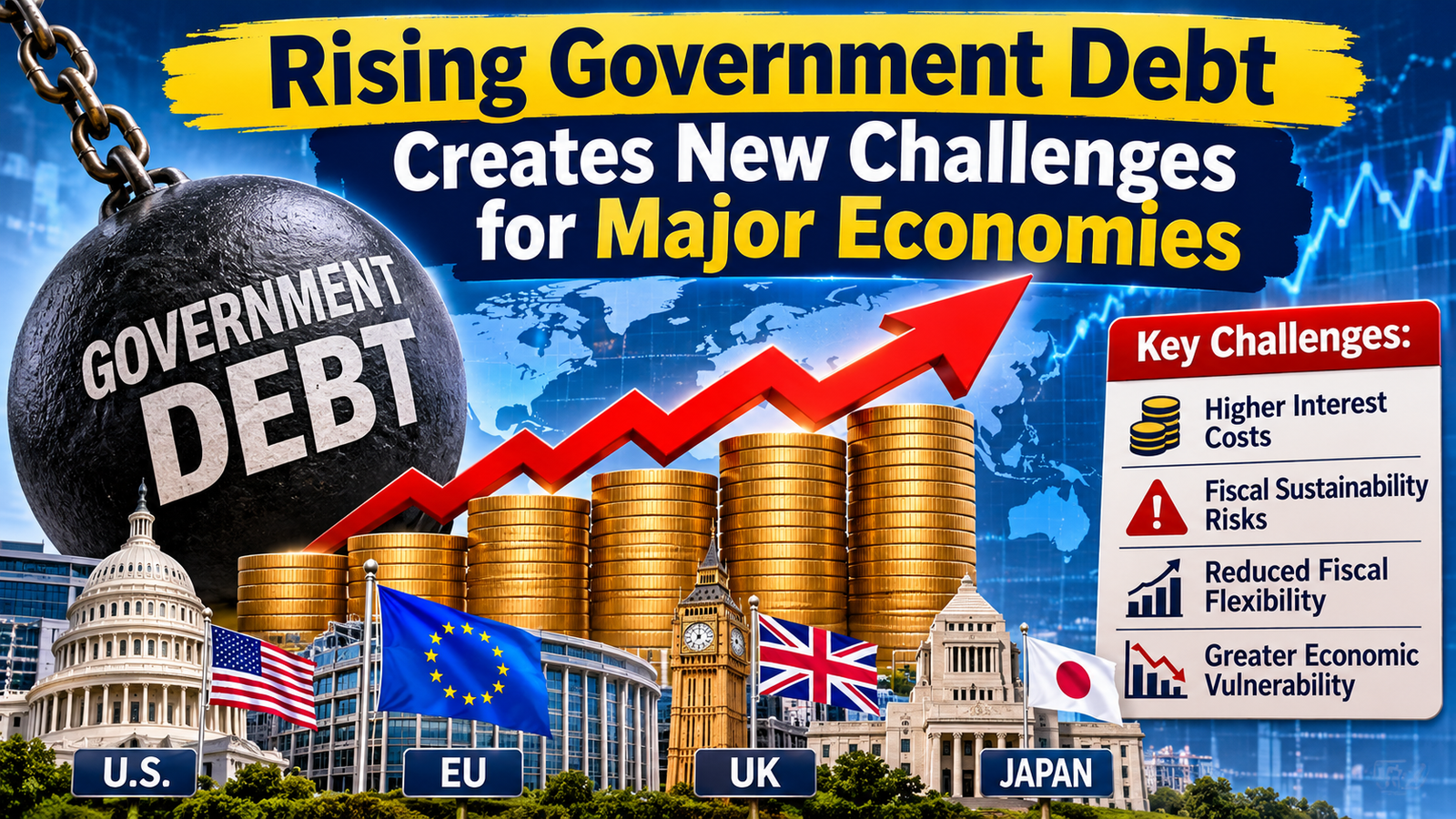
The growing burden of government debt has become a major concern for policymakers, financial markets and international institutions. Governments across advanced and emerging economies are facing increasing demands for public investment, defence, healthcare, infrastructure and social protection. At the same time, higher borrowing costs are making it more expensive to finance existing debt and meet future spending commitments.
According to the International Monetary Fund (IMF), global public debt reached approximately 93.9% of global GDP in 2025 and could rise to 100% by 2029 under current projections. This trend highlights the importance of sustainable fiscal policies at a time when economic uncertainty and geopolitical pressures remain elevated.
Government Borrowing Reaches Record Levels
Government borrowing has increased significantly as countries respond to economic challenges and expanding public expenditure requirements. The Organisation for Economic Co-operation and Development (OECD) reported that gross borrowing by OECD governments reached a record $17 trillion in 2025 and is projected to increase to approximately $18 trillion in 2026.
Outstanding sovereign bond debt across OECD countries also reached a record $61 trillion in 2025. The organisation expects this figure to rise further, with government borrowing requirements remaining elevated because of refinancing needs and continuing budget deficits.
A significant share of new borrowing is being used to repay existing debt rather than finance entirely new expenditure. As governments refinance maturing bonds at higher interest rates, the cost of servicing public debt gradually increases. This creates additional pressure on national budgets and limits the resources available for development programmes.
Higher Interest Rates Increase Financial Pressure
One of the biggest challenges associated with rising government debt is the increasing cost of interest payments. When central banks maintain higher interest rates to control inflation, governments often have to offer higher returns to attract investors purchasing their bonds.
The IMF has highlighted how rising sovereign bond yields are increasing fiscal pressure in major economies. Its October 2026 analysis noted that average 10-year government bond yields across the G7 increased by more than one percentage point between February and September, reaching their highest level in nearly two decades.
Higher borrowing costs create a difficult situation for governments. A larger portion of public revenue must be allocated to interest payments, leaving less money for infrastructure, education, healthcare and other essential services.
The OECD estimates that interest expenditure across its member economies stood at approximately 3.3% of GDP, close to the highest level recorded over the previous decade. These developments demonstrate how debt servicing is becoming an increasingly important fiscal challenge.
Major Economies Face Different Debt Challenges
The United States, Japan and several European economies are among the world’s largest government borrowers. Their fiscal decisions have international consequences because their bond markets influence global interest rates, investment flows and financial conditions.
The United States faces substantial financing requirements due to persistent budget deficits, rising interest expenses and growing expenditure commitments. Since US Treasury securities are widely used as benchmark assets in global financial markets, changes in American borrowing costs can influence financial conditions worldwide.
Japan continues to manage a substantial public debt burden while addressing the financial implications of an ageing population and changing interest-rate conditions. Higher government bond yields have increased attention on the country’s long-term fiscal position.
European governments are also balancing public investment, defence expenditure, energy security and social spending against fiscal constraints. Different countries face different levels of debt and borrowing capacity, making a common approach to fiscal management difficult.
China faces its own fiscal challenges, including pressure from local-government financing obligations, property-sector weakness and measures intended to support domestic economic activity. Its fiscal position is particularly important because of the country’s significant influence on international manufacturing, trade and investment.
Impact on Emerging and Developing Economies
Rising government debt is not limited to advanced economies. Emerging and developing countries often face greater difficulties because they may have smaller domestic financial markets, less stable currencies and limited access to affordable international financing.
When interest rates increase in major economies, international investors may become more selective about emerging-market assets. This can raise borrowing costs, weaken currencies and make it more difficult for developing countries to refinance existing obligations.
The World Bank’s June 2026 analysis found that increasing government debt is associated with higher sovereign borrowing spreads and domestic bond yields in emerging and developing economies. It also highlighted how rising yields in advanced economies can create additional financing pressure for developing countries.
For lower-income countries, the situation can become particularly difficult when debt repayments compete with spending on healthcare, education, infrastructure and poverty reduction. Governments may have to consider difficult fiscal adjustments to maintain financial stability.
Implications for India
India’s public finances are closely connected to the global debt environment. Changes in international interest rates, crude oil prices and foreign investment flows can influence the country’s borrowing costs and fiscal position.
India requires substantial public investment in infrastructure, transportation, renewable energy, manufacturing and digital development. Government borrowing helps finance these priorities, but maintaining a sustainable debt trajectory remains important.
Higher global interest rates can also influence domestic bond yields and the cost of financing. Currency fluctuations may increase the rupee cost of imported energy and other essential commodities, potentially adding to inflationary pressures and government expenditure.
For India, improving tax collection, increasing the efficiency of public spending, encouraging private investment and maintaining fiscal discipline will be important. A growing economy can support stronger government revenues, helping finance development while managing debt obligations.
The Worldonomics Times View
Rising government debt represents one of the most important long-term challenges facing the global economy. Borrowing can support economic development, protect employment during downturns and finance essential infrastructure. However, persistent deficits and increasing interest payments can gradually reduce governments’ ability to respond to future economic shocks.
The challenge for policymakers is not simply to reduce borrowing but to ensure that public debt supports productive economic activity. Investment in infrastructure, education, technology and healthcare can strengthen long-term growth, while inefficient expenditure and poorly designed subsidies may create additional fiscal pressure.
The Worldonomics Times believes that sustainable public finances require credible medium-term fiscal plans, stronger revenue systems, transparent budgeting and responsible borrowing practices. International cooperation and financial transparency will also be important in managing cross-border debt risks.
As major economies navigate changing economic conditions, the management of government debt will remain central to global financial stability. Countries that balance development priorities with responsible fiscal management will be better positioned to support long-term growth and withstand future economic uncertainty.