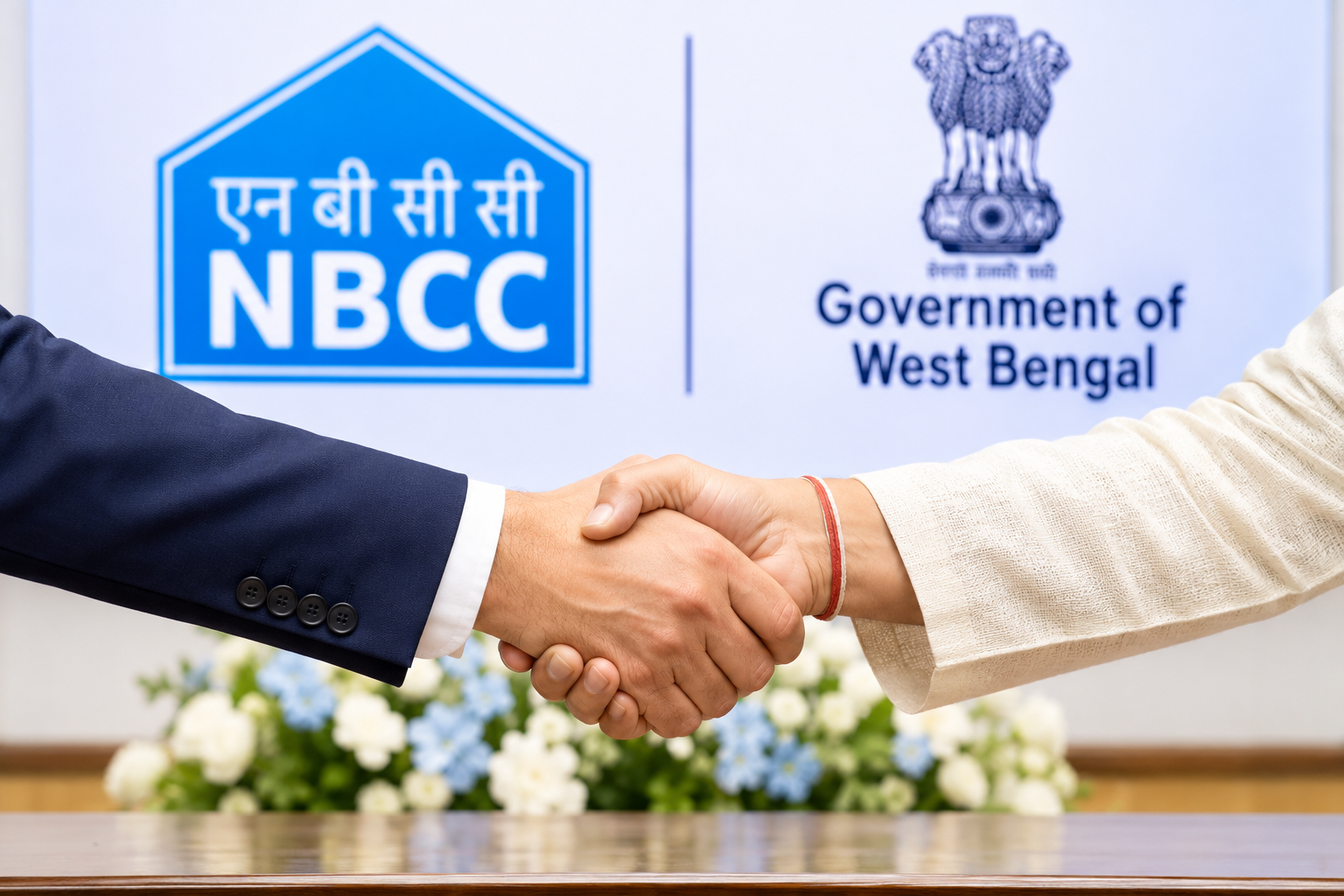
New Delhi, November 13, 2026: In a significant development for India’s public infrastructure and urban development landscape, state-owned NBCC (India) Limited has entered into multiple Memorandums of Understanding (MoUs) with the Department of Urban Development and Municipal Affairs (UD&MA), Government of West Bengal, and various municipal and development authorities to undertake a series of urban redevelopment and infrastructure projects across the state.
The agreements, signed on November 12, 2026, represent an important step towards strengthening urban infrastructure, improving civic amenities and promoting the planned redevelopment of strategically important urban locations. The signing ceremony was attended by Smt. Agnimitra Paul, Hon’ble Minister for Urban Development and Municipal Affairs, Government of West Bengal, and Dr. K. P. Mahadevaswamy, Chairman and Managing Director of NBCC, along with senior officials and other dignitaries.
Six Agreements Cover Diverse Urban Development Initiatives
The MoUs cover six distinct assignments involving different government departments, municipal corporations and development authorities.
One of the key projects involves the redevelopment of the historic College Street area and Chinatown at Tangra, Kolkata, in association with the Kolkata Metropolitan Development Authority (KMDA). Both locations hold considerable cultural, commercial and social significance for the city. Their redevelopment presents an opportunity to improve urban infrastructure while preserving the distinctive character and identity of these established neighbourhoods.
Another important initiative concerns riverfront development at Chandernagore, to be undertaken in association with the Chandernagore Municipal Corporation. Riverfront development can play an important role in improving public spaces, strengthening urban connectivity and enhancing the environmental and recreational value of cities.
The agreements also include the development of river ghats at Howrah and Nabadwip through their respective municipal authorities. These locations have significant civic, cultural and public importance. Planned development of riverfront facilities and ghats can contribute towards better public access, improved amenities and more organised urban spaces.
In the housing sector, NBCC will undertake a feasibility study for the proposed redevelopment of government housing in the Bidhannagar Municipal Corporation (BMC) area for the Department of Urban Development and Municipal Affairs. The study is expected to provide the foundation for assessing the viability and potential scope of housing redevelopment.
Additionally, the State Urban Development Agency has entered into an MoU with NBCC for the development of public toilets across various urban areas, highlighting the importance of sanitation infrastructure as an integral component of inclusive urban development.
Project Execution and Financial Framework
As per the company’s regulatory disclosure, NBCC will execute these projects on a ‘Deposit Work Basis’. Under this arrangement, the company will be paid the actual cost of the projects, along with agency charges at the rate of 5% of the actual project cost, excluding Goods and Services Tax (GST).
The overall financial outlay, individual project costs and implementation timelines have not yet been disclosed. NBCC has indicated that project-specific costs and further details will be provided in due course.
The deposit-work model provides an institutional framework for government authorities to utilise NBCC’s project execution capabilities while retaining the responsibility for project funding. It also provides NBCC with an opportunity to expand its project management and infrastructure development portfolio through government assignments.
NBCC’s Growing Role in India’s Urban Transformation
NBCC (India) Limited is a Navratna Central Public Sector Enterprise (CPSE) under the Ministry of Housing and Urban Affairs, Government of India. The company has established its presence in project management consultancy, engineering and construction, and real estate development.
Over the years, NBCC has undertaken several significant infrastructure and redevelopment assignments, including major government housing redevelopment projects in the national capital. Its experience in managing large-scale construction, institutional buildings and urban redevelopment initiatives places it in an important position within India’s evolving infrastructure ecosystem.
The latest agreements with West Bengal further demonstrate the expanding role of Central Public Sector Enterprises in supporting state governments in the delivery of infrastructure and urban development projects.
A Step Towards Sustainable and Inclusive Urban Development
India’s rapid urbanisation has increased the need for planned redevelopment, modern civic amenities, better housing infrastructure and sustainable public spaces. Urban development is no longer limited to constructing roads and buildings; it increasingly involves creating functional, accessible and environmentally responsible urban environments.
The projects proposed under these MoUs address several interconnected priorities, including heritage-area redevelopment, riverfront infrastructure, public sanitation and government housing.
For West Bengal, these initiatives could provide an opportunity to strengthen urban infrastructure across multiple municipalities while leveraging the technical and project management expertise of a Central PSU.
The success of these initiatives, however, will ultimately depend on detailed project planning, financial viability, timely approvals, coordination between government agencies and effective execution.
With these six MoUs, NBCC and the Government of West Bengal have taken an important step towards collaborative infrastructure development. As New Delhi, November 13, 2026: In a significant development for India’s public infrastructure and urban development landscape, state-owned NBCC (India) Limited has entered into multiple Memorandums of Understanding (MoUs) with the Department of Urban Development and Municipal Affairs (UD&MA), Government of West Bengal, and various municipal and development authorities to undertake a series of urban redevelopment and infrastructure projects across the state.
The agreements, signed on November 12, 2026, represent an important step towards strengthening urban infrastructure, improving civic amenities and promoting the planned redevelopment of strategically important urban locations. The signing ceremony was attended by Smt. Agnimitra Paul, Hon’ble Minister for Urban Development and Municipal Affairs, Government of West Bengal, and Dr. K. P. Mahadevaswamy, Chairman and Managing Director of NBCC, along with senior officials and other dignitaries.
Six Agreements Cover Diverse Urban Development Initiatives
The MoUs cover six distinct assignments involving different government departments, municipal corporations and development authorities.
One of the key projects involves the redevelopment of the historic College Street area and Chinatown at Tangra, Kolkata, in association with the Kolkata Metropolitan Development Authority (KMDA). Both locations hold considerable cultural, commercial and social significance for the city. Their redevelopment presents an opportunity to improve urban infrastructure while preserving the distinctive character and identity of these established neighbourhoods.
Another important initiative concerns riverfront development at Chandernagore, to be undertaken in association with the Chandernagore Municipal Corporation. Riverfront development can play an important role in improving public spaces, strengthening urban connectivity and enhancing the environmental and recreational value of cities.
The agreements also include the development of river ghats at Howrah and Nabadwip through their respective municipal authorities. These locations have significant civic, cultural and public importance. Planned development of riverfront facilities and ghats can contribute towards better public access, improved amenities and more organised urban spaces.
In the housing sector, NBCC will undertake a feasibility study for the proposed redevelopment of government housing in the Bidhannagar Municipal Corporation (BMC) area for the Department of Urban Development and Municipal Affairs. The study is expected to provide the foundation for assessing the viability and potential scope of housing redevelopment.
Additionally, the State Urban Development Agency has entered into an MoU with NBCC for the development of public toilets across various urban areas, highlighting the importance of sanitation infrastructure as an integral component of inclusive urban development.
Project Execution and Financial Framework
As per the company’s regulatory disclosure, NBCC will execute these projects on a ‘Deposit Work Basis’. Under this arrangement, the company will be paid the actual cost of the projects, along with agency charges at the rate of 5% of the actual project cost, excluding Goods and Services Tax (GST).
The overall financial outlay, individual project costs and implementation timelines have not yet been disclosed. NBCC has indicated that project-specific costs and further details will be provided in due course.
The deposit-work model provides an institutional framework for government authorities to utilise NBCC’s project execution capabilities while retaining the responsibility for project funding. It also provides NBCC with an opportunity to expand its project management and infrastructure development portfolio through government assignments.
NBCC’s Growing Role in India’s Urban Transformation
NBCC (India) Limited is a Navratna Central Public Sector Enterprise (CPSE) under the Ministry of Housing and Urban Affairs, Government of India. The company has established its presence in project management consultancy, engineering and construction, and real estate development.
Over the years, NBCC has undertaken several significant infrastructure and redevelopment assignments, including major government housing redevelopment projects in the national capital. Its experience in managing large-scale construction, institutional buildings and urban redevelopment initiatives places it in an important position within India’s evolving infrastructure ecosystem.
The latest agreements with West Bengal further demonstrate the expanding role of Central Public Sector Enterprises in supporting state governments in the delivery of infrastructure and urban development projects.
A Step Towards Sustainable and Inclusive Urban Development
India’s rapid urbanisation has increased the need for planned redevelopment, modern civic amenities, better housing infrastructure and sustainable public spaces. Urban development is no longer limited to constructing roads and buildings; it increasingly involves creating functional, accessible and environmentally responsible urban environments.
The projects proposed under these MoUs address several interconnected priorities, including heritage-area redevelopment, riverfront infrastructure, public sanitation and government housing.
For West Bengal, these initiatives could provide an opportunity to strengthen urban infrastructure across multiple municipalities while leveraging the technical and project management expertise of a Central PSU.
The success of these initiatives, however, will ultimately depend on detailed project planning, financial viability, timely approvals, coordination between government agencies and effective execution.
With these six MoUs, NBCC and the Government of West Bengal have taken an important step towards collaborative infrastructure development. As project details, financial estimates and execution schedules emerge, the initiatives will be worth watching for their potential contribution to the state’s urban transformation agenda and the broader development of India’s public infrastructure sector.New Delhi, November 13, 2026: In a significant development for India’s public infrastructure and urban development landscape, state-owned NBCC (India) Limited has entered into multiple Memorandums of Understanding (MoUs) with the Department of Urban Development and Municipal Affairs (UD&MA), Government of West Bengal, and various municipal and development authorities to undertake a series of urban redevelopment and infrastructure projects across the state.
The agreements, signed on November 12, 2026, represent an important step towards strengthening urban infrastructure, improving civic amenities and promoting the planned redevelopment of strategically important urban locations. The signing ceremony was attended by Smt. Agnimitra Paul, Hon’ble Minister for Urban Development and Municipal Affairs, Government of West Bengal, and Dr. K. P. Mahadevaswamy, Chairman and Managing Director of NBCC, along with senior officials and other dignitaries.
Six Agreements Cover Diverse Urban Development Initiatives
The MoUs cover six distinct assignments involving different government departments, municipal corporations and development authorities.
One of the key projects involves the redevelopment of the historic College Street area and Chinatown at Tangra, Kolkata, in association with the Kolkata Metropolitan Development Authority (KMDA). Both locations hold considerable cultural, commercial and social significance for the city. Their redevelopment presents an opportunity to improve urban infrastructure while preserving the distinctive character and identity of these established neighbourhoods.
Another important initiative concerns riverfront development at Chandernagore, to be undertaken in association with the Chandernagore Municipal Corporation. Riverfront development can play an important role in improving public spaces, strengthening urban connectivity and enhancing the environmental and recreational value of cities.
The agreements also include the development of river ghats at Howrah and Nabadwip through their respective municipal authorities. These locations have significant civic, cultural and public importance. Planned development of riverfront facilities and ghats can contribute towards better public access, improved amenities and more organised urban spaces.
In the housing sector, NBCC will undertake a feasibility study for the proposed redevelopment of government housing in the Bidhannagar Municipal Corporation (BMC) area for the Department of Urban Development and Municipal Affairs. The study is expected to provide the foundation for assessing the viability and potential scope of housing redevelopment.
Additionally, the State Urban Development Agency has entered into an MoU with NBCC for the development of public toilets across various urban areas, highlighting the importance of sanitation infrastructure as an integral component of inclusive urban development.
Project Execution and Financial Framework
As per the company’s regulatory disclosure, NBCC will execute these projects on a ‘Deposit Work Basis’. Under this arrangement, the company will be paid the actual cost of the projects, along with agency charges at the rate of 5% of the actual project cost, excluding Goods and Services Tax (GST).
The overall financial outlay, individual project costs and implementation timelines have not yet been disclosed. NBCC has indicated that project-specific costs and further details will be provided in due course.
The deposit-work model provides an institutional framework for government authorities to utilise NBCC’s project execution capabilities while retaining the responsibility for project funding. It also provides NBCC with an opportunity to expand its project management and infrastructure development portfolio through government assignments.
NBCC’s Growing Role in India’s Urban Transformation
NBCC (India) Limited is a Navratna Central Public Sector Enterprise (CPSE) under the Ministry of Housing and Urban Affairs, Government of India. The company has established its presence in project management consultancy, engineering and construction, and real estate development.
Over the years, NBCC has undertaken several significant infrastructure and redevelopment assignments, including major government housing redevelopment projects in the national capital. Its experience in managing large-scale construction, institutional buildings and urban redevelopment initiatives places it in an important position within India’s evolving infrastructure ecosystem.
The latest agreements with West Bengal further demonstrate the expanding role of Central Public Sector Enterprises in supporting state governments in the delivery of infrastructure and urban development projects.
A Step Towards Sustainable and Inclusive Urban Development
India’s rapid urbanisation has increased the need for planned redevelopment, modern civic amenities, better housing infrastructure and sustainable public spaces. Urban development is no longer limited to constructing roads and buildings; it increasingly involves creating functional, accessible and environmentally responsible urban environments.
The projects proposed under these MoUs address several interconnected priorities, including heritage-area redevelopment, riverfront infrastructure, public sanitation and government housing.
For West Bengal, these initiatives could provide an opportunity to strengthen urban infrastructure across multiple municipalities while leveraging the technical and project management expertise of a Central PSU.
The success of these initiatives, however, will ultimately depend on detailed project planning, financial viability, timely approvals, coordination between government agencies and effective execution.
With these six MoUs, NBCC and the Government of West Bengal have taken an important step towards collaborative infrastructure development. As project details, financial estimates and execution schedules emerge, the initiatives will be worth watching for their potential contribution to the state’s urban transformation agenda and the broader development of India’s public infrastructure sector.project details, financial estimates and execution schedules emerge, the initiatives will be worth watching for their potential contribution to the state’s urban transformation agenda and the broader development of India’s public infrastructure sector.