By: The Worldonomics Times
Introduction
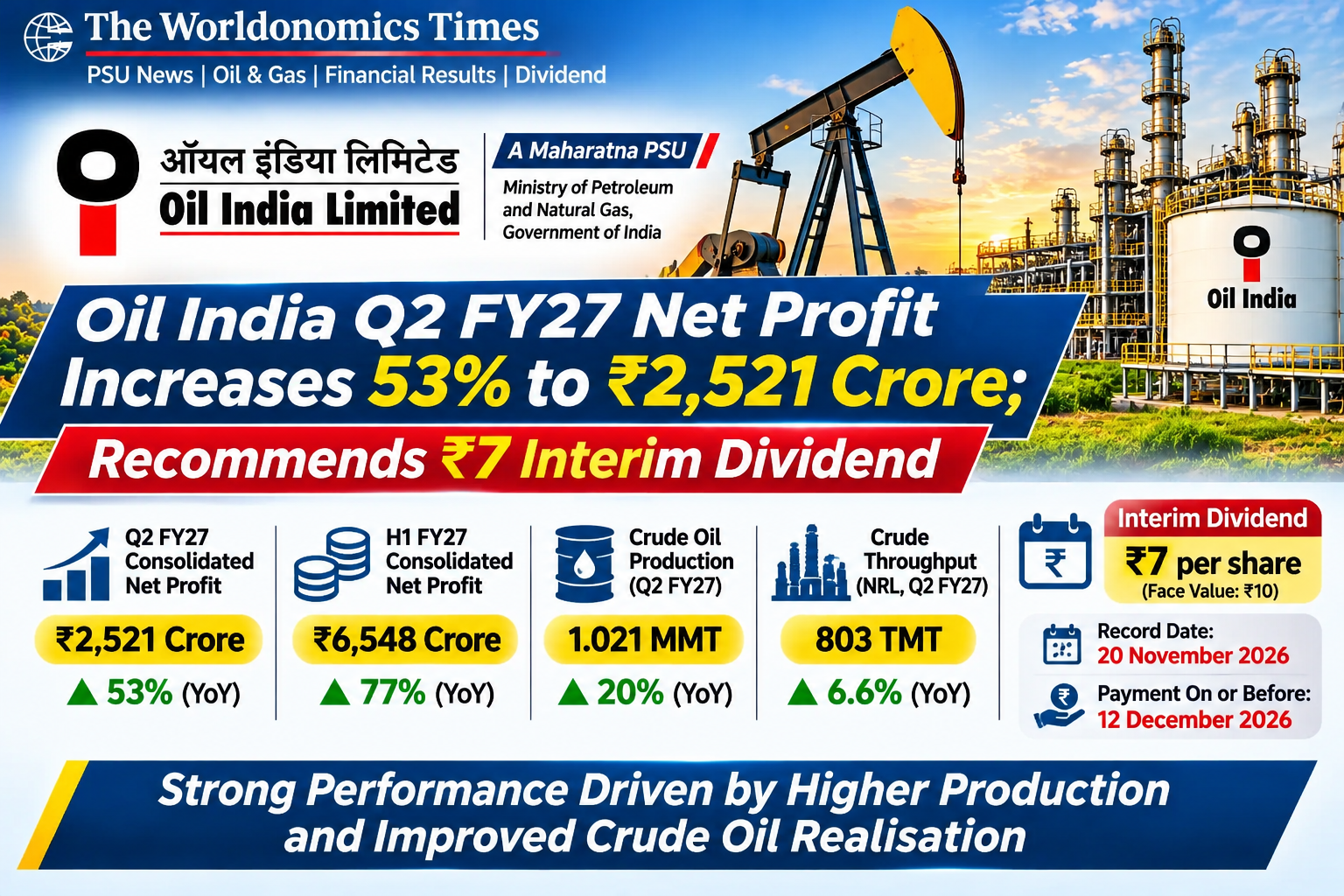
Oil India Limited (OIL), a Maharatna Central Public Sector Enterprise (CPSE) under the Ministry of Petroleum and Natural Gas, has reported a strong financial performance for the second quarter of FY2026-27, with consolidated profit after tax (PAT) increasing 53% year-on-year to ₹2,521 crore.
The company reported consolidated PAT of ₹1,644 crore in the corresponding quarter of the previous financial year. The improvement was supported by higher crude oil production, improved international crude oil price realisation and sustained operational performance.
The company’s Board of Directors, at its 586th meeting held in New Delhi on November 12, 2026, approved the financial results for the quarter and half year ended September 30, 2026, and recommended an interim dividend of ₹7 per fully paid-up equity share having a face value of ₹10 each.
The latest results underline Oil India’s important role in strengthening India’s domestic hydrocarbon production and supporting the country’s energy security requirements.
Q2 FY27 Financial Performance: Consolidated Profit Grows 53%
Oil India recorded significant growth in consolidated profitability during Q2 FY27.
The key financial highlights include:
- Consolidated profit after tax: ₹2,521 crore, up 53%.
- Previous-year Q2 consolidated PAT: ₹1,644 crore.
- Total income: ₹12,303 crore, compared with ₹9,692 crore.
- Year-on-year growth in total income: approximately 26%.
The growth in profitability reflects the combined impact of higher crude oil production and improved realisation from crude oil sales.
As an upstream oil and gas company, Oil India’s financial performance is influenced by production volumes, international crude oil prices, domestic pricing arrangements, operating costs and exploration activities.
The improvement in crude oil realisation during the quarter provided an important contribution to the company’s earnings growth.
Standalone Performance: Profit Rises 116%
Apart from its consolidated results, Oil India reported a substantial improvement in its standalone financial performance.
Standalone profit after tax increased to ₹2,259 crore in Q2 FY27 from ₹1,044 crore in Q2 FY26, registering growth of approximately 116%.
The improvement was primarily supported by two important operational factors:
1. Higher Crude Oil Production: Crude oil production increased approximately 20% year-on-year.
2. Better Crude Oil Price Realisation: Average crude oil realisation increased 35% to US$92.24 per barrel in Q2 FY27, compared with US$68.19 per barrel in the corresponding quarter last year.
The combination of higher production and improved price realisation strengthened the company’s standalone earnings during the reporting period.
H1 FY27: Consolidated Profit Increases 77%
Oil India also reported encouraging financial results for the first half of FY2026-27.
Consolidated profit after tax for the six months ended September 30, 2026, increased to ₹6,548 crore from ₹3,690 crore in H1 FY26, representing growth of approximately 77%.
The company also achieved its highest-ever standalone half-yearly PAT of ₹5,130 crore during H1 FY27, compared with ₹1,857 crore in the corresponding period of the previous financial year.
This represents an increase of approximately 176%.
The half-yearly performance demonstrates the company’s improved earnings capacity and operational contribution during the first six months of the financial year.
Board Recommends ₹7 Interim Dividend
In another important announcement, Oil India’s Board of Directors recommended an interim dividend of ₹7 per fully paid-up equity share of ₹10 each for FY2026-27.
The dividend represents 70% of the face value of each equity share.
Important dividend details are as follows:
| Particulars | Details |
|---|---|
| Interim dividend | ₹7 per share |
| Face value | ₹10 per share |
| Dividend percentage | 70% |
| Record date | 20 November 2026 |
| Payment deadline | On or before 12 December 2026 |
The record date has been fixed as November 20, 2026, for determining the eligibility of shareholders to receive the interim dividend.
The recommendation reflects the company’s financial performance and its approach towards distributing returns to shareholders.
Crude Oil Production Reaches 1.021 Million Tonnes
Oil India’s operational performance was another major highlight of Q2 FY27.
The company produced 1.021 million metric tonnes (MMT) of crude oil during the quarter from its mature and ageing oilfields, compared with 0.848 MMT in Q2 FY26.
This represents an increase of approximately 20%.
The company also achieved its highest daily crude oil production in the last decade on September 29, 2026, when production reached 11,300 tonnes, equivalent to approximately 87,051 barrels.
This operational achievement is significant because sustaining and increasing output from mature oilfields requires continuous investment in technology, well management, reservoir monitoring and production optimisation.
Oil India’s efforts to improve production from existing assets are important for maintaining domestic crude oil supplies and supporting India’s energy security.
Numaligarh Refinery Records Higher Throughput
Oil India’s subsidiary, Numaligarh Refinery Limited (NRL), also contributed to the group’s operational performance.
The refinery recorded crude throughput of 803 thousand metric tonnes (TMT) during Q2 FY27, compared with 753 TMT in the corresponding quarter of the previous financial year.
During H1 FY27, refinery capacity utilisation stood at 106.26%, compared with 103.48% in H1 FY26.
The performance reflects the importance of refining operations within Oil India’s integrated business portfolio.
Higher refinery throughput supports the utilisation of processing infrastructure and contributes to the company’s broader petroleum value chain.
Strengthening India’s Energy Security
Oil India plays an important role in India’s upstream oil and gas sector through exploration, development and production activities.
The company operates primarily in Assam and other hydrocarbon-producing regions and has expanded its presence through domestic and international exploration and production initiatives.
Increasing domestic crude oil and natural gas production is an important national priority because India remains dependent on imports to meet a substantial portion of its energy requirements.
Oil India’s investments in exploration, field development, enhanced recovery techniques and production infrastructure are therefore strategically significant.
Its efforts to increase production from mature fields, discover new hydrocarbon resources and strengthen operational efficiency support the country’s broader objective of improving energy security.
Outlook for FY2026-27
Oil India’s strong first-half performance provides a positive foundation for the remaining quarters of FY27.
The company’s ability to sustain crude oil production growth, improve recovery from existing fields and maintain favourable price realisations will remain important factors influencing its future financial performance.
Key areas to watch include:
- Sustaining crude oil production growth.
- Expanding exploration and development activities.
- Improving recovery from mature oilfields.
- Strengthening natural gas production.
- Expanding refining and downstream capabilities through NRL.
- Maintaining operational efficiency amid fluctuations in global crude oil prices.
The company’s future performance will also depend on international energy market conditions, domestic pricing policies and the successful execution of its exploration and production projects.
Conclusion
Oil India Limited’s Q2 and H1 FY2026-27 results reflect strong financial and operational growth.
With consolidated Q2 profit increasing 53% to ₹2,521 crore, H1 consolidated profit rising 77% to ₹6,548 crore and crude oil production growing 20% during the quarter, the company has demonstrated continued business momentum.
The recommendation of a ₹7 interim dividend further highlights the company’s shareholder distribution policy.
As India continues to focus on strengthening domestic energy production and reducing dependence on imported hydrocarbons, Oil India is expected to remain an important contributor to the country’s energy security and petroleum industry.
The Worldonomics Times will continue to track Oil India’s financial results, dividend announcements, exploration projects, production milestones and other important developments across India’s public-sector enterprises.