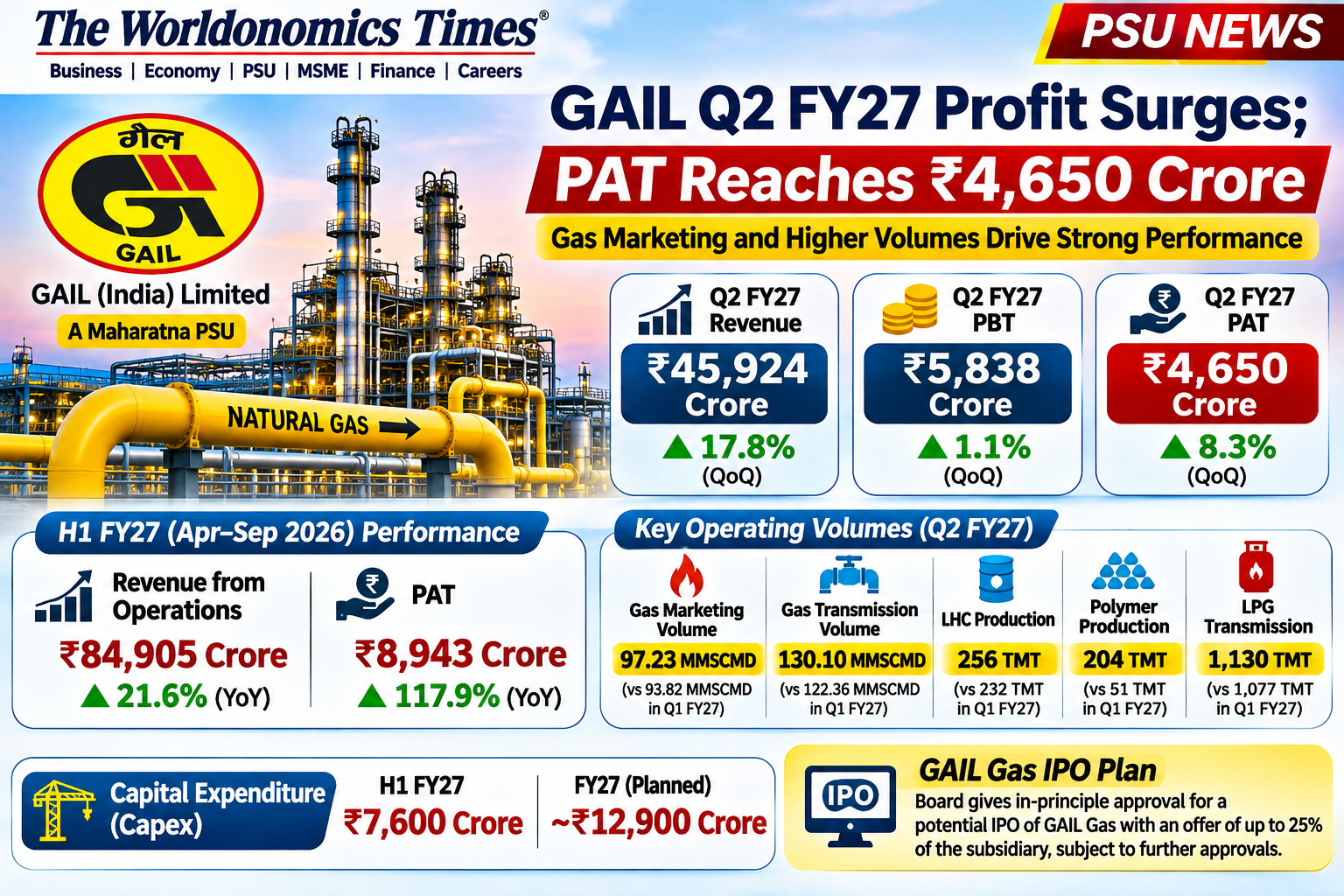
New Delhi, November 2, 2026: State-owned energy major GAIL (India) Limited has reported a strong financial performance for the second quarter of FY2026-27, with standalone Profit After Tax (PAT) rising to ₹4,650 crore. The company’s performance was supported by robust natural gas transmission and marketing volumes, along with growth across several key business segments.
According to GAIL’s official financial results, revenue from operations stood at ₹45,924 crore in Q2 FY27, compared with ₹38,981 crore in Q1 FY27. Profit Before Tax (PBT) increased to ₹5,838 crore from ₹5,773 crore in the previous quarter, while PAT rose from ₹4,292 crore to ₹4,650 crore.
The quarterly performance also represents a significant improvement compared with the year-ago period, with external reporting noting that GAIL’s quarterly PAT more than doubled from ₹2,217 crore in Q2 FY26.
Natural Gas Marketing Emerges as Key Growth Driver
GAIL’s natural gas marketing business played an important role in the strong quarterly performance.
The company’s gas marketing volume increased to 97.23 MMSCMD in Q2 FY27 from 93.82 MMSCMD in Q1 FY27. Natural gas transmission volume also increased to 130.10 MMSCMD, compared with 122.36 MMSCMD in the previous quarter.
The improvement in volumes reflects continued demand for natural gas across industrial, power, fertiliser, city gas distribution and other segments.
External reporting indicated that gas marketing revenue increased by more than 31% during the quarter, making it a major contributor to GAIL’s earnings growth.
Strong Performance Across Multiple Segments
GAIL’s Q2 performance was not limited to its core gas transmission business. Several operating segments recorded higher volumes during the quarter.
Liquefied Hydrocarbon (LHC) production increased to 256 thousand tonnes (TMT) from 232 TMT in Q1 FY27.
Polymer production recorded a particularly sharp increase, reaching 204 TMT, compared with 51 TMT in the previous quarter.
LPG transmission also increased to 1,130 TMT, compared with 1,077 TMT in Q1 FY27.
The performance demonstrates the breadth of GAIL’s integrated energy portfolio, which extends beyond pipeline transmission into gas marketing, petrochemicals, LPG and liquid hydrocarbons.
H1 FY27 Performance Shows Strong Momentum
GAIL’s performance for the first half of FY2026-27 was even more significant.
Revenue from operations during April-September 2026 reached ₹84,905 crore, compared with ₹69,824 crore during the corresponding period of FY2025-26.
PBT increased substantially to ₹11,611 crore, compared with ₹5,357 crore in the first half of the previous financial year.
H1 FY27 PAT stood at ₹8,943 crore, more than double the ₹4,104 crore reported during the corresponding period of FY26.
On a consolidated basis, H1 FY27 revenue from operations stood at ₹88,651 crore, while PAT excluding minority interest reached ₹9,385 crore, compared with ₹4,342 crore in H1 FY26.
₹7,600 Crore Capex in First Half
GAIL is also continuing to invest heavily in expanding its infrastructure and strengthening its long-term growth platform.
The company incurred cumulative capital expenditure of ₹7,600 crore during H1 FY27, including ₹1,425 crore during Q2 alone.
GAIL’s annual planned capital expenditure for FY27 is approximately ₹12,900 crore, reflecting the company’s continued investment in gas infrastructure and related businesses.
Such investments are important as India seeks to increase the role of natural gas in its energy mix and expand the country’s gas transmission infrastructure.
GAIL Gas IPO Plan Adds Strategic Significance
Another major development around the Q2 results is GAIL’s plan concerning its subsidiary GAIL Gas.
The company has granted in-principle approval for a potential IPO of GAIL Gas, with a proposal that could involve an offer of up to 25% of the subsidiary, subject to further approvals.
GAIL Gas operates in the city gas distribution segment, making the proposed listing potentially significant for India’s expanding natural gas ecosystem.
The development could also provide greater visibility to the value of GAIL’s subsidiary businesses while supporting future capital-raising opportunities.
Strengthening India’s Gas Economy
GAIL’s latest results come at a time when India is working to expand natural gas consumption and strengthen its gas-based infrastructure.
The company’s integrated presence across gas transmission, marketing, processing, petrochemicals and LPG gives it a strategic role in India’s energy economy.
The strong Q2 performance suggests that demand recovery and higher volumes across key businesses are supporting GAIL’s financial performance despite geopolitical uncertainties affecting global energy markets.
What GAIL’s Results Mean for Businesses and Investors
For businesses, particularly industries dependent on natural gas, GAIL’s volume growth indicates continuing expansion of India’s gas infrastructure and supply ecosystem.
For investors, the sharp improvement in PAT, higher gas marketing volumes, strong H1 performance and continued capital expenditure provide important indicators of the company’s operating momentum.
For finance professionals, GAIL’s results also offer an interesting case study of how an integrated energy PSU can manage multiple business segments while investing aggressively in infrastructure.
Outlook
GAIL enters the second half of FY27 with strong financial momentum, higher gas transmission and marketing volumes and a substantial investment programme.
With India’s energy demand continuing to expand, the company’s gas infrastructure, marketing network and diversification into petrochemicals and other businesses are expected to remain important growth drivers.
The proposed GAIL Gas IPO could add another strategic dimension to the company’s portfolio.
For The Worldonomics Times, GAIL’s Q2 FY27 results stand out as one of the important PSU developments of the quarter—highlighting the growing role of natural gas, infrastructure investment and public-sector enterprises in India’s evolving energy economy.