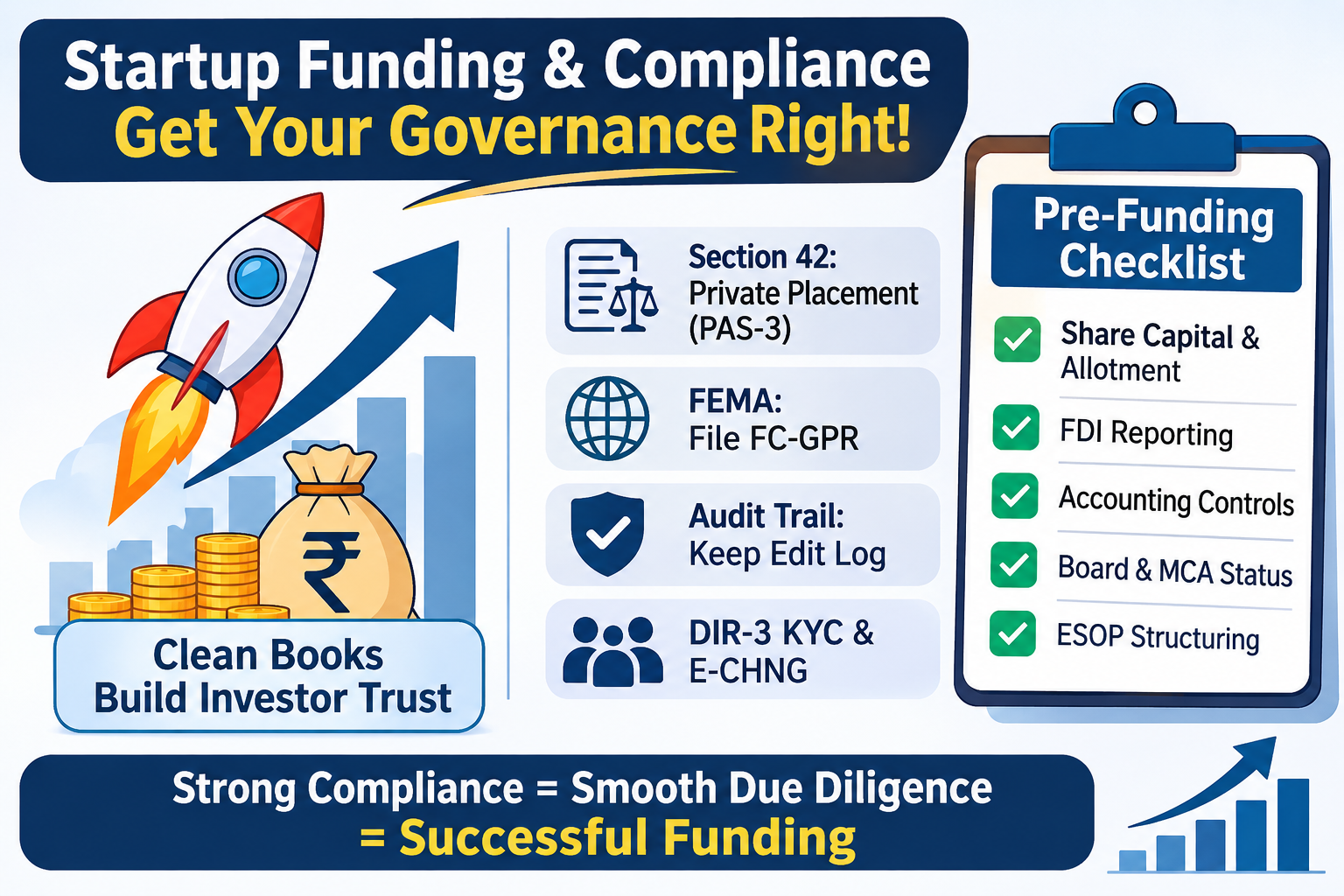
In the startup ecosystem, founders obsess over Customer Acquisition Cost (CAC), Annual Recurring Revenue (ARR), and product-market fit. Corporate governance is often relegated to an outsourced afterthought, viewed merely as an annual administrative hurdle. However, when a startup finally secures a term sheet from a Venture Capital (VC) or Private Equity (PE) firm, the subsequent financial and legal due diligence process abruptly changes the narrative.
Investors do not just buy a compelling pitch; they buy clean equity and manageable risk. A messy cap table, delayed Ministry of Corporate Affairs (MCA) filings, or unrecognized tax liabilities can instantly delay a funding round, significantly reduce the valuation, or cause the investor to walk away entirely.
To survive institutional due diligence in late 2026, founders must transition from reactive filings to proactive governance. Here are the most critical statutory and tax compliance traps startups face before raising funds, and how to fix them.
1. The Private Placement Minefield: Section 42 and Form PAS-3
When a startup raises priced equity rounds (Seed, Series A) from a select group of investors, it must strictly adhere to the private placement rules under Section 42 of the Companies Act, 2013. This is the most heavily scrutinized area during legal due diligence, as procedural lapses can render the entire equity allotment void.
The Common Trap: Founders frequently accept investment funds directly into the company’s primary operating bank account before passing the necessary board and shareholder resolutions. Alternatively, they delay filing the return of allotment (Form PAS-3) with the Registrar of Companies (ROC).
The Statutory Reality: Under Section 42, a startup must open a separate escrow/bank account specifically to receive subscription money. Once the money is credited, the company has exactly 60 days to allot the shares. Following the allotment, Form PAS-3 must be filed on the MCA V3 portal within 15 days. If the shares are not allotted within 60 days, the startup must refund the money within the next 15 days, failing which it accrues a punitive interest rate of 12% per annum. Furthermore, utilizing the investment funds for business operations before filing PAS-3 is a direct statutory violation, often resulting in heavy compounding penalties during funding rounds.
2. Cross-Border Capital: FEMA and the Form FC-GPR Bottleneck
If your startup is raising capital from foreign institutional investors, foreign VCs, or non-resident angels, the transaction falls under the strict purview of the Foreign Exchange Management Act (FEMA) governed by the Reserve Bank of India (RBI).
The Common Trap: Startups often treat foreign inward remittances identically to domestic funds, issuing shares and moving on without completing the required RBI reporting on the FIRMS (Foreign Investment Reporting and Management System) portal.
The Statutory Reality: Upon receiving foreign capital, the startup must obtain a Foreign Inward Remittance Certificate (FIRC) and KYC from the authorized dealer (AD) bank. Once the shares are allotted, the company must file Form FC-GPR (Foreign Currency – Gross Provisional Return) within 30 days of the allotment date. Failing to file FC-GPR restricts the startup from making any further outbound remittances and triggers a Late Submission Fee (LSF). In severe cases of delay, the company must apply for FEMA compounding, a lengthy legal process that can freeze subsequent funding rounds for months while the RBI investigates.
3. The Audit Trail Mandate: A New Dealbreaker for VCs
Startups often change accounting software rapidly as they scale, or worse, allow accounts teams to alter backdated invoices to “clean up” the books before an investor review.
The Common Trap: Founders disable the edit log feature in their ERP or accounting software (like Tally Prime, Zoho Books, or QuickBooks) to allow unrestricted modifications to historical entries.
The Statutory Reality: Under MCA Notification No. G.S.R. 206(E), implementing Rule 11(g) of the Companies (Audit and Auditors) Rules, 2014, every company must use accounting software with an active, non-tamperable Audit Trail (Edit Log). Statutory auditors are legally bound to report whether this edit log was functional throughout the year. During financial due diligence, PE firms now explicitly request the Audit Trail report. If your statutory auditor has qualified your audit report due to a disabled edit log, institutional investors view this as a severe internal control failure and a massive red flag regarding the integrity of your revenue numbers.
4. Ignored Director KYCs and the E-CHNG Consolidation
Startups frequently reshuffle their board of directors during early growth phases, bringing on advisors, co-founders, or early angel investors, while forgetting the trailing compliance requirements.
The Common Trap: Failing to perform annual KYC for directors or missing the filing deadlines for structural company changes.
The Statutory Reality: Every individual holding a Director Identification Number (DIN) must file their annual DIR-3 KYC by September 30th. Missing this deadline deactivates the DIN, immediately barring that individual from signing any statutory documents or MCA forms on behalf of the startup. Additionally, with the MCA’s latest November 2026 rollout of consolidated web forms, the new E-CHNG master form handles all board changes and capital alterations. VCs will run a master data check on the MCA portal; if your E-CHNG filings are pending or your directors’ DINs are deactivated, the term sheet execution will be stalled until the portal status reflects “Active and Compliant.”
The Pre-Funding Due Diligence Checklist for Founders
Before opening your data room to a VC, ensure your finance and secretarial teams have audited the following parameters:
| Compliance Area | Statutory Framework | Pre-Funding Verification |
| Share Capital & Allotment | Sec 42 (Companies Act) | Ensure separate bank accounts were used for all past rounds; verify all PAS-3 forms are filed and approved. |
| FDI Reporting | FEMA / RBI Guidelines | Verify all past foreign remittances have corresponding FC-GPR filings and AD bank approvals on the FIRMS portal. |
| Accounting Controls | Rule 11(g) (Audit Rules) | Confirm your ERP’s Audit Trail (Edit Log) has been active 24/7 since April 2023 without manual override. |
| Board & MCA Status | DIR-3 / Form ACTIVE | Check that all current and resigning directors have active DINs and the registered office address is physically verified. |
| ESOP Structuring | Sec 17(2) / Sec 156(2) (IT Act) | Ensure the ESOP scheme is formally approved via board resolution (SH-9) and tax liabilities are mapped for employees. |
A startup’s valuation is driven by its product and market potential, but its actual fundability is heavily dictated by its governance. By treating ROC and Tax compliance as core strategic pillars rather than back-office chores, founders can clear due diligence rapidly, secure their capital, and return their focus to building the business.
Vivek Kumar is a qualified Cost and Management Accountant (ACMA) and B.Com (Accounting Honours) graduate with extensive experience in statutory and tax audits, direct and indirect taxation, and ROC/MCA corporate compliances. Alongside his practice, he mentors CA, CMA, and CS aspirants and designs exam-oriented test series to bridge practical industry expertise with academic preparation.