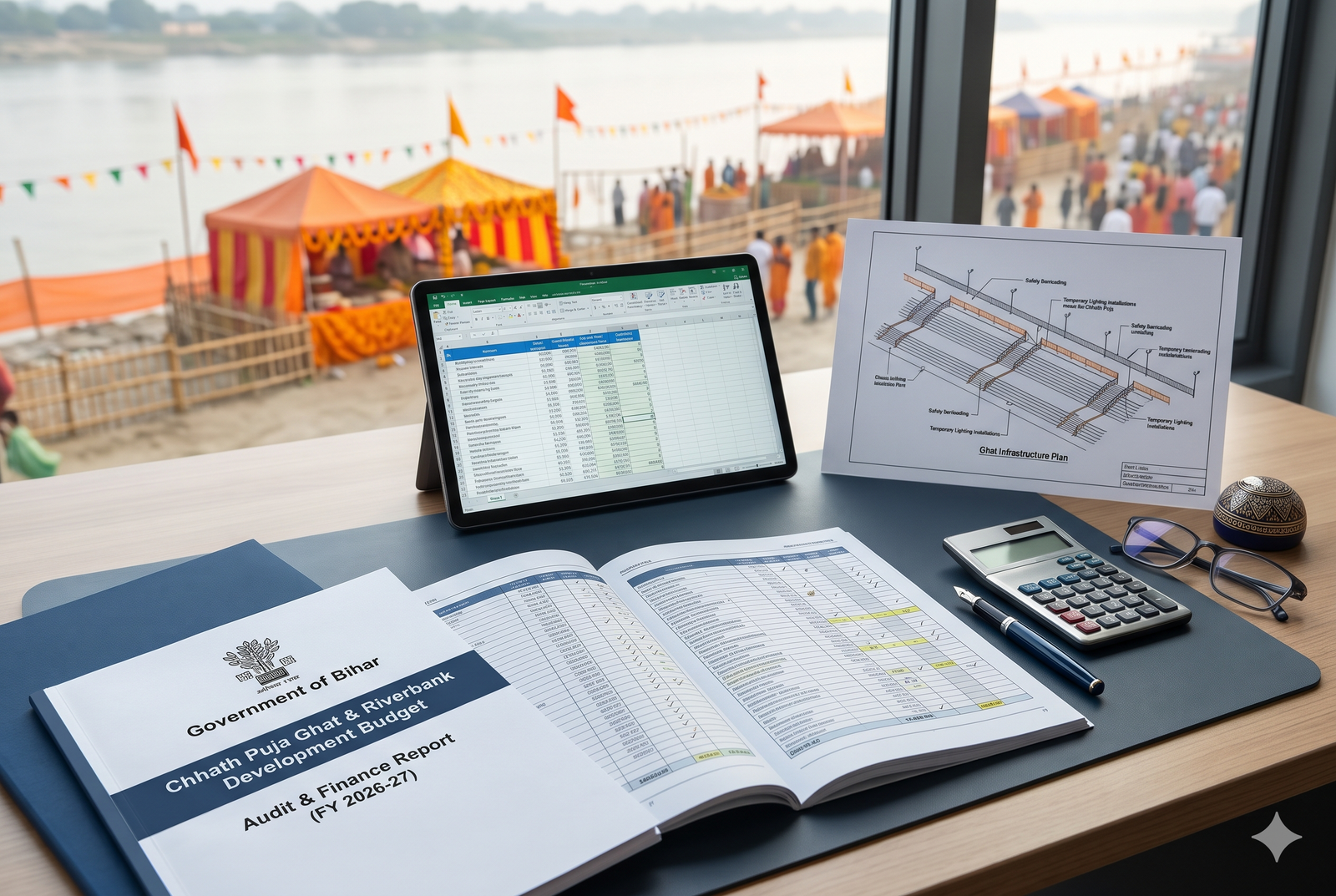
Chhath is a fixed-date public project. The ghats must be ready before the first arghya, and no extension is possible. That makes its public spending a useful test of how Bihar’s civic bodies budget, buy, pay and account.
A note on scope: this article applies an audit lens to publicly reported figures. No Chhath-specific audit report was found in the public domain, so nothing here alleges irregularity. It sets out what is known, what is not, and what an auditor would ask.
The money that is visible
In 2024 the Urban Development and Housing Department announced ₹25 crore for Chhath: ₹12 crore for Patna Municipal Corporation (PMC), ₹1.8 crore shared among 18 other corporations (an average of ₹10 lakh each), ₹4 lakh for each municipal council and ₹3 lakh for each nagar panchayat. In 2025, PMC reported about ₹13.91 crore for 91 Ganga ghats and 62 ponds, an average of roughly ₹9.1 lakh per site. That was about 0.46% of PMC’s ₹3,043.22 crore budget for 2026–27, though the years differ.
This year’s scope is wider: 92 river ghats and 103 ponds in Patna alone, 195 sites against 153, a 27% increase. If the outlay were unchanged, spending per site would fall to about ₹7.1 lakh. That is a hypothetical, as the 2026 outlay was not found, but it shows why the per-site figure matters.
Six audit questions
| Audit area | What is publicly known | What an auditor would test |
|---|---|---|
| Budget vs actual | Allocations are announced before the festival | Sanction, release and expenditure reconciled ghat by ghat; any reappropriation |
| Tendering | Works are time-bound and recur yearly | Single-bid tenders, splitting of works, nomination, rates against the Schedule of Rates |
| Contractor payments | Teams were told to work on a “war footing” | Measurement books, dated challans, geo-tagged photos, statutory deductions |
| Utilisation certificates | Grants flow to dozens of local bodies | Certificate filed within a defined period, with matching expenditure |
| Assets | Permanent and temporary works are mixed | Asset register, handover, post-festival upkeep |
| Value for money | Safety and readiness are the stated goals | Cost per site, incidents, complaints, readiness dates |
Tendering and payments under a deadline
Chhath works are standard: cleaning, lighting, barricades, sandbags, bamboo fencing, toilets and changing rooms. This year Patna’s plan includes 552 temporary toilets, 450 urinals, 400 changing rooms and 13 rest sheds. Fixed dates create pressure to buy fast, which is where audit risk concentrates.
For comparison, a PMC open tender in June 2026 for ₹17.97 lakh carried earnest money of ₹36,300 (about 2%), a ₹5,000 fee and a six-day bidding window. Such e-tender discipline is the benchmark. Auditors would ask whether festival works followed it, how many drew only one bidder, and whether the same vendors win the same items every year.
Payment evidence is the harder problem. Temporary assets vanish by 17 November, so proof of delivery must be created in real time: hire-day counts for toilets, dated photographs, and certified measurements. Auditors would also confirm that income-tax TDS on contractors and GST TDS on contracts above ₹2.5 lakh were deducted and deposited.
Utilisation certificates: the weak link
Utilisation certificates (UCs) tell the grantor that money was spent for its intended purpose. The Comptroller and Auditor General’s State Finances report for 2024–25 found 62,632 UCs worth ₹92,132.75 crore pending as of 31 March 2025, against 49,469 worth ₹70,878 crore a year earlier. That is an increase of about ₹21,255 crore, or 30%.
Chhath grants are a tiny part of this, and the figures are statewide, not Chhath-specific. But small, annual, formulaic grants are exactly where certificates should be quick to file. A rule that every festival grant is certified within three months of the event would be an easy discipline to adopt.
Assets: spend once or spend every year?
Patna’s Bihar Urban Infrastructure Development Corporation (BUIDCO) has built three concrete ghats, Bhadra, Mahavir and Naujar, under the Namami Gange project. Elsewhere, NTPC Kanti has earmarked ₹1 crore of CSR money for seven Chhath ghats in Muzaffarpur, through the state’s Deposit Work Scheme: about ₹14.3 lakh per ghat.
The scopes differ, but the arithmetic is suggestive. PMC’s annual ₹9.1 lakh per site means that repeated temporary spending could match a one-time permanent upgrade in about 1.6 years. For ghats used every year, the audit question becomes whether recurring annual spending would be better replaced by durable capital works with a maintenance plan.
Safety is part of asset quality. Five of Patna’s 103 Ganga ghats have been declared dangerous this year, and in March, Chaiti Chhath reports flagged hazardous stretches at Digha and a long walk to Collectorate Ghat. On 12 November the PMC commissioner was reported to be ordering action on delays, muddy approach roads and inadequate parking, a reminder that last-week readiness is a risk in itself.
Is it value for money?
Auditors judge economy, efficiency and effectiveness. On economy, the numbers look lean: about ₹0.93 of public money for every ₹1,000 of the ₹15,000 crore in estimated Bihar trade. Leanness, however, is not the same as value. Efficiency would be measured as cost per ghat, and effectiveness as outcomes such as zero fatal incidents, complaints closed and sites ready on time. Cost per devotee, the most telling metric, cannot be computed because crowd counts are not published.
CMA Vivek Kumar is a associate Cost and Management Accountant (ACMA) and B.Com (Accounting Honours) graduate specializing in statutory and tax audits, direct and indirect taxation, and ROC/MCA corporate compliances. Alongside his active corporate finance practice, he mentors CA, CMA, and CS aspirants by designing exam-oriented test series that bridge practical industry expertise with academic preparation.