By The Worldonomics Times
China’s economic performance remains a major focus for international investors, policymakers and businesses as the world’s second-largest economy navigates a complex recovery. Strong manufacturing output, expanding exports and growing demand for advanced technology are providing important support. However, weaker domestic consumption, persistent difficulties in the property sector and uncertainty surrounding international trade continue to affect economic confidence.
China plays a central role in global manufacturing, commodity markets and international supply chains. Its economic performance influences demand for energy and raw materials, the outlook for Asian exporters and investment decisions across major financial markets. As a result, investors are closely monitoring whether the country’s recovery can become more balanced and sustainable.
Industrial Production Provides Support
China’s industrial sector remains an important source of economic strength. Manufacturing activity, particularly in high-technology industries, is benefiting from investment in advanced equipment, electric vehicles, batteries and artificial intelligence-related products.
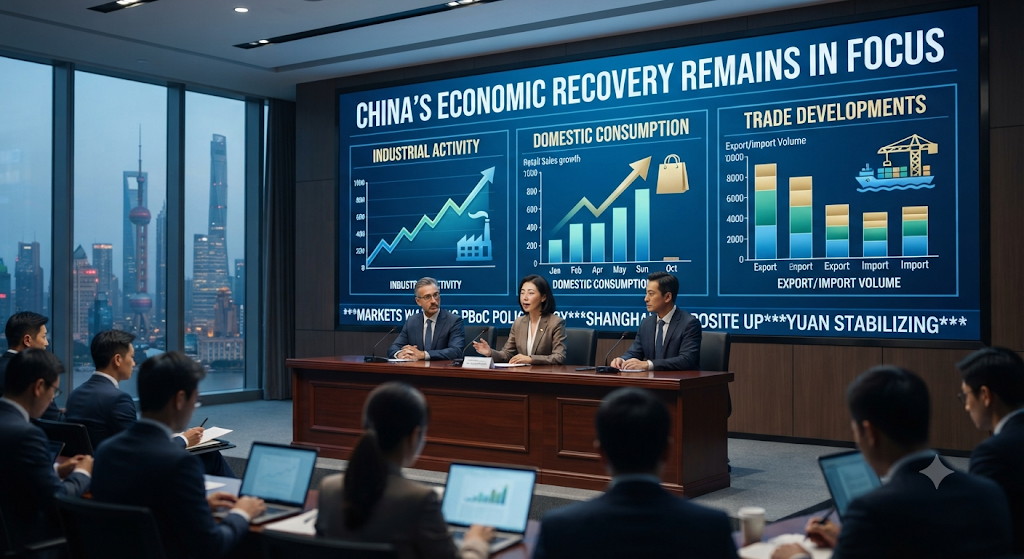
According to China’s National Bureau of Statistics, industrial value added increased by 4.8% year on year in October 2026. High-tech manufacturing grew by 17.6%, while equipment manufacturing expanded by 10.6%. Production of lithium-ion batteries and industrial robots also recorded strong increases.
These figures highlight China’s continued efforts to move towards higher-value manufacturing and technology-driven growth. However, the manufacturing Purchasing Managers’ Index stood at 49.3 in October, indicating that factory activity remained under pressure despite growth in industrial output.
Domestic Consumption Remains a Key Challenge
One of the biggest challenges facing China’s economy is the relatively weak recovery in household consumption.
Retail sales of consumer goods increased by just 0.4% year on year in October, according to official data. For the first ten months of 2026, consumer goods retail sales rose by 1%. These figures suggest that households remain cautious about spending despite government efforts to encourage consumption.
Uncertainty surrounding employment, household income and future economic conditions can encourage consumers to save rather than make major purchases. This creates difficulties for businesses that depend on domestic demand, including retailers, automobile manufacturers and consumer goods companies.
Strengthening household confidence will therefore be essential if China wants to reduce its reliance on exports and investment as the main drivers of economic growth.
Property Sector Continues to Weigh on Recovery
The property market remains another major concern for China’s economic outlook. The prolonged adjustment in real estate has affected construction activity, household wealth, local government finances and investor confidence.
Official data showed that real estate development investment declined by 21.6% year on year during the first ten months of 2026. Sales of newly built commercial properties also remained weak.
The property sector has traditionally played an important role in China’s economic development, supporting industries such as steel, cement, construction materials, furniture and household appliances. Continued weakness can therefore affect a wide range of businesses.
Stabilising the housing market and managing the financial risks associated with property developers will remain important policy priorities. At the same time, improving consumer confidence and creating alternative sources of investment demand will be necessary to support a broader recovery.
Exports and International Trade Provide Momentum
While domestic demand remains subdued, international trade has provided significant support to China’s economy.
According to China’s General Administration of Customs, the country’s total imports and exports increased by 20% year on year during January–October 2026. Exports rose by 17.6%, while imports increased by 23.6%.
Technology-related products have been an important contributor to export performance. Exports of mechanical and electrical products grew by 25.2%, supported by strong demand for integrated circuits, memory components, electric vehicles and other advanced products.
China’s expanding trade relationships with ASEAN economies and other developing markets have also helped diversify its international commercial activity.
Nevertheless, export growth faces risks from changing tariffs, trade restrictions and geopolitical tensions. Any slowdown in global demand could affect Chinese manufacturers and reduce one of the economy’s strongest sources of support.
Global Investors Monitor China’s Economic Direction
China’s economic outlook has important consequences for international financial markets.
Strong industrial activity and technology exports can support investor confidence in Chinese manufacturing and technology companies. However, weak consumer demand, falling property investment and uncertainty about future policy measures can create volatility in equity and bond markets.
China is also a major consumer of commodities such as crude oil, iron ore, copper and natural gas. Changes in its industrial activity and infrastructure investment can influence international commodity prices and the earnings outlook for mining and energy companies.
The World Bank’s October 2026 assessment projected China’s economic growth at 4.5% in 2026 and 4.3% in 2027. It highlighted the need to strengthen domestic demand, improve private-sector confidence and manage risks associated with the property market and local government finances.
Implications for India
China’s economic performance has direct and indirect implications for India. Both countries are important participants in Asian trade, manufacturing and international supply chains.
A stronger Chinese economy can increase regional demand for raw materials and intermediate goods, creating opportunities for exporters. However, China’s large manufacturing capacity also creates competitive pressure for Indian producers in sectors such as electronics, chemicals, engineering goods and consumer products.
For India, changing supply-chain strategies offer an opportunity to attract international investment and strengthen domestic manufacturing. Companies seeking to diversify production locations may consider India alongside other Asian economies.
At the same time, slower Chinese demand can affect commodity markets and countries that export goods to China. Indian policymakers and businesses must therefore monitor developments in Chinese consumption, industrial production, trade and investment.
Strengthening domestic manufacturing, improving infrastructure and expanding export markets can help India benefit from changes in the regional economic landscape.
The Worldonomics Times View
China’s economic recovery remains a crucial factor in the outlook for the global economy. Strong industrial production, technology investment and export performance demonstrate that the country retains significant economic strengths. However, weak household consumption and continued property-sector difficulties indicate that the recovery is not yet evenly balanced.
The challenge for Chinese policymakers is to encourage domestic demand while managing financial risks and maintaining confidence among businesses and investors. Greater support for household consumption, a more stable property market and continued investment in innovation could help establish stronger foundations for long-term growth.
For international investors, China’s economic direction will remain important when assessing global trade, commodity demand and financial market opportunities. For India, the changing economic environment creates both competition and opportunities to strengthen its position in Asian supply chains.
Ultimately, the sustainability of China’s recovery will depend not only on industrial output and exports but also on the strength of domestic consumption, private investment and household confidence.