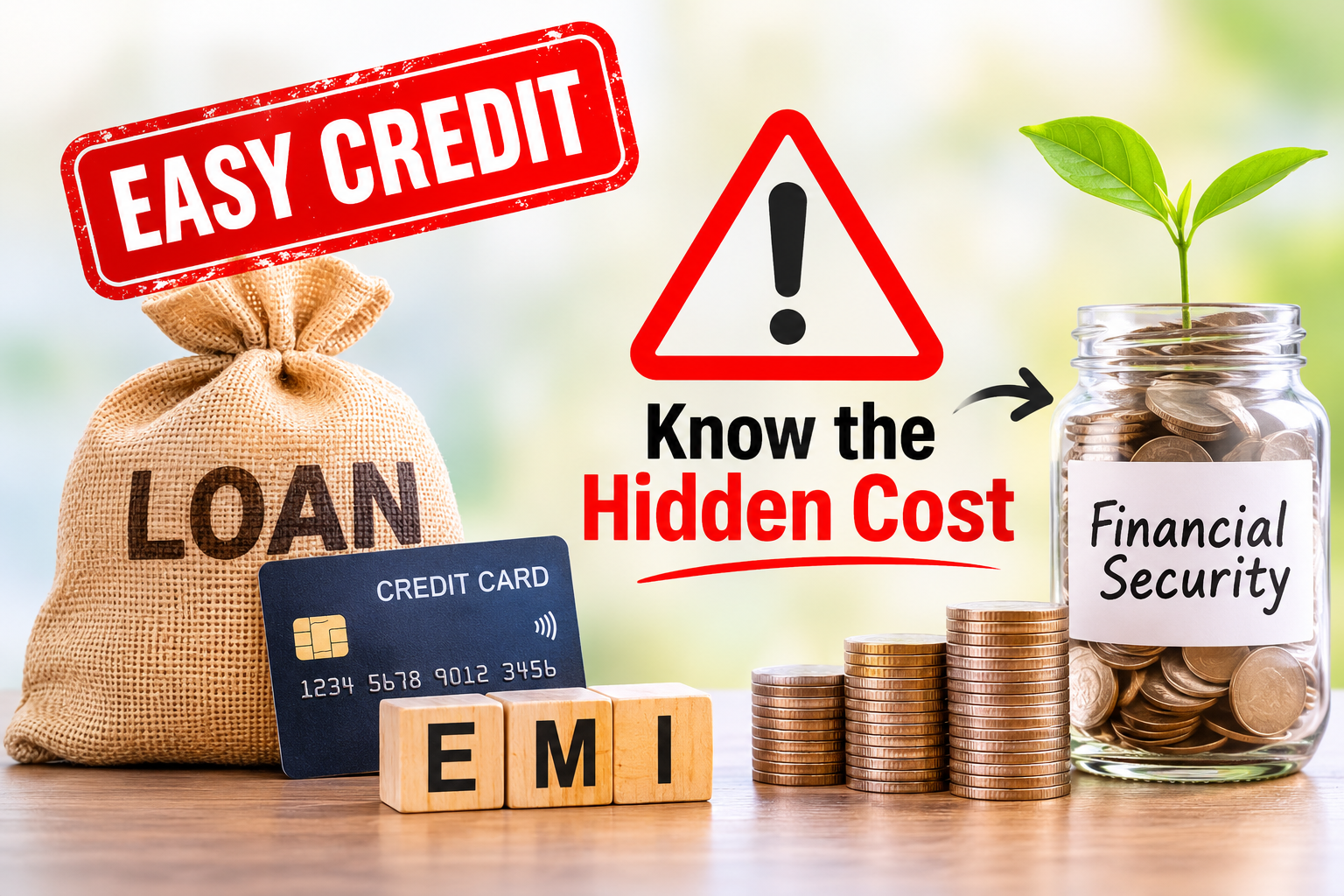
Subtitle: Understanding debt traps, managing monthly repayments, and building a financially secure future.
Introduction
In today’s fast-moving economy, borrowing money has become easier than ever. From instant personal loans and credit card offers to Buy Now, Pay Later (BNPL) services and attractive monthly instalment schemes, financial institutions are encouraging consumers to purchase products and services without making immediate payments.
A smartphone, television, car, holiday or even daily shopping can now be financed through easy credit facilities. While these options provide convenience and immediate purchasing power, they also create a financial challenge that many people fail to recognise: the hidden cost of borrowing.
The real problem is not borrowing money itself; it is borrowing without understanding the long-term financial consequences. An affordable monthly EMI may appear harmless, but multiple loans, interest charges, processing fees and late payment penalties can gradually damage an individual’s financial health.
1. The Growing Culture of Easy Credit
Credit has become an important part of modern consumer finance. Banks, NBFCs and digital lending platforms offer loans with simplified documentation and faster approval processes.
For consumers, this creates an opportunity to meet immediate financial requirements. However, easy access to credit can also encourage unnecessary spending.
Many individuals purchase expensive products because they can afford the monthly instalment, rather than because they can afford the actual product. This creates a situation where future income is already committed before it is earned.
For example, a salaried employee earning ₹50,000 per month may have several financial commitments, including a personal loan EMI, a vehicle loan EMI, credit card payments and consumer durable instalments. Although each individual payment may seem manageable, their combined impact can significantly reduce monthly savings.
2. The EMI Trap: Small Payments, Bigger Financial Burden
One of the biggest misconceptions about borrowing is that a low EMI means a cheap loan.
In reality, the total cost of a loan depends on its principal amount, interest rate, repayment period and additional charges.
Consider an example of a personal loan of ₹5,00,000 at an annual interest rate of 14% for five years.
- Loan amount: ₹5,00,000
- Annual interest rate: 14%
- Loan tenure: 5 years
- Approximate monthly EMI: ₹11,634
- Total repayment: Approximately ₹6,98,000
- Total interest paid: Approximately ₹1,98,000
This means the borrower pays nearly ₹2 lakh in interest in addition to the original loan amount.
A longer repayment period may reduce the monthly EMI, but it generally increases the total interest payable. Therefore, borrowers should always compare the total repayment amount rather than focusing only on the monthly instalment.
3. Credit Cards: Convenience That Can Become Expensive
Credit cards are useful financial tools when managed responsibly. They offer payment flexibility, reward points, purchase protection and short-term interest-free credit when the full outstanding amount is paid within the applicable billing cycle.
However, problems arise when users pay only the minimum amount due.
Paying the minimum due may prevent an immediate payment default, but the remaining outstanding balance continues to attract finance charges. New purchases may also lose the benefit of the interest-free period, subject to the card’s terms and conditions.
For example, an individual with a credit card outstanding balance of ₹50,000 who regularly pays only the minimum amount may find the debt increasing because of accumulated interest and additional spending.
The practical lesson is simple: A credit card should be used as a payment facility, not as an additional source of income.
4. How Excessive Borrowing Affects Financial Health
Excessive borrowing affects more than just a person’s bank balance. It can influence several aspects of financial well-being.
Reduced Savings: A large portion of monthly income goes towards loan repayments, leaving less money for emergency funds, investments and retirement planning.
Increased Financial Stress: Multiple repayment dates and outstanding balances create uncertainty and financial pressure.
Lower Creditworthiness: Missed EMIs, delayed credit card payments and loan defaults can negatively affect an individual’s credit history and credit score.
Limited Financial Flexibility: People with significant debt obligations may struggle to handle unexpected expenses such as medical emergencies, job losses or business losses.
Delayed Financial Goals: Borrowing for unnecessary consumption can delay important goals such as buying a home, funding education or building long-term wealth.
5. Practical Ways to Manage Loans and EMIs
Managing debt requires discipline, financial awareness and proper planning. Individuals can take several practical steps to avoid falling into a debt trap.
1. Calculate Your Debt-to-Income Ratio
Before taking a new loan, calculate how much of your monthly income is already committed to existing EMIs.
For example, if your monthly income is ₹60,000 and your total monthly debt repayments are ₹18,000, your debt-to-income ratio is 30%.
A lower debt burden generally provides greater financial flexibility. However, the appropriate level depends on income stability, household expenses and other financial responsibilities.
2. Prepare a Monthly Budget
Maintain a record of income, essential expenses, savings and loan repayments. A monthly budget helps identify unnecessary expenditure and ensures that repayment obligations are not ignored.
3. Avoid Paying Only the Minimum Credit Card Due
Whenever possible, pay the full credit card outstanding amount by the due date. Avoid withdrawing cash through credit cards unless absolutely necessary, as such transactions may attract immediate charges and interest.
4. Build an Emergency Fund
Maintain an emergency fund covering approximately three to six months of essential living expenses and financial obligations. This can help prevent dependence on expensive short-term loans during unexpected situations.
5. Compare Loan Offers Carefully
Before accepting any loan, compare the annual percentage rate (APR), interest rate, processing fees, prepayment charges, tenure and total repayment amount. Read the loan agreement carefully.
6. Prioritise High-Interest Debt
If you have multiple outstanding loans, consider prioritising repayment of the debt carrying the highest effective interest rate while maintaining minimum required payments on other obligations.
6. Responsible Borrowing: A Key to Financial Stability
Borrowing is not always a bad financial decision. A home loan, education loan or business loan may support long-term financial goals and create economic opportunities.
The difference lies in the purpose of borrowing and the ability to repay.
Before taking any loan, individuals should ask themselves three important questions:
- Is this borrowing necessary, or is it driven by lifestyle pressure?
- Can I comfortably repay the instalments even if my income temporarily decreases?
- Have I calculated the total cost of borrowing, including interest and additional charges?
These questions can help consumers distinguish between productive borrowing and unnecessary financial commitments.
Conclusion: Financial Freedom Begins with Financial Discipline
Easy credit has transformed the way people spend, invest and manage their finances. While loans and credit cards can provide valuable financial support, irresponsible borrowing can create long-term financial difficulties.
Financial security is not measured by the number of products someone purchases, the size of their credit limit or the number of loans they can obtain. It is measured by the ability to manage income, control expenses, repay obligations on time and build savings for the future.
The key to financial independence is not avoiding all forms of debt, but understanding when to borrow, how much to borrow and how to repay it responsibly.
About Author:-
CMA Vivek Kumar (ACMA), an Associate Member of ICMAI and B.Com (Accounting Honours) graduate, is an author, finance professional, and Founder of VK Chartered Academy (www.cacmacstestseries.com). He specializes in statutory and tax audits, taxation, financial reporting, GST advisory, and corporate compliance. He also mentors CA, CMA, and CS aspirants through structured academic guidance and exam-oriented test series, bridging practical industry expertise with professional education. Email: cmavivek2026@gmail.com