By The Worldonomics Times
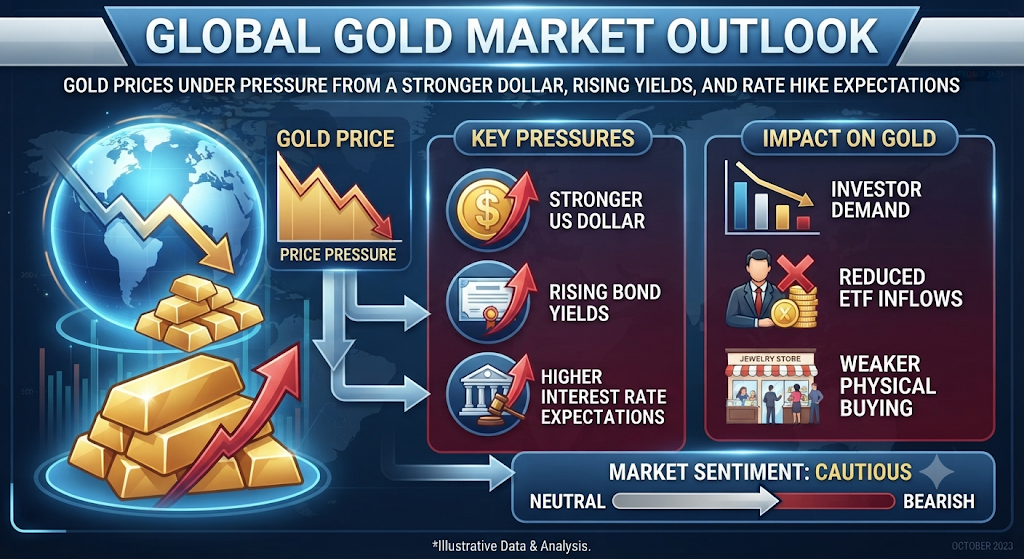
Gold prices are facing renewed pressure as a stronger US dollar, rising government bond yields and expectations of further interest rate increases weigh on investor demand. The precious metal has fallen to its lowest level in more than a year, reflecting changing expectations about US monetary policy and a shift in financial market sentiment.
On November 18, 2026, spot gold declined by more than 1% to approximately $3,796 per ounce, its lowest level since September 2025. The decline followed several sessions of weakness as investors responded to hawkish comments from Federal Reserve officials and expectations that borrowing costs could rise further. According to Reuters, markets were pricing in a high probability of another 25-basis-point Federal Reserve rate increase in December.
The latest movement highlights the sensitivity of gold to changes in global financial conditions. Although the metal is traditionally viewed as a safe-haven asset and a hedge against inflation, its performance is also influenced by currency movements, interest rates and investor liquidity requirements.
Strong US Dollar Makes Gold More Expensive
One of the main factors weighing on gold is the strength of the US dollar. Since international gold prices are generally quoted in dollars, a stronger US currency makes the metal more expensive for buyers using other currencies.
This can reduce international demand, particularly in countries where consumers and investors are already facing higher prices. Currency movements also influence the purchasing decisions of central banks, institutional investors and jewellery buyers.
The dollar has recently traded near a 19-month high, adding pressure to gold prices. Investors have increasingly favoured dollar-denominated assets as expectations of higher US interest rates improve their potential returns.
A sustained rise in the dollar could therefore remain an important obstacle to a recovery in international gold prices.
Rising Bond Yields Reduce Gold’s Appeal
Higher government bond yields are another major challenge for the precious metal.
Gold does not generate interest or regular income. When government bonds and other interest-bearing investments offer higher returns, investors may prefer these assets over holding bullion.
US Treasury yields have increased as financial markets anticipate further monetary tightening. The benchmark 10-year Treasury yield was around 5.14% in the November 17 market session, according to Reuters. This has increased the opportunity cost of holding gold and contributed to weaker investment sentiment.
The relationship between bond yields and gold is particularly important when inflation-adjusted, or real, yields rise. Higher real returns on bonds can make non-yielding assets less attractive, although the relationship is not always consistent because gold also responds to geopolitical uncertainty and financial market risks.
Federal Reserve Rate Expectations Influence Market Sentiment
Expectations of further interest rate increases by the US Federal Reserve have added to the pressure on gold.
Recent comments from several Federal Reserve officials have indicated concern that inflation remains persistent. New York Federal Reserve President John Williams has suggested that another rate increase may be necessary to control price pressures, while other officials have also expressed support for a tighter monetary policy.
According to Reuters, financial markets were assigning approximately a 95.7% probability to a 25-basis-point rate increase at the Federal Reserve’s December meeting on November 18. Investors were also monitoring the minutes of the October policy meeting for further indications of the central bank’s position.
Higher interest rates can support the dollar and bond yields, creating additional pressure on gold. However, the actual direction of prices will depend on incoming inflation, employment and economic growth data, as well as the Federal Reserve’s final policy decisions.
Global Gold Demand Presents a Mixed Picture
Despite the recent decline, the underlying gold market continues to receive support from some important sources of demand.
The World Gold Council’s third-quarter 2026 report showed that global gold demand reached 1,369 tonnes, while central banks and other official institutions added a net 321 tonnes to their reserves. This represented a 42% increase compared with the same quarter of the previous year.
Physically backed gold exchange-traded funds also attracted 211 tonnes of inflows during the quarter, taking global holdings to a record 4,256 tonnes. However, global bar and coin investment declined by 19% year-on-year to 268 tonnes, indicating that individual investors were becoming more cautious.
The World Gold Council expects investment demand and central bank purchases to remain important market drivers. Nevertheless, its outlook identifies higher interest rates, rising bond yields and a stronger dollar as potential obstacles to gold demand in the final quarter of 2026.
This combination of opposing forces suggests that gold prices may remain sensitive to changes in both monetary policy and global risk sentiment.
Geopolitical Uncertainty Could Provide Support
Although current financial conditions are unfavourable for gold, geopolitical risks and concerns about economic stability can help limit further losses.
Investors traditionally turn towards gold during periods of conflict, financial instability and uncertainty about government debt or currency values. Central banks also use gold as part of their reserve diversification strategies.
The World Gold Council’s latest analysis indicates that geopolitical concerns, fiscal risks and financial market stress could continue supporting investment demand even as higher interest rates create headwinds.
Consequently, the gold market is being influenced by two competing forces: tighter monetary conditions are reducing its attractiveness, while uncertainty in the global economy continues to support its role as a store of value.
Implications for India
India is one of the world’s major gold-consuming markets, making international price movements particularly important for domestic consumers, jewellery businesses and investors.
A decline in international gold prices can create opportunities for Indian buyers, especially households planning purchases during the wedding and festival seasons. However, domestic gold prices do not move in direct proportion to international prices.
The rupee-dollar exchange rate, import duties, domestic taxes and local market premiums also influence the final price paid by Indian consumers. A stronger dollar can make imported gold more expensive in rupee terms, potentially offsetting some of the benefit from lower international prices.
The World Gold Council reported that Indian bar and coin demand stood at 55 tonnes in the third quarter of 2026, down 40% year-on-year. It also noted that Indian gold-backed funds attracted investment during the quarter, reflecting continued interest in gold as a financial asset.
For Indian investors, the current environment highlights the importance of considering currency movements and interest rate expectations alongside international gold prices. Consumers and businesses should also recognise that short-term price declines do not necessarily indicate a lasting change in the metal’s longer-term investment appeal.
The Worldonomics Times View
The recent decline in gold prices demonstrates how strongly the precious metal responds to changes in global financial conditions. A stronger US dollar, rising Treasury yields and expectations of further Federal Reserve rate increases have reduced the attractiveness of holding gold in the short term.
However, the broader market outlook is not entirely negative. Central bank purchases, investment through gold-backed funds and continuing geopolitical uncertainty provide important sources of support. The market therefore faces a balance between monetary policy pressures and gold’s traditional role as a safe-haven asset.
Investors should avoid making decisions based solely on short-term price movements. Monitoring inflation trends, Federal Reserve policy, bond yields and currency markets will be essential to understanding the direction of gold prices.
For India, lower international prices may create buying opportunities, but exchange-rate movements and domestic market costs will remain important considerations.
Ultimately, gold’s future performance will depend on whether inflation and financial uncertainty encourage investors to seek protection or whether higher interest rates and stronger dollar returns continue to draw capital towards interest-bearing assets. The coming months will be important in determining which of these forces has the greater influence on the global gold market.