By The Worldonomics Times
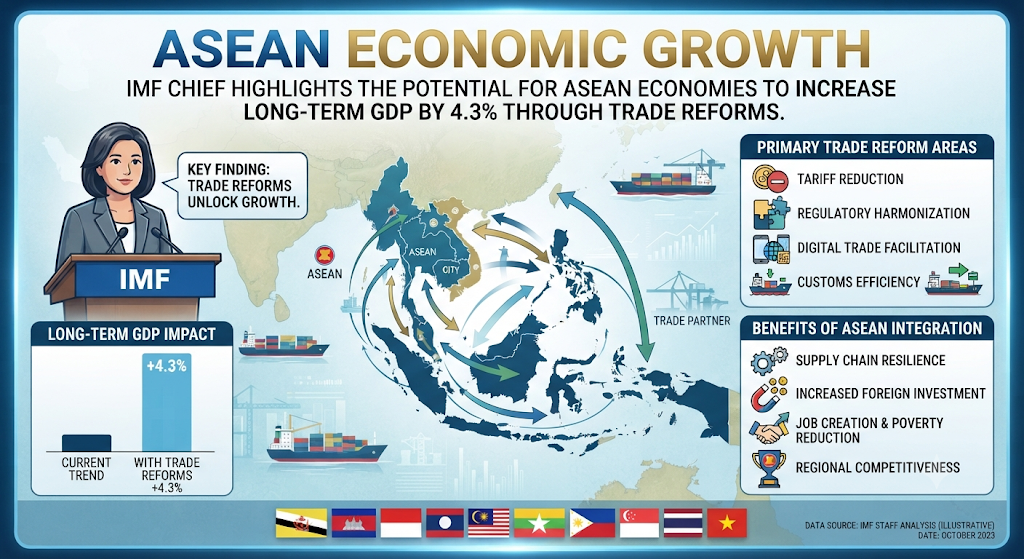
The Association of Southeast Asian Nations (ASEAN) could significantly strengthen its economic position by reducing trade barriers and deepening regional integration. International Monetary Fund (IMF) Managing Director Kristalina Georgieva has highlighted the potential for the region to increase its combined economic output by 4.3% over the long term through reforms that make trade between member countries easier.
Speaking during the 49th ASEAN Summit in Manila, Philippines, in November 2026, Georgieva said that removing non-tariff barriers could unlock substantial economic opportunities. She also indicated that reforms in services trade alone could contribute up to 2.5 percentage points to the potential GDP gain. With appropriate labour market policies, the reforms could create an estimated four million additional jobs across the region.
The assessment highlights the importance of regional cooperation at a time when global trade is facing geopolitical tensions, changing supply chains and economic uncertainty.
Trade Reforms Could Unlock Significant Economic Potential
ASEAN has developed into an important centre for international manufacturing, investment and commerce. Its member economies participate in global supply chains covering electronics, automobiles, textiles, machinery and other industries.
However, despite their strong international trade connections, ASEAN countries continue to trade relatively less with one another than their economic potential would suggest.
An IMF analysis published in September 2026 found that only around 22% of ASEAN’s exports go to other member countries, compared with approximately 61% of exports within the European Union. Much of the trade taking place within ASEAN involves intermediate goods and components used in manufacturing rather than finished products sold to regional consumers.
This difference indicates that ASEAN has developed interconnected production networks but has not yet fully established a unified regional marketplace.
Reducing non-tariff barriers could help address this gap. Such barriers include complicated customs procedures, inconsistent product standards, licensing requirements, administrative delays and restrictions affecting cross-border services.
Removing unnecessary obstacles would make it easier for businesses to sell products, establish operations and provide services across neighbouring markets. It could also reduce costs, improve competition and encourage investment.
Services Trade and Digital Integration Take Centre Stage
Services trade is expected to play a major role in ASEAN’s future economic development. Financial services, telecommunications, information technology, professional services, logistics and digital commerce are increasingly important to modern economies.
According to Georgieva, reforms in services trade could account for up to 2.5 percentage points of the estimated 4.3% long-term GDP gain. This makes the sector a particularly important area for regional policy cooperation.
The ASEAN Digital Economy Framework Agreement (DEFA), signed in Manila on November 14, 2026, is expected to support this objective. The agreement aims to improve digital connectivity and facilitate cross-border economic activities, including digital payments and online business transactions.
Stronger digital integration could help smaller companies reach customers in other ASEAN markets without needing extensive physical infrastructure. It could also support e-commerce, financial technology, digital services and more efficient regional supply chains.
However, successful implementation will require compatible regulations, reliable digital infrastructure, effective cybersecurity measures and appropriate safeguards for consumers and businesses.
ASEAN’s Economic Performance Remains Resilient
Georgieva described ASEAN as a bright spot in the global economy, highlighting regional growth of approximately 4.9%, compared with a global average of 3.1%.
The region has demonstrated resilience despite higher energy costs and international uncertainty. Investment in manufacturing, technology and artificial intelligence has also supported economic activity in several member countries.
An IMF analysis published in September 2026 described ASEAN as an economic bloc worth approximately $4.5 trillion, with a population of around 700 million. It also highlighted the region’s growing importance as international companies diversify manufacturing and sourcing operations.
However, external dependence remains a vulnerability. When demand weakens in major markets such as the United States, China and Europe, ASEAN exporters can experience reduced orders and investment uncertainty.
Developing stronger regional demand could provide an additional source of economic support and make member countries less dependent on developments outside Southeast Asia.
Four Million Potential Jobs Could Strengthen Employment
The estimated creation of four million additional jobs is another important aspect of the IMF’s assessment.
Greater regional trade can encourage companies to expand production, establish new operations and recruit workers across manufacturing and services industries. Improved digital connectivity may also create opportunities in software development, logistics, online commerce and financial services.
However, economic integration alone will not guarantee that these employment opportunities benefit workers equally. Governments will need to invest in education, vocational training and digital skills to prepare their populations for changing labour market requirements.
Policies that support worker mobility, professional qualifications and access to employment opportunities across borders could also help businesses find the skills they need.
The growing adoption of artificial intelligence makes these measures particularly important. While AI investment can improve productivity and create new industries, it may also disrupt existing occupations. Governments must therefore balance technological development with worker protection and reskilling programmes.
Challenges Facing ASEAN Governments
Despite the potential benefits, implementing regional trade reforms will require sustained political commitment and coordination.
ASEAN members have different economic structures, regulatory systems and levels of development. Some countries have advanced financial and digital infrastructure, while others need significant investment in logistics, connectivity and administrative capacity.
Governments must also address differences in product standards, customs procedures, taxation and investment regulations. Without consistent implementation, businesses may continue to face obstacles even when regional agreements are in place.
Georgieva also highlighted the need to strengthen government revenue collection. ASEAN’s tax-to-GDP ratio stands at around 12%, below the approximately 15% average in other parts of Asia. Improving revenue mobilisation could provide governments with greater resources for infrastructure, education and public services.
Deeper financial integration and more developed regional capital markets could further support investment and economic stability.
Implications for India
Although India is not an ASEAN member, stronger economic integration across Southeast Asia could create important opportunities for Indian businesses.
India has established commercial relationships with several ASEAN economies through trade, investment and regional cooperation. Greater regional demand could benefit Indian exporters of pharmaceuticals, engineering products, machinery, chemicals, textiles and information technology services.
Improved digital connectivity and cross-border business regulations could also create opportunities for Indian technology companies and service providers.
India’s Act East Policy and its participation in regional economic initiatives provide a foundation for strengthening these relationships. Better transport connectivity, competitive manufacturing and stronger trade facilitation could help Indian companies become more closely integrated with Southeast Asian supply chains.
At the same time, Indian businesses will need to remain competitive as ASEAN countries improve their investment environments and attract international manufacturers.
The Worldonomics Times View
The IMF’s estimate that ASEAN could increase its long-term GDP by 4.3% through trade reforms highlights the economic value of deeper regional integration. The opportunity is significant, particularly because the region already has strong manufacturing capabilities, expanding digital industries and established international trade connections.
However, the estimated gain should be understood as a potential increase in long-term economic output, not an immediate annual growth forecast. Achieving it will depend on whether governments can translate regional agreements into practical improvements for businesses and consumers.
Reducing non-tariff barriers, expanding services trade, strengthening digital infrastructure and improving customs procedures should remain important priorities. Governments must also ensure that workers have the skills required to benefit from new employment opportunities.
For India, stronger ASEAN integration could create additional opportunities in exports, technology and investment. Greater cooperation between India and Southeast Asian economies would support more diversified regional supply chains.
Ultimately, ASEAN’s ability to turn its economic potential into lasting prosperity will depend on effective implementation, policy coordination and investment in people. A more integrated regional market could strengthen the bloc’s global competitiveness while creating a broader foundation for sustainable economic growth.