By The Worldonomics Times
China’s trade surplus has exceeded $1 trillion for the second consecutive year, highlighting the country’s growing dependence on exports and raising concerns among major international trading partners. Strong overseas demand for Chinese manufactured goods, particularly semiconductors, automobiles and artificial intelligence-related equipment, has helped drive export growth despite continued challenges in the domestic economy.
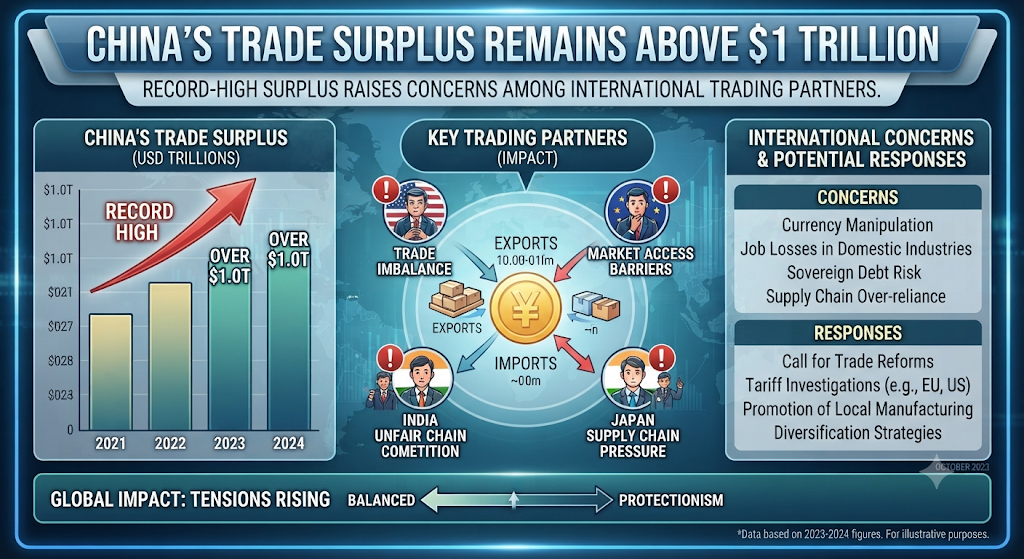
According to China’s customs data released on November 10, 2026, the country’s trade surplus reached approximately $1.04 trillion during the first ten months of the year. The figure puts China on course to exceed its record surplus of approximately $1.2 trillion recorded in 2025. The latest development has intensified concerns in the United States and European Union about trade imbalances, industrial competition and the impact of Chinese exports on domestic manufacturers.
The growing surplus reflects China’s strong manufacturing capabilities, but it also raises questions about the balance between domestic consumption, imports and exports in the world’s second-largest economy.
China’s Exports Continue to Grow Rapidly
China’s export performance has remained strong throughout 2026. In October, exports increased by 35.2% year-on-year in US dollar terms, reaching approximately $412.3 billion. The growth exceeded market expectations and followed a 36.3% increase in September.
High-tech products have played an important role in this expansion. Demand for semiconductors, computer components, data-centre equipment and other technology products has benefited from the global investment boom in artificial intelligence.
Automobiles, electric vehicles, batteries and renewable energy equipment have also strengthened China’s position in international markets. These industries have benefited from large-scale manufacturing capacity, established supply chains and competitive production costs.
The expansion of exports has helped support China’s economic growth at a time when domestic consumption and the property sector continue to face difficulties.
Imports Increase but Trade Imbalance Remains
Although exports have expanded rapidly, imports have also recorded significant growth. China’s imports increased by 41.6% year-on-year in October, reaching approximately $307.1 billion.
The increase reflected stronger purchases of certain energy products, technology inputs and industrial materials. Demand for imported components has also been supported by investment in artificial intelligence infrastructure and advanced manufacturing.
As imports grew faster than exports during October, the monthly trade surplus narrowed to approximately $105.3 billion, compared with $133.5 billion in September.
However, the cumulative surplus for January to October remained above $1 trillion. This indicates that the country’s overall export earnings continue to exceed its import spending by a substantial margin.
A persistent trade surplus is not automatically evidence of unfair trade practices. It can reflect strong industrial competitiveness, international demand and differences between domestic savings and investment. Nevertheless, when the imbalance becomes exceptionally large, it can create economic and political tensions with trading partners.
United States and European Union Raise Concerns
China’s growing trade surplus has become an important issue in its economic relationships with major trading partners.
The United States has long expressed concern about its trade deficit with China, arguing that differences in market access, industrial subsidies and manufacturing policies create an uneven competitive environment. Although recent trade negotiations have helped reduce some immediate tensions, disagreements over tariffs, technology restrictions and market access remain unresolved.
The European Union has also raised concerns about the rapid growth of Chinese exports, particularly in electric vehicles, batteries and other industrial products. European manufacturers face increasing competition from Chinese companies that benefit from large production capacities and competitive pricing.
According to reporting based on customs data, China’s trade surplus with the European Union exceeded $310 billion during the first ten months of 2026. This has increased pressure on European policymakers to examine trade protection measures and seek greater balance in economic relations with Beijing.
The issue is expected to remain important in discussions between Chinese and Western leaders as governments attempt to protect domestic industries while maintaining access to international markets.
Domestic Economic Challenges Encourage Export Dependence
China’s large trade surplus also reflects challenges within its domestic economy.
Household consumption has remained relatively weak, while the property sector continues to experience a prolonged slowdown. These conditions have limited the strength of domestic demand in some industries.
Manufacturers facing intense competition at home have increasingly looked towards overseas markets to maintain production and revenue growth. China’s substantial industrial capacity allows companies to supply international markets across a wide range of products.
However, heavy dependence on exports creates vulnerabilities. If major trading partners introduce additional tariffs or restrictions, Chinese manufacturers could face reduced access to important markets.
There is also a risk that excessive production capacity and price competition could place pressure on business profitability. A slowdown in global demand for artificial intelligence equipment or other major export categories could further affect China’s trade performance.
Strengthening household consumption and expanding domestic demand could therefore help China achieve a more balanced and sustainable economic structure.
Global Supply Chains Face New Pressures
China remains a central part of global manufacturing and supply chains. Its exports include essential components and finished products used by businesses across Asia, Europe, North America and other regions.
A growing trade surplus can increase concerns among trading partners that domestic manufacturers may struggle to compete with imported Chinese goods. Governments could respond through tariffs, anti-dumping investigations, subsidies for local industries or stricter import regulations.
Such measures may lead to higher production costs and greater uncertainty for international businesses.
At the same time, companies are increasingly diversifying their supply chains through strategies such as China Plus One. This involves retaining important operations in China while developing additional manufacturing and sourcing locations in other countries.
Although this process can create opportunities for emerging economies, it may also increase short-term adjustment costs for businesses that depend on established Chinese suppliers.
Implications for India
China’s large trade surplus has important implications for India, which maintains extensive trade relations with the Chinese economy.
Indian manufacturers depend on imports from China for several industrial inputs, including electronics components, machinery, chemicals, solar equipment and pharmaceutical ingredients. Competitive Chinese supplies can help reduce production costs, but excessive dependence on a single source can create vulnerabilities.
At the same time, the changing global trade environment provides India with an opportunity to attract companies seeking to diversify manufacturing and sourcing operations.
Sectors such as electronics, automobiles, engineering goods, pharmaceuticals, textiles and renewable energy could benefit from stronger investment and improved domestic production capabilities.
India will need to strengthen infrastructure, logistics, technology development and manufacturing competitiveness to take advantage of these opportunities. Expanding export markets and developing reliable domestic supply chains will also be important.
However, India must balance the benefits of affordable imports with the need to protect domestic industries from unfair trade practices and excessive external dependence.
The Worldonomics Times View
China’s trade surplus exceeding $1 trillion for a second consecutive year highlights the strength of its manufacturing and export sectors. Demand for advanced technology products, automobiles and industrial equipment has helped the country maintain strong overseas sales despite domestic economic challenges.
However, such a large imbalance also creates pressure on international trade relationships. The United States and European Union are increasingly concerned about competition, market access and the effects of Chinese industrial production on their domestic manufacturers.
China’s long-term economic stability will depend partly on its ability to strengthen domestic consumption and reduce excessive reliance on overseas demand. Greater imports and stronger household spending could contribute to a more balanced relationship with international trading partners.
For the global economy, the challenge will be to manage trade disagreements without creating unnecessary disruption to supply chains and investment. Protectionist measures may offer short-term relief to certain industries, but prolonged trade restrictions could increase costs for businesses and consumers.
For India, the changing environment offers opportunities to expand manufacturing and attract investment, provided domestic industries become more competitive.
Ultimately, sustainable international trade requires cooperation, transparent market practices and a reasonable balance between exports and imports. China’s ability to address these concerns will play an important role in shaping the future of global commerce.