By The Worldonomics Times
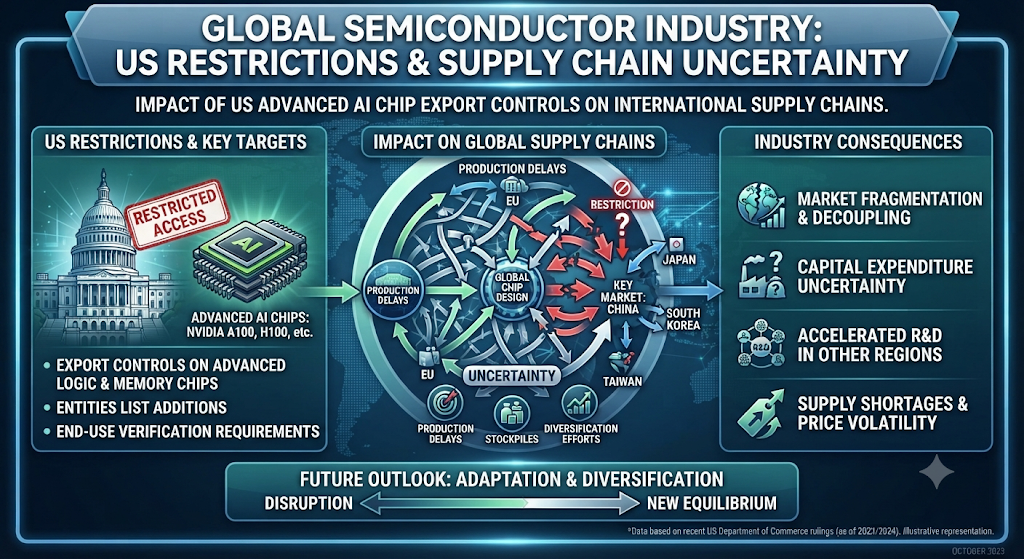
The global semiconductor industry is facing renewed uncertainty as the United States introduces tighter restrictions on access to advanced artificial intelligence (AI) chips. The measures are intended to prevent sensitive computing technology from reaching countries subject to US restrictions, particularly China, either through direct purchases or indirect access to computing facilities located overseas.
The latest rules, announced by the US Department of Commerce on November 16, 2026, extend export controls to certain overseas data centres and introduce additional licensing requirements for advanced semiconductor shipments to selected countries. The changes are expected to affect international technology companies, cloud service providers, semiconductor suppliers and businesses operating across global supply chains. <Cite refs={[“turn418563news8″,”turn418563search10”]}/>
The development highlights how semiconductors have become central not only to commercial technology but also to national security, international trade and competition in artificial intelligence.
United States Expands Restrictions on Advanced AI Chips
The United States has been tightening controls on advanced semiconductor exports to China for several years. The restrictions focus particularly on high-performance processors used to train and operate sophisticated AI systems.
The latest measures seek to address indirect access to restricted technology. Under the new interim rule, overseas data centres supplying significant computing capacity to companies headquartered in China and certain other restricted jurisdictions may require US export licences. The rules also require chip exporters, foreign foundries and data-centre operators to conduct due diligence on customers, including their ownership and control structures.
In addition, new licensing requirements will apply to certain advanced semiconductor exports, re-exports and transfers involving Indonesia, Malaysia, Singapore, Thailand and Brazil. The US administration has identified these markets as presenting a higher-than-normal risk of technology diversion. Existing operators covered by the remote-access provisions will have a transition period to obtain the necessary licences.
Washington argues that these measures are necessary to protect sensitive computing capabilities from being used in ways that could threaten national security. However, the expanded scope of the controls also increases compliance responsibilities for companies operating across international markets.
China-US Technology Tensions Intensify
China remains at the centre of the semiconductor dispute. Advanced AI processors are essential for developing large language models, data-centre infrastructure, autonomous systems and other high-performance computing applications.
US restrictions have limited the ability of Chinese companies to purchase certain advanced processors directly. However, companies have also explored alternative ways to obtain computing capacity, including renting access to overseas data centres equipped with US-designed chips.
The latest rules seek to close some of these indirect access channels. Reuters reported that China has opposed the proposed restrictions, with its Commerce Ministry warning on November 17 that Beijing could take countermeasures if Washington proceeds with the measures. China has called for differences to be addressed through consultation and cooperation.
The dispute creates uncertainty for businesses that depend on access to both American semiconductor technology and Chinese markets. Companies must consider not only current export permissions but also the possibility of further changes to licensing requirements.
Semiconductor Supply Chains Face New Challenges
The semiconductor industry depends on a highly interconnected international production network. Chip design, manufacturing, advanced equipment, materials, packaging and testing are often carried out in different countries.
The United States plays an important role in chip design and semiconductor equipment, while Taiwan is a major centre for advanced chip manufacturing. South Korea is important for memory semiconductors, and Japan supplies essential materials and manufacturing equipment. China remains a major market for electronic components and semiconductor products, as well as an important participant in global manufacturing.
Restrictions on advanced chip exports can therefore affect several stages of the supply chain. Manufacturers may need to review customer relationships, verify the final destination of products and introduce additional compliance procedures.
Cloud computing companies could also face higher administrative costs if they must monitor which customers are accessing advanced processors and where those customers are based. Businesses operating data centres across multiple countries may need to reconsider investment plans, equipment procurement and service arrangements.
These requirements could encourage companies to diversify suppliers and manufacturing locations. However, building alternative semiconductor capacity requires significant investment, specialised skills and time. As a result, supply-chain diversification is unlikely to provide an immediate solution to every disruption.
Technology Companies Reassess Their Global Strategies
The new restrictions are likely to influence the strategies of major semiconductor and technology companies.
Chip designers and manufacturers must evaluate which products can be sold to particular customers and under what licensing conditions. Cloud providers may need stronger customer-verification systems, while international distributors will face greater scrutiny over the movement and use of advanced processors.
Companies that depend heavily on the Chinese market could face uncertainty over future sales opportunities. At the same time, restrictions may encourage investment in alternative technologies and domestic semiconductor development in countries seeking to reduce dependence on foreign suppliers.
The policy environment is also changing as governments balance national security concerns against the commercial interests of technology businesses. The US decision to replace parts of its earlier AI-chip policy framework with a different regulatory approach illustrates how quickly the rules governing international technology trade can evolve.
Implications for the Global AI Industry
Access to advanced processors is an important factor in the development of artificial intelligence. Large technology companies require substantial computing power to train models, operate AI services and develop new applications.
Restrictions on chip access could influence where companies build data centres and how they organise computing services. Some businesses may increase investment in countries where they can obtain the necessary licences and operate within the applicable rules.
There may also be greater interest in alternative processors, specialised AI chips and domestic semiconductor technologies. However, developing competitive alternatives requires research, capital, manufacturing expertise and access to advanced production equipment.
For emerging technology markets, these developments could create opportunities to attract data-centre investment and strengthen local semiconductor capabilities. Nevertheless, companies will need to ensure that their operations comply with international export-control requirements.
Implications for India
The changing semiconductor environment presents both opportunities and challenges for India.
India is seeking to expand its semiconductor manufacturing capacity, attract investment in chip fabrication and assembly, and strengthen its electronics production ecosystem. Global companies reviewing their supply chains may consider India as an additional location for manufacturing, packaging, testing and technology services.
The country also has a growing digital economy and demand for data-centre infrastructure. Investment in cloud computing, AI services and electronics manufacturing could support India’s ambition to become a more important participant in the global technology supply chain.
However, India must also consider the potential impact of stricter international controls. Companies importing advanced processors, supplying technology services or operating data centres with international customers may need to review their compliance procedures carefully.
Building a competitive semiconductor industry will require reliable infrastructure, skilled workers, research investment, access to specialised equipment and stronger cooperation with international technology partners.
India’s opportunity lies in developing a dependable manufacturing and technology ecosystem while maintaining transparent trade practices and compliance with relevant international regulations.
The Worldonomics Times View
The latest US restrictions demonstrate that the semiconductor industry is increasingly influenced by geopolitical and national security considerations. Advanced AI chips are no longer simply commercial products; they are strategic resources that governments seek to regulate because of their economic, technological and security significance.
Although the new controls are intended to prevent restricted access to sensitive computing technology, they could create additional costs and uncertainty for international businesses. Chipmakers, cloud providers and manufacturers will need to adapt their operations to changing licensing requirements and customer-verification standards.
For China, the restrictions could increase pressure to develop domestic semiconductor capabilities and alternative sources of computing power. For other economies, they may encourage supply-chain diversification and investment in local technology infrastructure.
India could benefit from these changes if it strengthens its manufacturing capabilities, attracts international investment and develops a reliable semiconductor ecosystem. However, achieving this will require sustained policy support and long-term investment.
Ultimately, the future of the global semiconductor industry will depend on how governments balance national security objectives with the need for international trade and technological cooperation. Predictable regulations, transparent licensing procedures and stable business relationships will be essential to maintaining resilient supply chains in an increasingly competitive global technology market.