The Worldonomics Times | Customs, Taxation & International Trade | November 2026
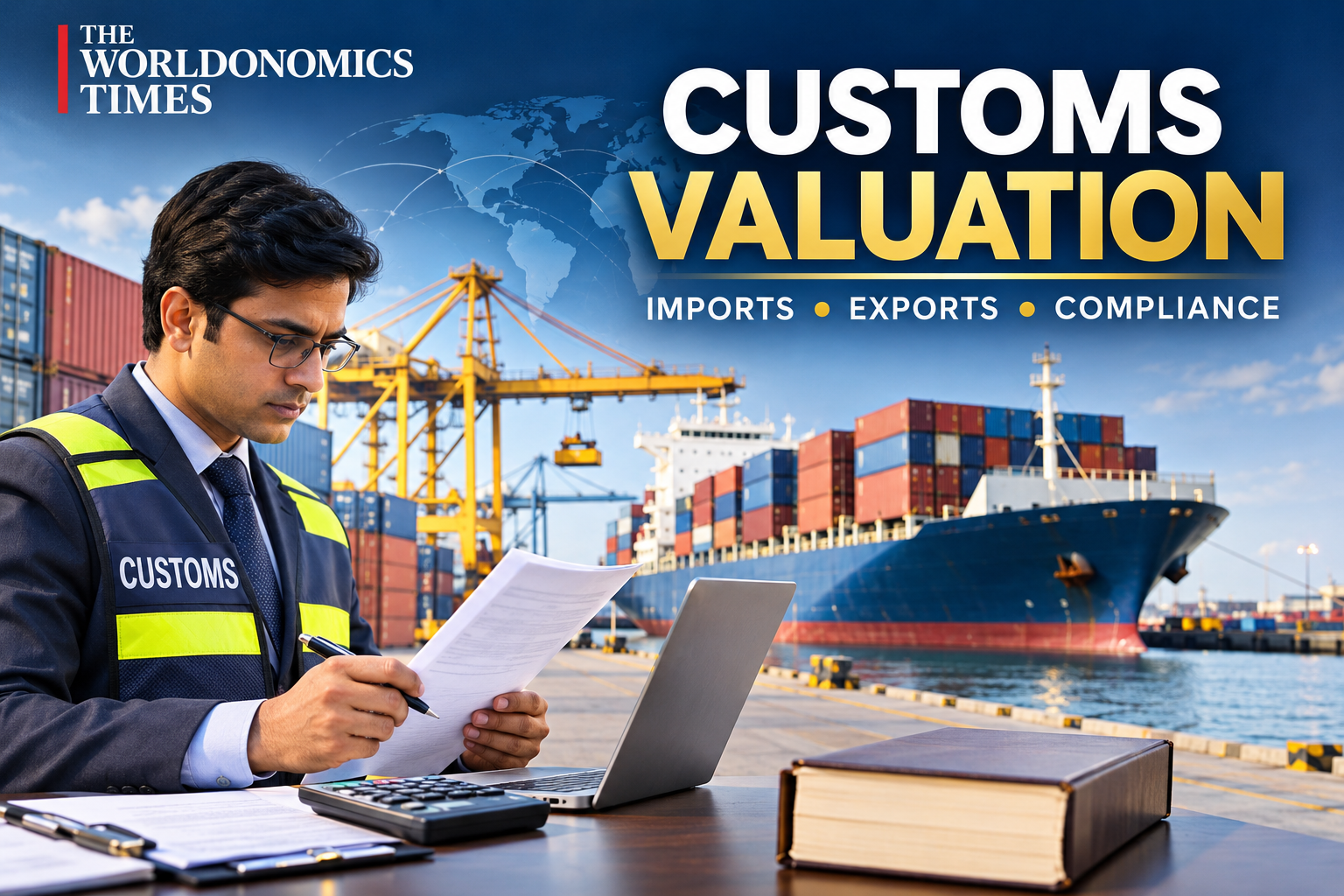
International trade involves the movement of goods across national borders, where the determination of the correct customs value plays a crucial role in taxation, regulatory compliance and trade administration. Valuation of imported and exported goods is one of the most important aspects of the Indian Customs framework, as it establishes the value on which applicable customs duties, export duties and other statutory levies are determined.
For importers, exporters, manufacturers, customs brokers and tax professionals, understanding customs valuation is essential for accurate duty assessment, transparent international transactions and effective cost management.
1. Meaning and Importance of Customs Valuation
Customs valuation refers to the process of determining the monetary value of goods for customs purposes when they are imported into or exported from India.
The primary objective is to establish a fair, uniform and legally acceptable value for assessing applicable customs duties and ensuring that international trade transactions are properly reported.
Correct valuation is important for:
- Determination of Basic Customs Duty (BCD).
- Calculation of Social Welfare Surcharge (SWS) and import IGST.
- Assessment of applicable export duties.
- Prevention of under-invoicing and over-invoicing.
- Monitoring related-party international transactions.
- Ensuring compliance with foreign trade and customs regulations.
- Accurate determination of import costs and export realisation.
Incorrect customs valuation may result in differential duty demands, interest, penalties, delayed clearance and litigation.
2. Legal Framework Governing Customs Valuation
The principal legal provision governing customs valuation in India is Section 14 of the Customs Act, 1962.
Section 14 provides that the value of imported and exported goods shall generally be the transaction value, subject to the prescribed conditions and valuation rules.
The principal rules governing valuation are:
- Customs Valuation (Determination of Value of Imported Goods) Rules, 2007.
- Customs Valuation (Determination of Value of Export Goods) Rules, 2007.
These rules establish the methodology for determining customs value and provide procedures for situations where the declared transaction value cannot be accepted.
India’s customs valuation framework is also aligned with the principles of the World Trade Organization (WTO) Agreement on Customs Valuation, which promotes transparent and consistent valuation practices in international trade.
3. Valuation of Imported Goods
For imported goods, the primary basis of customs valuation is the transaction value, meaning the price actually paid or payable for goods when sold for export to India for delivery at the time and place of importation.
Under Rule 3 of the Customs Valuation Rules, 2007, the transaction value is generally accepted when the prescribed conditions are satisfied.
These conditions include:
- There should be no disqualifying restrictions on the buyer’s use or disposal of goods.
- The sale price should not be subject to conditions whose value cannot be determined.
- No part of subsequent resale proceeds should accrue to the seller unless an appropriate adjustment is made.
- Where the buyer and seller are related, their relationship should not have influenced the price.
Important additions to transaction value
Under Rule 10, certain expenses and payments must be added to the declared price to the extent they are not already included, including:
- Commissions and brokerage, excluding buying commissions.
- Packing and container costs.
- Value of materials, components, tools and designs supplied free or at reduced cost by the buyer.
- Royalties and licence fees payable as a condition of sale.
- Certain subsequent resale proceeds accruing to the seller.
- Transportation, loading, unloading, handling and insurance costs, as prescribed.
These adjustments ensure that the customs value reflects the legally prescribed value of imported goods rather than merely the supplier’s invoice amount.
4. Methods of Valuation of Imported Goods
Where the declared transaction value cannot be accepted, the Customs Valuation Rules prescribe alternative methods in a sequential manner.
The principal methods include:
- Transaction Value Method.
- Transaction Value of Identical Goods.
- Transaction Value of Similar Goods.
- Deductive Value Method.
- Computed Value Method.
- Residual Method.
Customs authorities must follow the prescribed sequence, subject to the flexibility permitted under the rules.
The declared value may be rejected under Rule 12 where the proper officer has reasonable doubt regarding its truth or accuracy, after following the prescribed procedure and providing the importer an opportunity to explain the valuation.
. Valuation of Exported Goods
Valuation of exported goods is equally important for determining export duty, where applicable, and ensuring accurate declaration of export transactions.
Under the Customs Valuation (Determination of Value of Export Goods) Rules, 2007, the transaction value is the primary basis of valuation.
The transaction value generally represents the price actually paid or payable for goods when sold for export from India for delivery at the time and place of exportation.
The rules provide alternative valuation methods where the transaction value cannot be determined or accepted.
These include:
- Comparison with the transaction value of goods of like kind and quality.
- Computation based on production costs, processing expenses, profit and general expenses.
- Residual methods based on reasonable and consistent valuation principles.
Unlike import valuation, the export valuation rules permit acceptance of transaction value even in related-party transactions, provided the relationship has not influenced the price.
Exporters must maintain appropriate commercial invoices, purchase orders, contracts, shipping bills and supporting financial records to substantiate declared export values.
6. Practical Example: Import Customs Valuation
Consider an Indian company importing industrial machinery from Germany.
| Particulars | Amount |
|---|---|
| FOB value | ₹9,50,000 |
| International freight | ₹40,000 |
| Insurance | ₹10,000 |
| Illustrative assessable value | ₹10,00,000 |
Assuming all relevant additions are included and no other valuation adjustment is required, the assessable value would be ₹10 lakh.
If BCD is applicable at 10%, the Basic Customs Duty would be ₹1 lakh.
This illustrates how freight and insurance costs can influence the customs value and consequently increase the overall import tax liability.
7. Importance of Related-Party Transactions
International businesses frequently undertake transactions between associated enterprises, subsidiaries, holding companies and group entities.
Such transactions require particular attention under customs valuation provisions.
A relationship between buyer and seller does not automatically mean that the declared transaction value must be rejected. However, customs authorities may examine whether the relationship has influenced the price.
Businesses should maintain transfer pricing documentation, inter-company agreements, pricing policies and supporting commercial evidence.
It is important to recognise that customs valuation and transfer pricing are separate regulatory exercises, although both may examine related-party transactions and pricing arrangements.
8. Professional Opportunities and Compliance Responsibilities
Customs valuation offers significant professional opportunities for Cost Accountants, Chartered Accountants, customs consultants and international trade advisers.
Important professional services include:
- Import and export valuation reviews.
- Verification of freight, insurance and handling costs.
- Related-party transaction valuation analysis.
- Royalty and licence fee assessment.
- Customs audit and valuation reconciliation.
- Examination of declared transaction values.
- Import landed cost calculations.
- Export invoice and shipping bill verification.
- Assistance in customs valuation disputes and assessments.
Professionals can help businesses develop systematic valuation procedures, maintain supporting documentation and minimise customs compliance risks.
9. Challenges and the Way Forward
Businesses may face valuation challenges involving related-party transactions, transfer pricing adjustments, free-of-charge supplies, software and technology charges, royalties, assists and fluctuating international commodity prices.
To address these issues, importers and exporters should maintain transparent commercial agreements, accurate invoices, payment records, freight documentation and appropriate valuation working papers.
Digital customs systems, risk-based assessment and improved coordination between customs authorities and businesses can further strengthen transparency and efficiency in international trade.
Conclusion
Valuation of imported and exported goods is a fundamental element of India’s customs administration and international trade taxation system. Section 14 of the Customs Act, 1962, together with the Customs Valuation Rules, 2007, provides the legal framework for determining the appropriate value of cross-border transactions.
Accurate customs valuation ensures correct duty assessment, prevents revenue leakage, promotes fair international trade and reduces the risk of disputes.