Trade disruptions, political rivalries, inflationary pressures and shifting alliances are reshaping the global economic outlook, challenging governments, businesses and investors to navigate an increasingly unpredictable landscape.
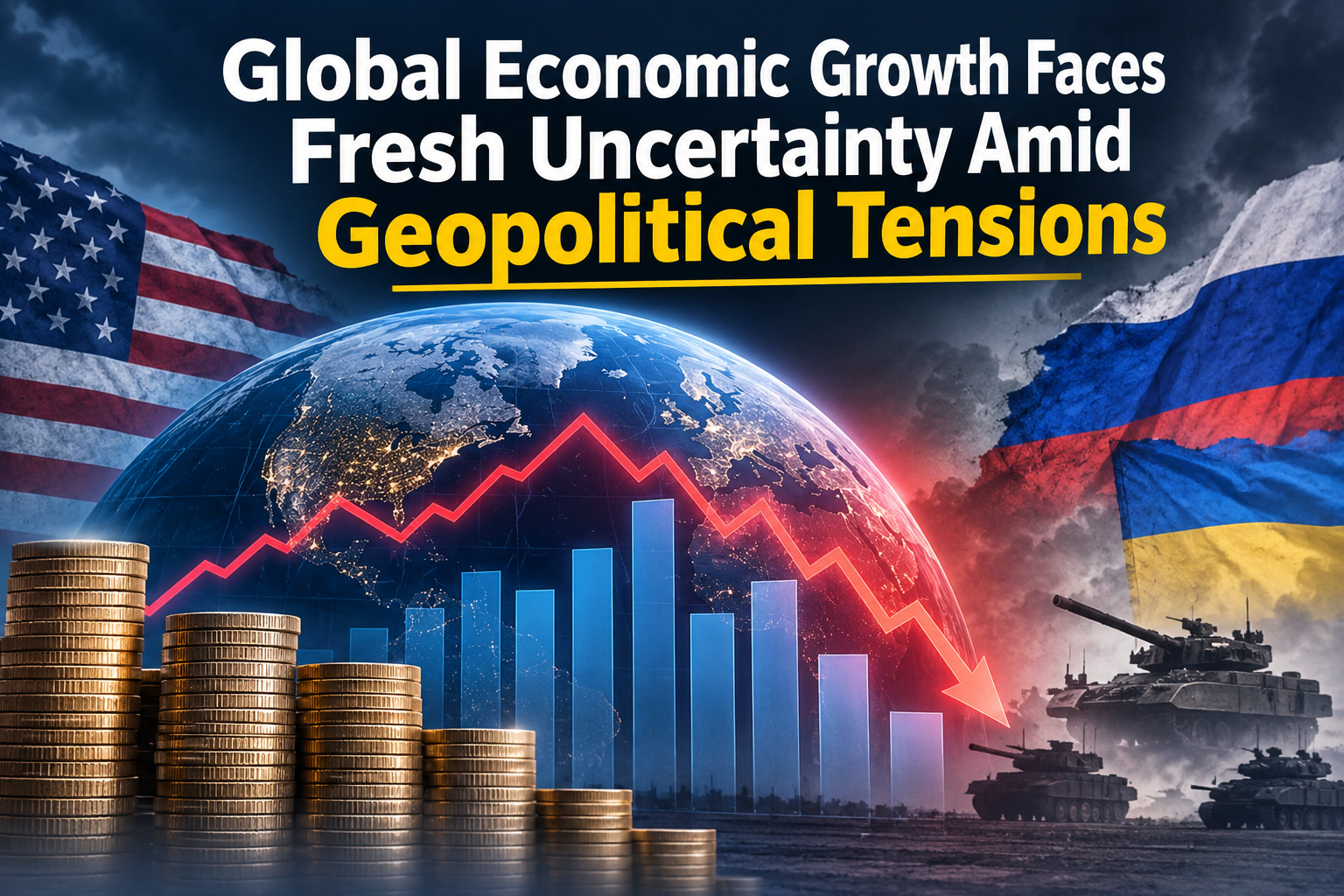
The global economy is entering a period of renewed uncertainty as geopolitical tensions, regional conflicts, trade disputes and evolving international alliances continue to influence economic activity across the world. While several economies have demonstrated resilience in the face of recent challenges, the outlook for global growth remains fragile. Rising uncertainty is affecting trade flows, investment decisions, energy markets and financial stability, creating a complex environment for policymakers and businesses alike.
In an increasingly interconnected world, geopolitical developments are no longer confined to political or diplomatic spheres. Their economic consequences often extend across borders, influencing supply chains, commodity prices, manufacturing costs and consumer confidence. As countries navigate competing strategic interests, the global economy faces the challenge of maintaining stability while adapting to a rapidly changing international environment.
Geopolitical tensions and their economic impact
Geopolitical tensions remain one of the most significant sources of uncertainty for global economic growth. Conflicts, diplomatic disagreements, sanctions and trade restrictions can disrupt the movement of goods, services and capital. Such disruptions often increase production costs, weaken investor confidence and create pressure on economies that depend heavily on international trade.
The ongoing transformation of global trade relationships has also encouraged countries to reconsider their economic dependencies. Governments and businesses are increasingly prioritising supply-chain resilience, strategic autonomy and domestic production capabilities. Although these measures may reduce vulnerability to external shocks, they can also increase costs and complicate international commerce.
Trade restrictions and tariffs, in particular, have the potential to slow economic activity. Higher import costs may affect businesses relying on international raw materials, technology and components. These costs can eventually be passed on to consumers, contributing to inflationary pressures and reducing purchasing power.
Inflation, energy markets and financial stability
Energy markets remain highly sensitive to geopolitical developments. Political instability in major energy-producing regions, disruptions to shipping routes and uncertainty surrounding international supply can influence oil, gas and electricity prices. Sudden increases in energy costs can affect transportation, manufacturing, agriculture and household expenditure.
For emerging and developing economies, rising energy prices can be particularly challenging. Many countries rely on imported energy, making them vulnerable to currency fluctuations and international price shocks. Higher import bills may widen current-account deficits, weaken currencies and increase pressure on government finances.
Inflation continues to be a concern for policymakers as economic uncertainty complicates monetary policy decisions. Central banks must balance the need to support economic growth against the responsibility of maintaining price stability. Persistent inflation may limit the scope for interest-rate reductions, while excessively restrictive monetary conditions could weaken investment, employment and consumer spending.
Financial markets are also affected by changing geopolitical conditions. Investors often respond to uncertainty by shifting towards perceived safer assets, creating volatility in currencies, bond yields and equity markets. Such fluctuations can influence borrowing costs and investment decisions, particularly in countries with weaker financial fundamentals.
Global trade and the changing supply-chain landscape
The global trading system is undergoing a significant transformation. Businesses are increasingly diversifying suppliers, relocating production facilities and exploring alternative markets to reduce geopolitical and operational risks. Strategies such as nearshoring, friendshoring and regional manufacturing have gained prominence as companies seek greater security and predictability.
While these strategies can improve resilience, they may also reshape the traditional efficiency-driven model of globalisation. Production could become more fragmented, with companies maintaining multiple suppliers and manufacturing locations. This may strengthen certain economies and industries while creating challenges for others.
Emerging markets have an opportunity to benefit from these changes by attracting investment in manufacturing, infrastructure, logistics and technology. However, capitalising on these opportunities will require competitive policies, skilled labour, reliable infrastructure and regulatory stability.
Emerging economies and opportunities for growth
Developing economies face a mixed outlook. On one hand, geopolitical uncertainty, currency volatility and rising financing costs can create significant challenges. On the other, changing global supply chains may open new avenues for industrial development, trade expansion and foreign investment.
Countries investing in infrastructure, digital technology, renewable energy, education and manufacturing could strengthen their economic position over the long term. Diversifying export markets and improving domestic production capabilities may also help reduce exposure to external shocks.
However, the benefits will not be automatic. Governments must focus on fiscal discipline, structural reforms, productivity enhancement and policies that encourage sustainable private-sector investment.
The Worldonomis Times View
Resilience, cooperation and strategic foresight will define the next phase of global economic growth.
The Worldonomis Times believes that the global economy’s greatest challenge is not uncertainty itself, but the ability of nations to respond to it without undermining long-term economic stability. Geopolitical tensions may encourage protectionism and economic fragmentation, but excessive isolation could ultimately weaken growth prospects and limit innovation.
Governments must recognise that economic security and international cooperation are not mutually exclusive. Diversifying supply chains, strengthening domestic industries and protecting strategic sectors are important priorities, but these efforts should not come at the expense of productive international partnerships.
Greater cooperation in trade, energy security, climate finance, technology and infrastructure can help reduce vulnerabilities and create new opportunities. Businesses, meanwhile, must adopt flexible strategies, strengthen risk management and invest in innovation to remain competitive amid shifting global conditions.
The global economy has repeatedly demonstrated its capacity to adapt to crises. Yet the road ahead will require careful policymaking, responsible investment and a renewed commitment to economic collaboration. In a world shaped by geopolitical uncertainty, sustainable growth will depend not only on the strength of individual economies but also on their ability to work together.
For The Worldonomis Times, the message is clear: uncertainty may shape the global economic landscape, but resilience, innovation and cooperation will determine its future.