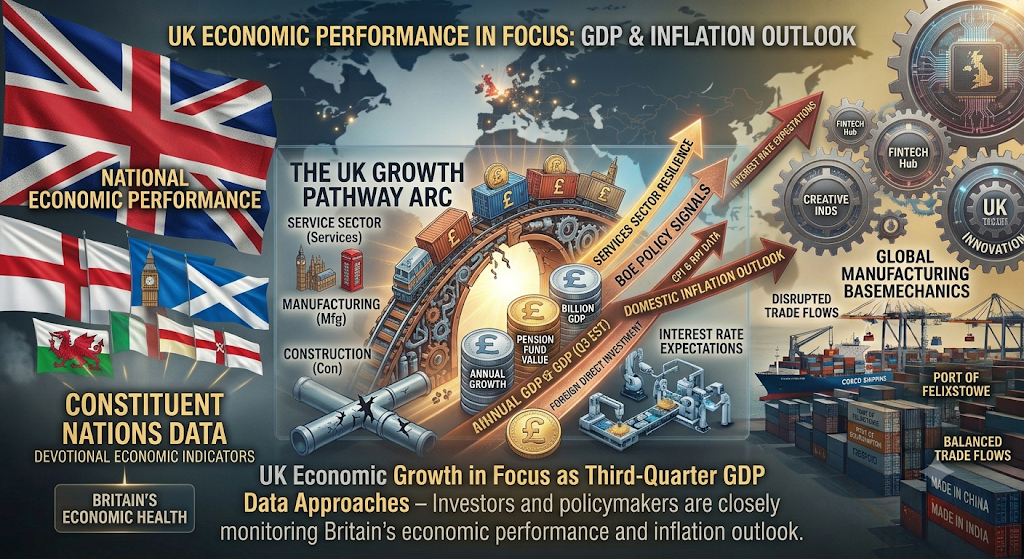
Investors and policymakers are closely monitoring Britain’s economic performance and inflation outlook.
The United Kingdom’s economy recorded stronger-than-expected momentum during the third quarter of 2026, offering some reassurance to investors and policymakers amid persistent inflation, higher borrowing costs and geopolitical uncertainty. Official figures released by the Office for National Statistics (ONS) on November 12 showed that gross domestic product (GDP) increased by 0.7% in the July-to-September period, compared with growth of 0.5% in the previous quarter.
The performance suggests that the British economy has remained more resilient than earlier expectations indicated. However, concerns about rising energy prices, household spending and restrictive financial conditions continue to create uncertainty over the outlook for the final months of the year.
UK Economy Records Stronger Third-Quarter Growth
The latest ONS figures show that UK GDP expanded by 0.7% in the third quarter, matching economists’ expectations and improving on the 0.5% growth recorded in the second quarter. Compared with the same period in 2025, the economy was 1.9% larger.
Monthly figures also provided some encouragement. Economic output increased by 0.2% in September after recording no growth in August. This followed stronger monthly expansion in July, indicating that economic activity recovered towards the end of the quarter.
The figures suggest that the economy has maintained positive momentum despite elevated interest rates and uncertainty in international markets. However, the first quarterly estimate remains subject to revision as more complete information becomes available.
The stronger performance also follows revisions to earlier economic data, which have improved the picture of Britain’s recent growth trajectory.
Services and Business Activity Support Growth
The services sector remains an important contributor to the UK economy. Financial services, professional activities, retail, hospitality and other consumer-facing industries play a major role in national output.
The performance of these industries is closely connected to household confidence, employment conditions and disposable income. When consumers face higher food, housing and energy costs, discretionary spending can weaken, affecting businesses that depend on domestic demand.
Production and manufacturing activity also remain important areas to monitor. Higher energy prices and supply-chain costs can affect industrial competitiveness, while weaker international demand may limit opportunities for exporters.
Construction faces its own challenges, particularly because higher borrowing costs can discourage property purchases, housing development and commercial investment. The overall economic picture therefore reflects different conditions across sectors rather than uniform growth throughout the economy.
Inflation Remains a Major Concern
Despite the encouraging GDP figures, inflation continues to present a significant challenge for Britain.
The Bank of England’s November Monetary Policy Report stated that UK consumer price inflation reached 3.5% in September 2026. The central bank expects inflation to rise to around 5% by the middle of 2027, largely because of higher global energy prices.
Energy costs affect the economy through several channels. Higher fuel and electricity prices increase household expenses while raising operating costs for manufacturers, transport companies and service providers. Businesses may pass some of these additional expenses on to customers, potentially creating further inflationary pressure.
The Bank of England is particularly concerned about whether higher energy costs could influence wages and prices more broadly. If workers seek higher pay to compensate for rising living expenses and businesses increase prices to protect margins, temporary energy inflation could become more persistent.
Bank of England Maintains a Cautious Approach
Monetary policy remains central to the UK’s economic outlook. At its meeting ending November 4, the Bank of England’s Monetary Policy Committee voted by a majority of 8–1 to increase the Bank Rate by 0.25 percentage points to 4%.
The decision reflects concerns that inflation could remain above the central bank’s 2% target for an extended period. Higher interest rates can help control inflation by reducing borrowing and demand, but they can also increase mortgage payments, business financing costs and government debt-servicing expenses.
For households, higher borrowing costs may limit spending on homes, vehicles and other major purchases. Businesses may also delay expansion projects when financing becomes more expensive.
The central bank has emphasised that future decisions will depend on incoming economic evidence, particularly wage growth, pricing behaviour and the wider effects of higher energy prices.
Investors Assess the Economic Outlook
The stronger GDP figures could provide some support to investor confidence, particularly by reducing immediate concerns about a sharp slowdown in economic activity.
However, financial markets must balance stronger growth against the possibility of further inflationary pressure and higher interest rates. Expectations about monetary policy can influence the value of the pound, government bond yields and the performance of UK-listed companies.
The currency market is particularly sensitive to economic data because stronger growth may support sterling, while expectations of higher interest rates can also affect international investment flows. Nevertheless, a stronger pound is not guaranteed, as global financial conditions and geopolitical developments remain influential.
Equity investors are also assessing whether companies can maintain earnings growth while facing higher wages, energy expenses and borrowing costs.
The Road Ahead for Britain’s Economy
The outlook for the UK economy will depend on whether recent growth momentum can be sustained while inflationary pressures gradually ease.
The Bank of England expects economic activity to slow in the coming quarters as higher energy prices, tighter financial conditions and fiscal pressures affect households and businesses. Its November assessment also highlights the possibility that stronger investment in artificial intelligence and business activity may provide some support.
The Office for Budget Responsibility has projected UK GDP growth of 1.2% in 2026 and 1.0% in 2027, reflecting the challenges facing the economy. These forecasts underline the importance of productivity improvements, investment and stable consumer demand.
The Worldonomics Times Views
The UK’s third-quarter GDP performance provides an encouraging indication that the economy has retained resilience despite inflationary pressure and higher borrowing costs. Growth of 0.7% demonstrates that economic activity has remained stronger than some earlier projections suggested.
However, policymakers should not interpret stronger GDP figures as evidence that the country’s economic challenges have disappeared. Persistent inflation, rising energy expenses and expensive credit continue to affect households and businesses.
The Bank of England must carefully balance price stability with the need to support sustainable economic activity. Meanwhile, the government should prioritise productivity, infrastructure investment, business confidence and policies that strengthen long-term growth.
For investors, the latest figures offer a positive signal, but caution remains necessary. Britain’s economic direction will depend on how effectively it manages inflation while maintaining employment, investment and consumer confidence.
The coming quarters will reveal whether the recent improvement represents the beginning of a more stable recovery or a temporary period of resilience in an otherwise challenging economic environment.