The Role of Cost and Management Accountants in Transforming India’s MSME Sector
Strengthening Small Businesses Through Scientific Costing, Profitability Analysis and Financial Efficiency
Introduction
Micro, Small and Medium Enterprises (MSMEs) are among the most important pillars of the Indian economy. They contribute significantly to manufacturing, exports, employment generation, entrepreneurship and regional industrial development. From small manufacturing units and service providers to technology startups and traditional businesses, MSMEs play a crucial role in strengthening India’s economic foundation.
As India moves towards its vision of Viksit Bharat 2047, the development of a globally competitive MSME ecosystem becomes increasingly important. Government initiatives, access to finance, digital transformation and infrastructure development are essential. However, another critical factor deserves greater attention: professional cost management.
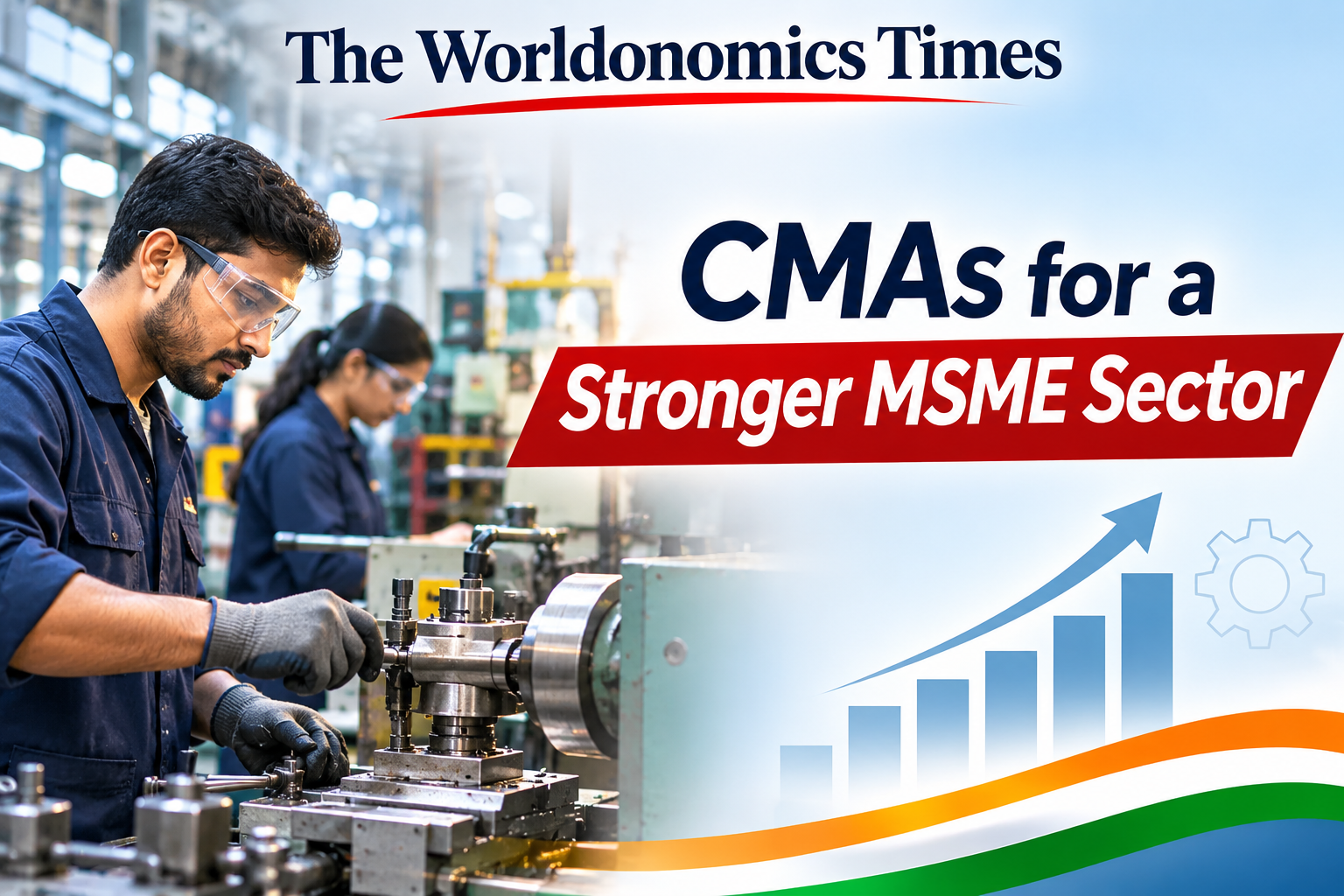
Cost and Management Accountants (CMAs), guided by the professional expertise promoted by the Institute of Cost Accountants of India (ICMAI), can help MSMEs improve profitability, control expenditure, optimise resources and build sustainable business models.
1. MSMEs: The Backbone of India’s Economic Development
India’s MSME sector is a major contributor to economic activity. It supports millions of enterprises across manufacturing, trading and services and provides livelihood opportunities to a large section of the population.
MSMEs also contribute to India’s export ecosystem by supplying products and services to domestic and international markets.
Despite their importance, many enterprises face challenges such as limited financial resources, rising input costs, inadequate technology adoption, working capital constraints and intense market competition.
To overcome these challenges, MSMEs need not only financial assistance but also professional management systems that improve operational efficiency and financial discipline.
2. Why Scientific Costing Is Important for MSMEs
Many small businesses determine their selling prices based on competitors’ prices or approximate estimates rather than scientifically calculated product costs.
This approach can result in underpricing, reduced profit margins and even business losses.
Scientific costing enables enterprises to understand the actual cost of manufacturing a product or delivering a service.
A professional costing system helps businesses identify:
- Direct material and labour costs.
- Manufacturing and administrative overheads.
- Product-wise and service-wise profitability.
- Fixed and variable expenditure.
- Wastage and production inefficiencies.
- Break-even points and contribution margins.
With accurate cost information, entrepreneurs can make better pricing decisions, negotiate with suppliers and identify opportunities to improve profitability.
3. Role of CMAs in Improving MSME Profitability
Cost and Management Accountants can act as strategic business advisers to MSMEs.
Their contribution extends beyond bookkeeping and financial reporting. They can help business owners understand the financial performance of individual products, departments and business operations.
Some important areas of professional intervention include:
Cost optimisation: Identifying unnecessary expenditure and reducing production costs without compromising quality.
Pricing strategy: Establishing scientifically calculated selling prices based on production costs, market conditions and desired profitability.
Profitability analysis: Identifying high-margin and low-margin products and improving the overall business portfolio.
Budgetary control: Preparing budgets and comparing actual performance against planned expenditure.
Working capital management: Improving inventory turnover, receivables management and cash flow planning.
Business planning: Supporting expansion decisions, capital investment proposals and financial forecasting.
These services can help MSMEs transition from informal business practices to structured and professionally managed enterprises.
4. Financial Management and Access to Institutional Finance
Access to affordable finance remains an important requirement for MSME growth.
Banks and financial institutions generally evaluate financial statements, repayment capacity, business performance, cash flows and creditworthiness before extending loans.
Many small enterprises struggle to present structured financial information and realistic business projections.
CMAs can assist MSMEs in preparing project reports, financial forecasts, cost estimates, cash flow statements and business feasibility studies.
Professional financial planning can improve the quality of loan applications and help entrepreneurs understand their borrowing requirements and repayment obligations.
It can also help enterprises make better use of government-supported credit facilities and other financial assistance programmes, subject to applicable eligibility conditions.
5. Government Initiatives and the Need for Professional Guidance
The Government of India has introduced several initiatives to strengthen the MSME ecosystem.
Important initiatives include:
- Udyam Registration: Formal recognition and registration of eligible MSMEs.
- PMEGP: Supporting the establishment of micro-enterprises through a credit-linked subsidy programme.
- CGTMSE: Facilitating collateral-free credit support through eligible lending institutions.
- RAMP Scheme: Improving MSME performance and institutional capacity.
- Public Procurement Policy: Creating procurement opportunities for eligible micro and small enterprises.
- MSME TEAM Initiative: Supporting market access and digital commerce through ONDC-related interventions.
Awareness of these programmes is important, but successful utilisation also requires financial discipline, documentation, project planning and compliance.
CMAs can help entrepreneurs understand the financial implications of these initiatives and prepare better business strategies.
6. Digital Transformation: The Future of MSME Cost Management
Digitalisation is transforming the way businesses manage their operations.
Cloud accounting, Enterprise Resource Planning (ERP), artificial intelligence, automated inventory systems and data analytics can provide MSMEs with better financial visibility.
Modern cost management systems can help entrepreneurs monitor production costs, inventory levels, sales margins and operational expenses.
For example, a manufacturing enterprise can use digital dashboards to compare actual material consumption against standard consumption. Any significant variation can be investigated immediately.
Similarly, data analytics can help identify slow-moving inventory, unnecessary overheads and products generating inadequate returns.
CMAs must increasingly combine their professional accounting knowledge with digital finance, data analytics and technology-driven business advisory services.
7. Export Competitiveness and Global Market Opportunities
Indian MSMEs have significant opportunities in international markets, particularly in engineering goods, textiles, food processing, pharmaceuticals, handicrafts and specialised manufacturing.
However, international competitiveness requires more than product quality. It also depends on production efficiency, logistics expenses, compliance costs, pricing and supply chain management.
Scientific costing can help exporters calculate the complete cost of products, assess export profitability and identify opportunities for cost reduction.
Professional cost analysis can also support decisions relating to foreign market entry, capacity expansion and international pricing strategies.
By improving cost competitiveness, Indian MSMEs can strengthen their position in global value chains.
8. ICMAI and the Expanding Role of the CMA Profession
The Institute of Cost Accountants of India has an opportunity to strengthen its contribution to India’s MSME development agenda.
The CMA profession can support enterprises through cost management consultancy, financial planning, performance measurement, business restructuring and management advisory services.
Greater collaboration between ICMAI, MSME associations, government institutions, banks, industrial clusters and educational institutions can help expand professional cost management services to smaller businesses.
Specialised MSME advisory programmes, awareness workshops and affordable professional consultation models can make scientific costing more accessible to entrepreneurs across India.
The profession should increasingly position itself as a partner in business growth, rather than being viewed only through the traditional lens of accounting and compliance.
9. MSME Development: A Key Pillar of Viksit Bharat 2047
India’s journey towards becoming a developed economy requires productive industries, strong entrepreneurship, employment opportunities and competitive domestic enterprises.
A financially sustainable MSME sector can contribute to all these objectives.
When businesses understand their costs, manage resources efficiently and make informed investment decisions, they become better equipped to expand operations, create employment and compete internationally.
CMAs can play an important role in this transformation by bringing financial discipline and scientific management practices to enterprises of every size.
Conclusion
The transformation of India’s MSME sector requires a combination of government support, entrepreneurship, technology, institutional finance and professional management.
Scientific costing and effective financial management can become powerful instruments for improving MSME productivity and profitability.
Cost and Management Accountants have an important opportunity to contribute to this transformation by helping enterprises control costs, strengthen financial systems, optimise resources and build sustainable business models.
As India advances towards Viksit Bharat 2047, empowering MSMEs through professional cost management should become a national economic priority.
Strong MSMEs build strong industries, and strong industries build a strong nation.
The Worldonomics Times – Connecting Business, Economy and Professional Excellence.