By The Worldonomics Times | GST Case Law | November 2026
Case: M/s Sterling and Wilson Pvt. Ltd. v. Union of India & Others
Court: Supreme Court of India
Decision Date: 16 November 2026
Citation: 2026 INSC 1222
Key Provisions: Sections 2(30), 2(119), 9, 15 and 74 of the CGST Act, 2017.
Introduction
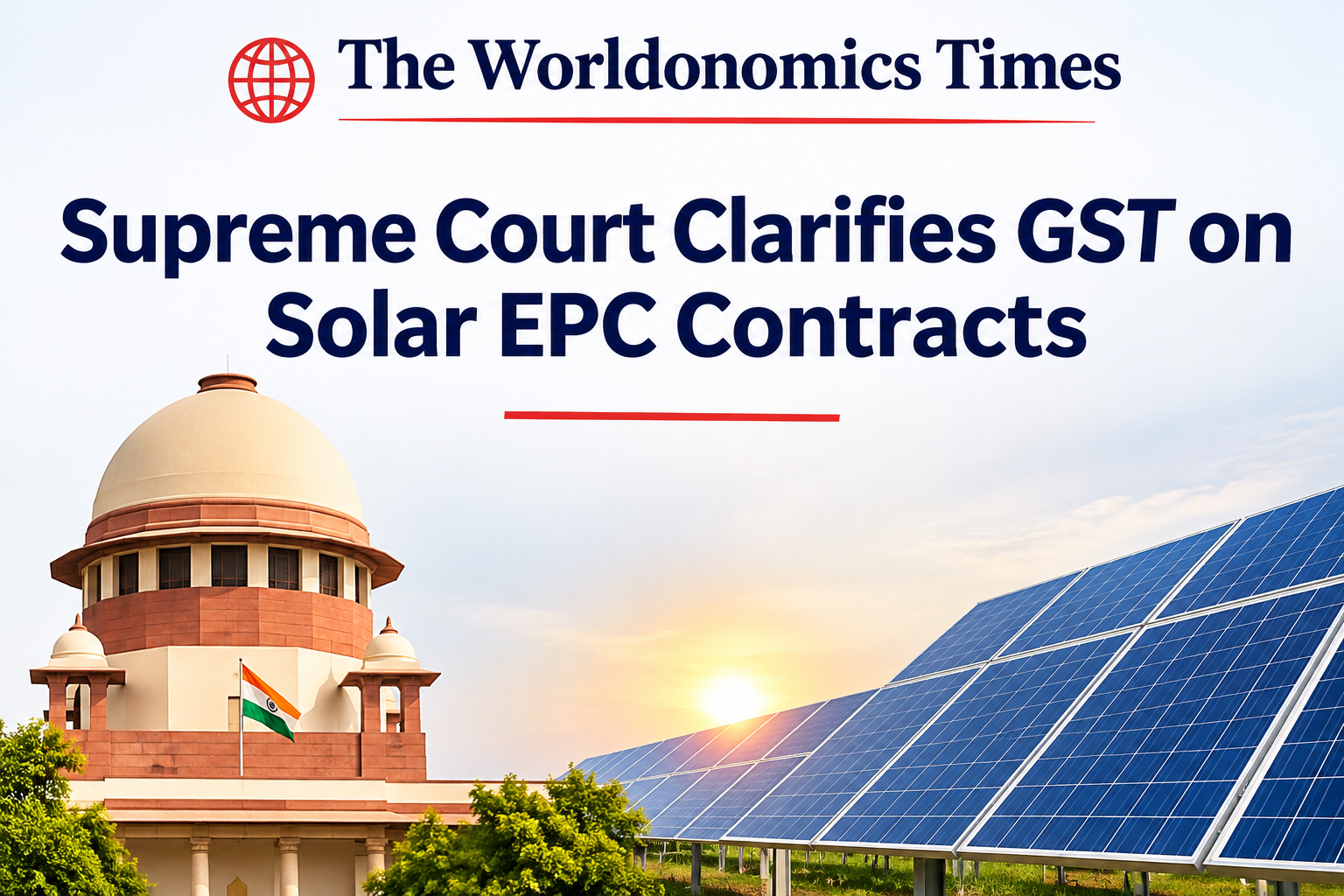
The Supreme Court of India has delivered a significant judgment concerning the Goods and Services Tax (GST) treatment of solar power generating systems supplied under Engineering, Procurement and Construction (EPC) contracts. In M/s Sterling and Wilson Pvt. Ltd. v. Union of India & Others, the Court examined whether the GST authorities could retrospectively apply the 70:30 valuation mechanism to solar EPC contracts executed before 1 January 2019.
The judgment, delivered on 16 November 2026, provides important clarification on GST valuation, composite supply, works contracts, the classification of movable and immovable property, and the invocation of extended limitation under Section 74.
The ruling is particularly relevant to renewable energy companies, infrastructure developers, EPC contractors, GST practitioners and tax professionals.
Background of the Case
Sterling and Wilson Pvt. Ltd. was engaged in supplying and installing solar power generating systems under EPC contracts.
For the period from 1 July 2017 to 31 December 2018, the company discharged GST at the applicable rate of 5% on the entire contract value.
However, the GST department subsequently questioned this treatment and sought to apply a 70:30 valuation mechanism. Under this approach, 70% of the total contract value was treated as the value of goods taxable at 5%, while the remaining 30% was treated as the value of services taxable at 18%.
The department raised a substantial demand, including tax and penalties, alleging that the taxpayer had incorrectly determined its GST liability.
The company challenged the demand, arguing that the 70:30 mechanism had been introduced with effect from 1 January 2019 and could not be imposed retrospectively as a compulsory method for earlier transactions.
Legal Issues Before the Supreme Court
The principal questions before the Court were:
- Whether the 70:30 valuation mechanism could be applied retrospectively to supplies made before 1 January 2019.
- Whether the supply and installation of solar power generating systems constituted a works contract under Section 2(119) of the CGST Act.
- Whether the GST department could invoke Section 74 on allegations of wilful misstatement and suppression of facts.
Supreme Court’s Important Findings
1. The 70:30 mechanism cannot be imposed retrospectively
The Court examined Notification No. 24/2018-Central Tax (Rate), dated 31 December 2018, which introduced the 70:30 valuation mechanism with effect from 1 January 2019.
The Court observed that the notification expressly provided for prospective application. Consequently, the mechanism could not be treated as a compulsory valuation requirement for transactions undertaken before that date.
For the earlier period, Circular No. 163/19/2021-GST dated 6 October 2021 clarified that taxpayers could adopt the 70:30 mechanism.
The Supreme Court emphasised that the word “can” indicated an option available to taxpayers and not a mandatory obligation. Legal Republic+1
2. Distinction between composite supply and works contract
Another important issue was the distinction between composite supply and works contract.
Section 2(30) of the CGST Act defines composite supply as a naturally bundled supply consisting of two or more taxable supplies, with one principal supply.
However, Section 2(119) specifically defines a works contract in relation to immovable property.
The Court explained that every works contract is a composite supply, but every composite supply does not necessarily constitute a works contract.
Therefore, the nature of the final property and the manner in which the equipment is attached to the earth become important considerations.
3. Solar equipment attachment does not automatically create immovable property
The Supreme Court considered earlier decisions, including Solid and Correct Engineering Works and Sirpur Paper Mills Ltd.
It reiterated that merely fixing machinery or equipment to a foundation for stability, operational efficiency or security does not automatically convert it into immovable property.
The intention behind the attachment, the nature of installation and the possibility of dismantling and relocating the equipment are relevant factors.
Applying these principles, the Court considered the findings of the Andhra Pradesh High Court concerning Sterling and Wilson’s solar power generating systems. The department had not challenged that decision, which had attained finality.
Accordingly, the relevant solar EPC transaction could not be treated as a works contract merely because the equipment was installed on civil foundations. Legal Republic
4. Section 74 cannot be invoked mechanically
Section 74 of the CGST Act provides for determination of tax not paid or short paid due to fraud, wilful misstatement or suppression of facts.
In the present case, the department alleged that the taxpayer had deliberately misclassified its supplies and suppressed facts to reduce its GST liability.
However, the Supreme Court found that the taxpayer’s adoption of the applicable pre-2019 GST treatment could not, by itself, establish fraud or suppression.
The extended limitation provision cannot be invoked merely because the department subsequently adopts a different interpretation of a tax notification or clarification.
Final Verdict
The Supreme Court allowed the appeal filed by Sterling and Wilson Pvt. Ltd. and set aside the impugned adjudication order dated 17 January 2025 and the consequential summary order dated 24 January 2025.
The total demand, including CGST, SGST and penalties, amounted to approximately ₹53.35 crore.
The judgment provides significant relief to the taxpayer and clarifies the interpretation of the GST valuation mechanism applicable to solar power generating systems. Legal Republic+1
Implications for Businesses and GST Professionals
The judgment has several important implications:
- Renewable energy companies: Historical GST assessments involving solar EPC contracts should be reviewed.
- EPC contractors: Contractual arrangements and the nature of installed equipment should be carefully examined before determining GST classification.
- Chartered Accountants and Cost Accountants: GST opinions should consider the effective dates of notifications and the precise language of CBIC circulars.
- Tax authorities: Demands involving retrospective application of valuation provisions must have a valid statutory foundation.
- Infrastructure developers: The distinction between movable and immovable property remains important for determining whether a transaction qualifies as a works contract.
Conclusion
The Supreme Court’s judgment in Sterling and Wilson Pvt. Ltd. v. Union of India & Others represents an important development in Indian indirect taxation.
By clarifying the prospective operation of the 70:30 valuation mechanism, the optional nature of the 2021 CBIC clarification for the earlier period and the distinction between composite supply and works contract, the Court has strengthened certainty in GST administration.
The decision also reinforces an essential principle of taxation: taxpayers should not be subjected to additional liabilities through retrospective interpretation of provisions that were introduced prospectively.
For India’s rapidly expanding renewable energy sector, this ruling provides valuable clarity and highlights the importance of consistent, transparent and legally sustainable GST administration.
Source and reference
Supreme Court of India, M/s. Sterling and Wilson Pvt. Ltd. v. Union of India & Others, 2026 INSC 1222, judgment dated 16 November 2026.
Read the full Supreme Court judgment.
Disclaimer: This article is intended for educational and informational purposes and does not constitute legal or tax advice.