New Delhi, November 24, 2026 | The Worldonomics Times
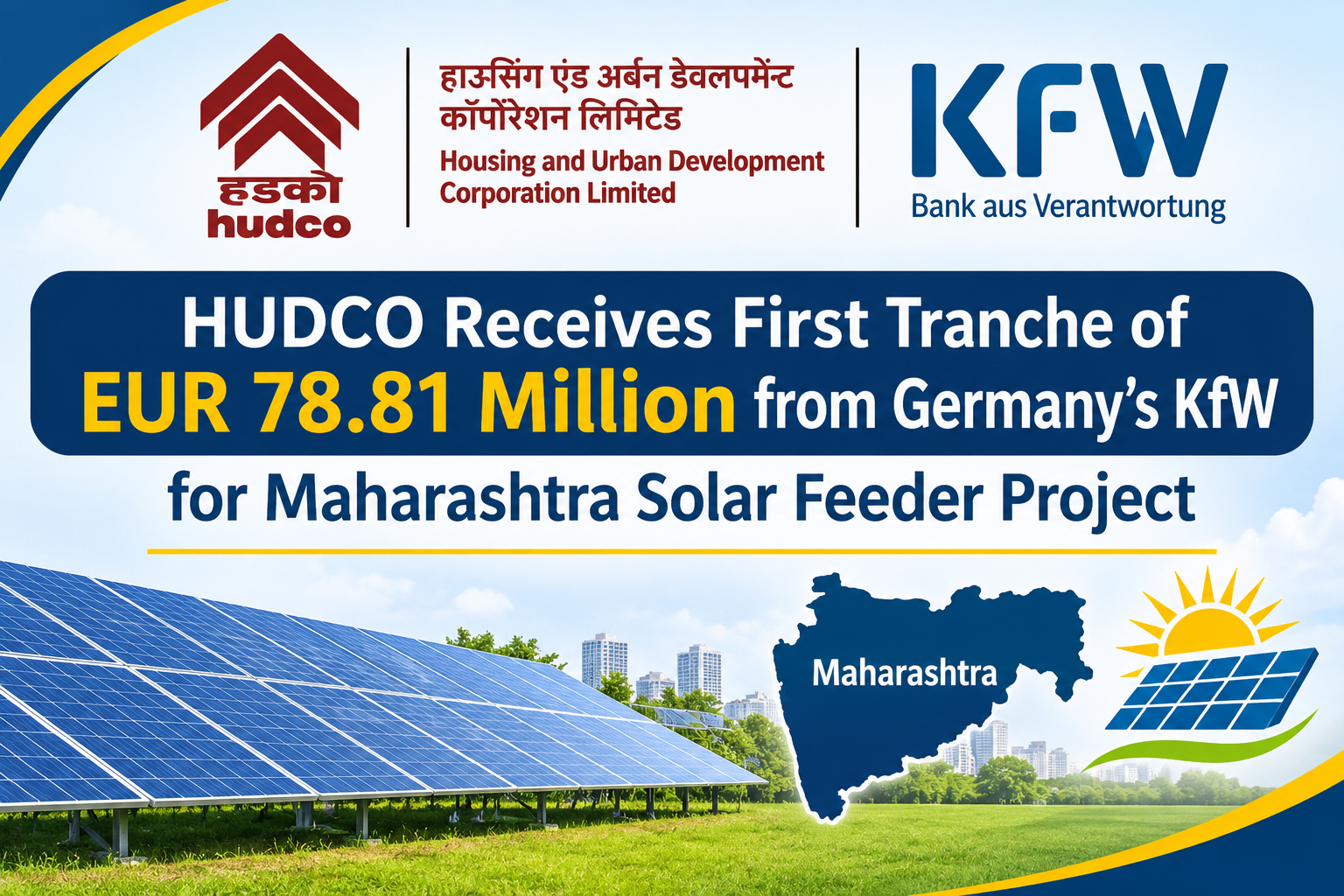
Housing and Urban Development Corporation Limited (HUDCO), a leading Government of India public sector financial institution, has received the first tranche of EUR 78.81 million from Germany’s development bank KfW under a EUR 200 million Line of Credit (LoC) for the solarisation of agricultural feeders across Maharashtra.
The financial assistance marks an important milestone in strengthening India’s renewable energy infrastructure and promoting sustainable agricultural power supply. The funding will support the refinancing of eligible sub-projects implemented by Maharashtra State Power Generation Company Limited (MahaGenco), which is undertaking the solarisation initiative across the state.
The project is expected to accelerate the adoption of solar energy in the agricultural electricity supply system, improve the availability of daytime power for farmers and reduce dependence on conventional fossil-fuel-based electricity generation.
The first tranche of EUR 78.81 million represents a significant step in the implementation of the broader EUR 200 million financing arrangement between HUDCO and KfW.
HUDCO-KfW Partnership Strengthens Green Infrastructure Financing
The EUR 200 million Line of Credit from KfW, headquartered in Frankfurt am Main, Germany, is designed to support eligible MahaGenco sub-projects focused on agricultural feeder solarisation.
Under this arrangement, HUDCO will play an important financial intermediary role by refinancing eligible project investments, helping mobilise international development finance for renewable energy infrastructure.
The partnership reflects growing cooperation between India and Germany in sustainable development, climate-focused investments and clean energy expansion.
For HUDCO, the financing also represents an expansion of its role beyond conventional housing and urban infrastructure funding into strategically important sustainable infrastructure segments.
The corporation has increasingly been associated with financing projects that contribute to India’s infrastructure development objectives, including renewable energy, energy efficiency and environmentally sustainable development.
502 MW Solarisation Programme to Benefit Maharashtra’s Agricultural Sector
The Maharashtra solar feederisation programme is designed to support the development of approximately 502 MW of solar power capacity through decentralised solar photovoltaic installations.
The programme covers agricultural feeders in the districts of Pune and Ahilyanagar and is being implemented by MahaGenco.
It is associated with the Maharashtra State Government’s Mukhyamantri Saur Krushi Vahini Yojana (MSKVY) 2.0 and contributes to the objectives of the Government of India’s PM-KUSUM scheme.
The primary objective is to provide farmers with reliable electricity during daytime hours through solar-powered agricultural feeders.
Agriculture remains one of the major electricity-consuming sectors in India, particularly because of the extensive use of electric pumps for irrigation. Solarisation of agricultural feeders can help address the energy requirements of farmers while reducing the environmental impact associated with conventional electricity generation.
By developing decentralised solar generation capacity closer to agricultural consumption centres, the programme is expected to improve the integration of renewable energy into Maharashtra’s power supply network.
Key Benefits of Agricultural Feeder Solarisation
The initiative is expected to deliver multiple economic, environmental and social benefits.
1. Reliable Daytime Electricity for Farmers
Solar-powered agricultural feeders can provide a more predictable daytime electricity supply, enabling farmers to manage irrigation activities more efficiently and reducing dependence on irregular power availability.
2. Reduction in Fossil Fuel Dependence
Increasing the contribution of solar energy to agricultural electricity consumption can reduce dependence on conventional fossil-fuel-based power generation and support India’s clean energy transition.
3. Lower Greenhouse Gas Emissions
The use of renewable solar power is expected to contribute to reduced greenhouse gas emissions, supporting India’s broader climate commitments and sustainability objectives.
4. Improved Energy Efficiency
Decentralised solar generation can improve the efficiency of electricity supply arrangements and support better management of agricultural power distribution.
5. Rural Economic Development
More reliable electricity can improve agricultural productivity, support rural economic activity and contribute to better living and working conditions for farming communities.
HUDCO’s Growing Role in India’s Renewable Energy Financing
HUDCO has traditionally played an important role in financing housing and urban infrastructure projects across India. Its involvement in the Maharashtra solar feederisation programme demonstrates the growing diversification of its financing activities towards sustainable infrastructure.
The institution’s participation in the KfW-backed programme highlights how public sector financial institutions can help channel international development funding into projects with long-term economic and environmental benefits.
As India’s infrastructure requirements expand, financing institutions such as HUDCO are expected to play an increasingly important role in supporting capital-intensive projects across renewable energy, urban development and essential public infrastructure.
The KfW partnership also demonstrates the importance of international financial cooperation in accelerating the implementation of large-scale clean energy projects.
India’s Renewable Energy Transition Gains Momentum
India has been steadily increasing its renewable energy capacity as part of its broader strategy to improve energy security, reduce carbon intensity and promote sustainable economic development.
Solar power has emerged as a particularly important component of this transition because of its scalability, declining technology costs and potential for decentralised deployment.
Agricultural feeder solarisation offers an opportunity to connect the renewable energy sector directly with rural development. Instead of treating electricity supply and agricultural productivity as separate policy priorities, the programme brings them together through a common clean-energy infrastructure model.
The Maharashtra initiative is an example of how coordinated efforts between government agencies, financial institutions and development partners can support this transformation.
The Worldonomis Times View
HUDCO’s receipt of the first EUR 78.81 million tranche from KfW represents a significant development in India’s sustainable infrastructure financing landscape. More importantly, it highlights the growing role of public sector financial institutions in mobilising international capital for projects that deliver both economic and environmental benefits.
The Maharashtra solar feederisation programme is particularly important because it connects renewable energy development with the everyday needs of India’s agricultural community. Reliable daytime electricity can improve irrigation planning, reduce uncertainty for farmers and support agricultural productivity.
HUDCO’s participation also demonstrates the potential of India’s public sector financial institutions to diversify their financing portfolios and support emerging infrastructure priorities. Its collaboration with KfW provides an example of how international development partnerships can help accelerate domestic clean energy projects.
However, successful implementation will depend on timely project execution, efficient utilisation of funds, effective coordination among stakeholders and long-term maintenance of solar infrastructure. The benefits must ultimately translate into reliable electricity supply and measurable improvements in farmers’ livelihoods.
The Worldonomis Times believes that agricultural feeder solarisation could become an important pillar of India’s renewable energy strategy. If implemented efficiently, the Maharashtra programme could provide a valuable model for other states seeking to combine rural development, energy security and environmental sustainability.
Conclusion
The disbursement of EUR 78.81 million by KfW under its EUR 200 million financing arrangement with HUDCO marks an important step towards accelerating Maharashtra’s agricultural solarisation programme.
With approximately 502 MW of planned solar capacity, the initiative has the potential to strengthen daytime electricity availability, support farmers, reduce emissions and advance India’s clean energy ambitions.
For HUDCO, the partnership further strengthens its position as an important financing institution supporting India’s evolving infrastructure and sustainability priorities.