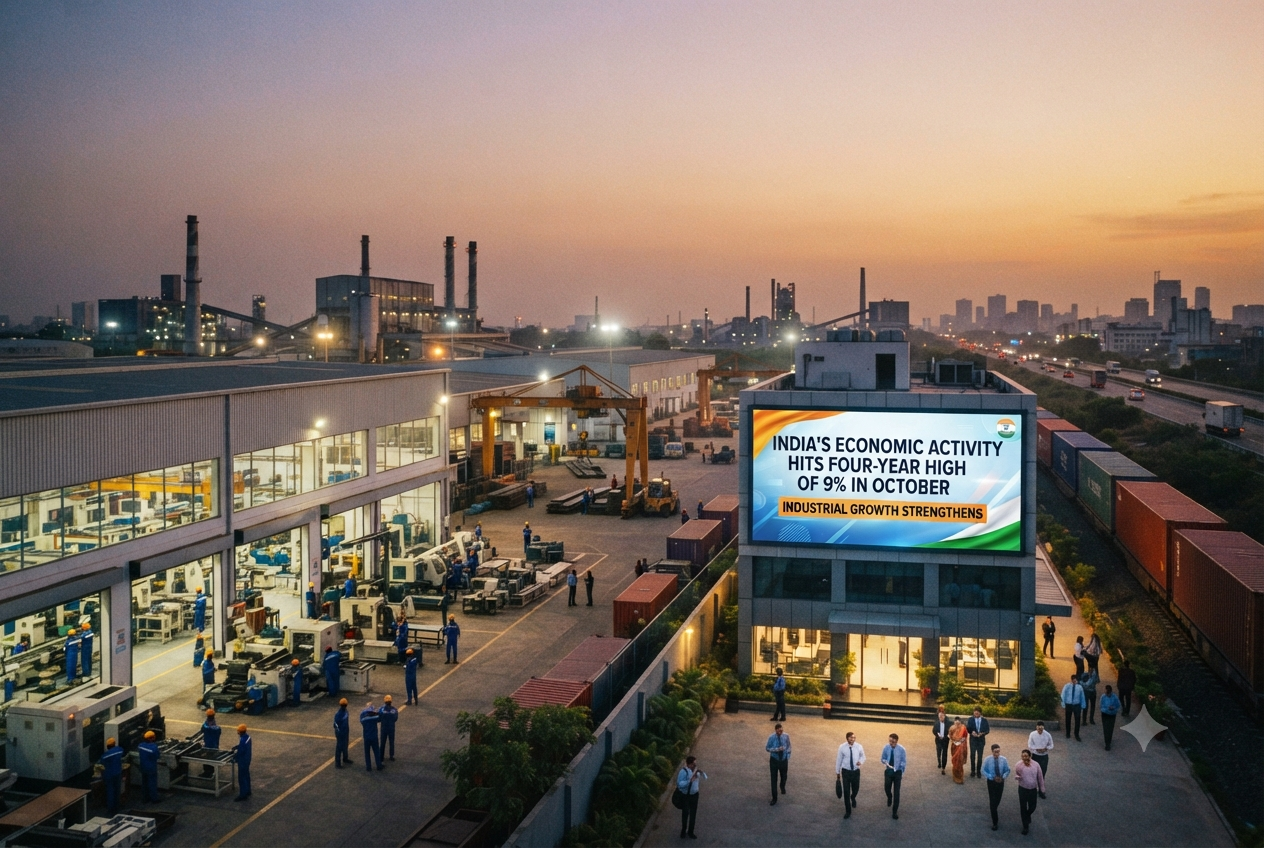
India’s economic activity growth reached a four-year high of 9% year-on-year in October 2026, supported by stronger industrial performance, increased infrastructure-related activity and festive-season demand, according to a report by global brokerage firm Jefferies.
The Jefferies Economic Indicator (JEI), which tracks 35 monthly indicators to assess economic momentum, improved by 2.2 percentage points month-on-month during October. Several industrial and transportation-related measures recorded multi-year highs, indicating stronger activity across important segments of the economy.
However, the report also highlights an uneven economic picture. While industrial indicators and bank lending remained strong, rural demand continued to face pressure following a subdued monsoon. Rising inflation and changing consumer spending patterns could also affect the sustainability of economic momentum in the coming months.
Importantly, the 9% figure represents growth in Jefferies’ economic activity indicator, not India’s official GDP growth rate.
Industrial Activity Drives October’s Economic Momentum
Industrial performance was a major contributor to the improvement in October’s economic indicators.
Electricity demand increased by 22% year-on-year, marking its strongest growth in approximately 15 years, excluding the exceptional post-pandemic surge in April 2021. Higher electricity consumption reflects increased requirements from industrial operations and broader commercial activity.
Diesel demand growth reached 12%, its highest level in approximately three-and-a-half years. Diesel consumption is closely associated with transportation, logistics, construction, agriculture and manufacturing, making it an important indicator of economic activity.
Port traffic growth also strengthened, reaching 19% and marking a three-year high. Increased port activity points towards stronger movement of goods through India’s trade and logistics networks.
Capital expenditure-related indicators remained encouraging. Cement production increased by 15%, while steel consumption grew by 7% during October. These trends suggest continued activity in construction, infrastructure development and industrial projects.
Together, the indicators point towards a strong contribution from manufacturing, infrastructure and transportation-related sectors.
Festive Demand Provides an Additional Boost
The timing of the festive season also influenced October’s economic performance.
Jefferies observed that the delayed onset of the festive season shifted some Diwali-related activity and industrial shutdowns into November. This timing supported production and commercial activity during October, potentially creating scope for some moderation in the following month.
Consumer spending indicators presented a mixed picture. The value of Unified Payments Interface (UPI) transactions during the festive period increased by approximately 18% year-on-year, reflecting continued activity in digital payments and consumer transactions.
However, retail sales performance varied across product categories. Two-wheeler retail sales grew by 4%, while passenger vehicle retail sales declined by 7%.
Selected consumer electronics categories, particularly smartphones, also experienced pressure on sales volumes because of sharp price increases.
These differences indicate that festive consumption remained active but was not equally strong across the consumer market. Businesses will therefore need to assess demand across individual product categories rather than rely solely on broader spending indicators.
Rural Demand Remains a Key Weakness
Despite the improvement in overall economic activity, rural demand continued to be a concern.
Jefferies attributed subdued rural indicators partly to weaker monsoon conditions, which have affected agricultural income and household purchasing power.
Rural wage growth stood at 3.3% year-on-year in September 2026, close to a five-year low. At the same time, rising rural inflation has placed pressure on real wages, limiting the ability of households to increase discretionary spending.
Demand for work under the rural employment guarantee programme increased by approximately 82% year-on-year. This rise may indicate greater reliance on employment support amid pressure on rural livelihoods.
Weak rural consumption can affect demand for two-wheelers, consumer goods, agricultural equipment and other products that depend significantly on rural purchasing power.
A broader improvement in rural incomes will therefore be important for making India’s economic expansion more balanced and sustainable.
Bank Credit Growth Reaches a Nearly 12-Year High
Another important development highlighted in the Jefferies report was the acceleration in bank credit growth to 19.5%, its highest level in nearly 12 years.
Stronger lending activity indicates increased demand for financing from households and businesses. Credit availability can support business expansion, working capital requirements, infrastructure investment and consumer purchases.
However, deposit growth moderated to 17%, creating a gap between the pace of lending and deposit expansion.
The report also highlighted a shift in banking system liquidity. Liquidity moved into a deficit of approximately ₹10,000 crore, compared with an average surplus of ₹2.4 lakh crore in October.
This change followed the Reserve Bank of India’s move towards a calibrated tightening stance. The development makes liquidity management increasingly important for banks as lending activity expands.
Although higher credit growth can support economic expansion, sustained lending will need to be accompanied by adequate deposit mobilisation, stable funding conditions and prudent assessment of loan quality.
Inflationary Pressures Complicate the Outlook
Rising inflation remains one of the most significant challenges for India’s economic outlook.
According to Jefferies, wholesale inflation reached 12.2%, close to a four-year high, while retail inflation increased to 6.1%, its highest level in approximately two years.
Higher prices can reduce household purchasing power and increase operating expenses for businesses. Rising food, fuel, transportation and industrial input costs may influence both consumer demand and corporate profitability.
The combination of strong credit growth and increasing inflation also presents a challenge for monetary policymakers. The Reserve Bank of India must balance the need to support economic activity with its responsibility to maintain price stability and manage financial conditions.
If inflationary pressures persist, the central bank may need to maintain a cautious policy approach. However, tighter monetary conditions could eventually increase borrowing costs and influence investment and consumption decisions.
India’s Economic Outlook: Strong Growth but Uneven Recovery
October’s indicators demonstrate that India’s economy continues to benefit from industrial activity, infrastructure-related demand and financial sector expansion.
Nevertheless, the contribution of festive-season timing, weak rural purchasing power and rising inflation suggest that the improvement is not uniform across all parts of the economy.
For businesses, the coming months will be important in determining whether industrial momentum continues after the festive season. Consumer companies will need to monitor differences between urban and rural demand, while banks will face the challenge of balancing credit expansion with funding and liquidity requirements.
Investors and policymakers will closely follow industrial production, inflation, bank lending, deposit growth and household consumption to assess the durability of October’s improvement.
The Worldonomics Times View
India’s 9% economic activity growth in October is an encouraging indication of stronger industrial and commercial momentum. Higher electricity demand, diesel consumption, port traffic and infrastructure-related indicators point towards improvement across several important sectors.
However, the headline figure requires careful interpretation because it is based on Jefferies’ 35-indicator economic activity index and does not represent official GDP growth.
Weak rural demand remains an important concern. Economic expansion becomes more sustainable when improvements in industrial production are accompanied by stronger household incomes and consumption across both urban and rural markets.
Inflation also requires close attention, as rising prices can reduce purchasing power and increase business costs. Meanwhile, rapid bank credit expansion will need to be supported by adequate deposits and stable liquidity conditions.
Conclusion: India’s economic activity indicator reached a four-year high of 9% in October 2026, supported by industrial strength, festive-season effects and robust bank credit growth. However, subdued rural demand, rising inflation and tighter banking liquidity present challenges for the months ahead. The sustainability of this momentum will depend on whether industrial growth translates into broader consumption gains and more balanced economic expansion.