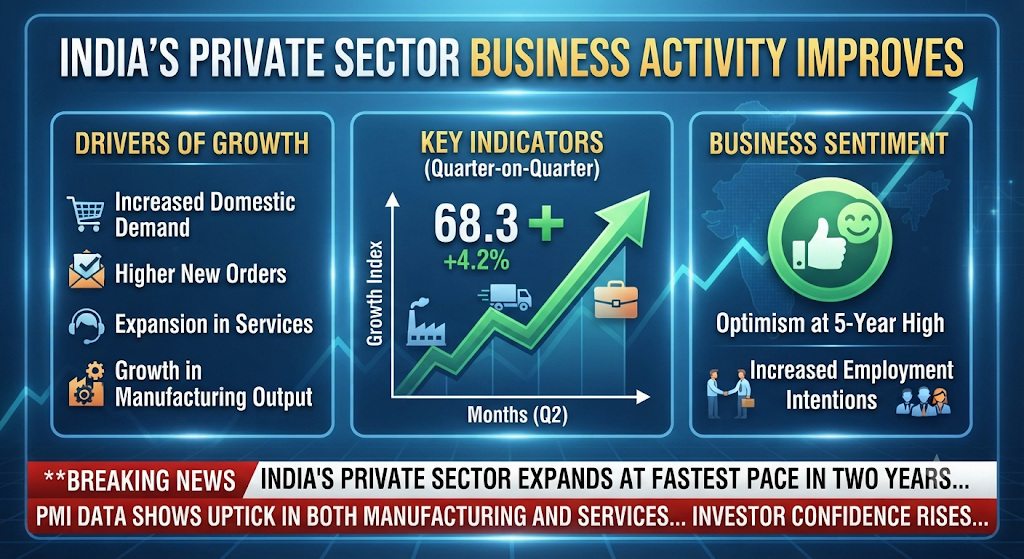
India’s private sector activity strengthened in November 2026, supported by accelerating manufacturing output, stronger domestic demand and a recovery in export orders. The HSBC Flash India Composite Purchasing Managers’ Index (PMI) rose to 56.3 from 56.2 in October, indicating continued expansion in business activity.
The latest reading reflects a modest improvement in overall private-sector momentum, with manufacturing emerging as the principal growth driver. The manufacturing PMI climbed to a nine-month high, supported by increasing production, new customer orders and improved business conditions.
However, growth across the services sector moderated during the month. Employment trends also remained uneven, with manufacturers increasing recruitment while service providers recorded a marginal decline in staffing.
The survey suggests that India’s private sector continues to expand, although the strength of the recovery varies across industries.
Manufacturing Growth Reaches a Nine-Month High
Manufacturing activity recorded a notable improvement in November, with the HSBC Flash India Manufacturing PMI increasing to 56.0 from 54.7 in October.
This was the strongest reading in nine months and indicated a faster expansion in factory activity.
The manufacturing output index also increased to 58.3 from 57.0, reflecting stronger production across industrial businesses.
Improved domestic demand, rising new orders and the acquisition of new customers contributed to the stronger performance. Businesses reported improved demand conditions across several industries, including pharmaceuticals, healthcare, chemicals, electronic components, metals, power transmission equipment and infrastructure-related sectors.
Manufacturers also increased their purchases of raw materials and built inventories in response to stronger demand expectations.
The improvement is significant because manufacturing plays an important role in supporting industrial investment, employment, exports and supply-chain activity. Sustained growth in factory production could also create additional demand for transportation, logistics, energy and business services.
Export Orders Recover as International Demand Improves
Another encouraging development in the November PMI survey was the improvement in export demand.
New export orders across manufacturing and services increased at their fastest pace in four months, indicating stronger international demand for Indian goods and services.
Manufacturing businesses reported an improvement in overseas orders, while service providers also recorded stronger export business.
The recovery in export orders provides an additional source of support for private-sector activity, particularly as companies seek to diversify their customer base and expand their international presence.
Export-oriented manufacturers may benefit from stronger demand for pharmaceuticals, chemicals, engineering products and electronic components.
For service providers, improving international business could support opportunities in information technology, financial services and other professional activities.
However, the pace of export-order growth in manufacturing moderated slightly compared with the previous month. This suggests that although international demand improved overall, the recovery was not equally strong across all export categories.
Services Sector Growth Moderates
While manufacturing gained momentum, the services sector recorded a slower pace of expansion.
The HSBC Flash India Services Business Activity Index declined to 55.3 in November from 55.8 in October.
Although the index remained comfortably above the 50-point threshold that separates expansion from contraction, the decline indicated that services activity was growing at a slower rate.
The moderation suggests that the improvement in India’s overall private-sector PMI was driven primarily by manufacturing rather than a simultaneous acceleration across both major sectors.
Nevertheless, domestic demand for services remained relatively steady, while international orders improved.
The contrasting performance of manufacturing and services highlights the importance of examining sector-specific trends when assessing the broader economic outlook.
Services remain a major contributor to India’s economic output and employment. A sustained slowdown in the sector could therefore affect business confidence, recruitment and overall economic momentum if manufacturing growth does not remain sufficiently strong.
Employment Growth Remains Uneven
Employment trends presented a mixed picture in November.
Manufacturing companies increased their workforce at the fastest pace in seven months, reflecting stronger production requirements and improved order volumes.
In contrast, services companies recorded a marginal reduction in employment. This was the first decline in services-sector staffing in nearly a year, according to the survey findings.
As a result, overall private-sector employment increased only slightly.
The difference between the two sectors indicates that stronger factory activity has not yet translated into equally strong recruitment across the wider economy.
Employment growth will remain an important indicator to monitor because sustained expansion requires businesses to increase production capacity, hire workers and generate additional household income.
If manufacturing demand remains strong, industrial recruitment could improve further. However, a continued moderation in services hiring may limit the broader employment benefits of economic expansion.
Input Costs Remain Relatively Subdued
The November survey also indicated that input-cost pressures remained relatively mild across India’s private sector.
Manufacturers and service providers reported only modest increases in operating expenses, providing some relief to businesses managing production and service-delivery costs.
At the same time, companies increased their selling prices at a somewhat faster pace than in October.
Although output-price inflation remained modest compared with its historical trend, the increase suggests that businesses were gradually passing some additional costs on to customers.
Relatively subdued input inflation can support corporate margins, particularly for companies facing competition and limited pricing flexibility.
However, businesses will need to monitor changes in raw material prices, energy costs, transportation expenses and wage pressures to assess whether the current cost environment remains favourable.
Business Confidence Improves but Remains Cautious
Business confidence strengthened in November, reaching its highest level since May 2026.
The improvement reflects better demand conditions, stronger manufacturing performance and expectations of continued business expansion.
Nevertheless, confidence remained below its long-term average, suggesting that companies are not yet fully convinced that the current momentum will translate into a stronger sustained recovery.
Outstanding business volumes declined for the second consecutive month, largely because of a reduction in unfinished work among service providers.
Manufacturers, meanwhile, reported a marginal increase in backlogs.
These trends suggest that businesses are experiencing improved new-order activity, but the ability to convert demand into sustained production and revenue growth will remain important.
Implications for India’s Economic Outlook
The November PMI reading provides an encouraging indication of continued private-sector expansion in India.
Stronger manufacturing output and improving export orders could support industrial production, investment activity and demand across supply chains.
Manufacturing companies may benefit from increased order volumes and improved capacity utilisation, while logistics providers and suppliers of industrial inputs could gain from stronger factory activity.
However, the slower expansion in services and relatively weak employment growth indicate that the improvement remains uneven.
For policymakers, the latest figures offer evidence of continued economic resilience but also underline the importance of encouraging job creation and maintaining demand across both manufacturing and services.
Investors will monitor upcoming PMI readings, industrial production figures, export data and employment trends to determine whether the manufacturing-led improvement can be sustained.
The Worldonomics Times View
India’s November PMI performance demonstrates that the private sector continues to expand, with manufacturing providing a stronger contribution to economic activity. The rise in the composite index to 56.3 and the manufacturing PMI to a nine-month high of 56.0 indicate improving business conditions.
The recovery in export orders is another positive development, suggesting that international demand is providing additional support to Indian companies.
However, the moderation in services activity and uneven employment trends deserve attention. Manufacturing growth is important, but a sustainable economic expansion also requires stronger services activity, broader recruitment and consistent domestic consumption.
The improvement in business confidence offers encouragement, although companies will need to see sustained order growth before making significant long-term investment and hiring commitments.
Conclusion: India’s private sector activity strengthened in November 2026 as manufacturing output accelerated and export orders recovered. The HSBC Flash Composite PMI rose to 56.3, while manufacturing reached a nine-month high. However, slower services growth and modest overall employment gains highlight the uneven nature of the expansion. The coming months will be important in determining whether stronger factory activity can translate into broader economic growth and more substantial job creation.