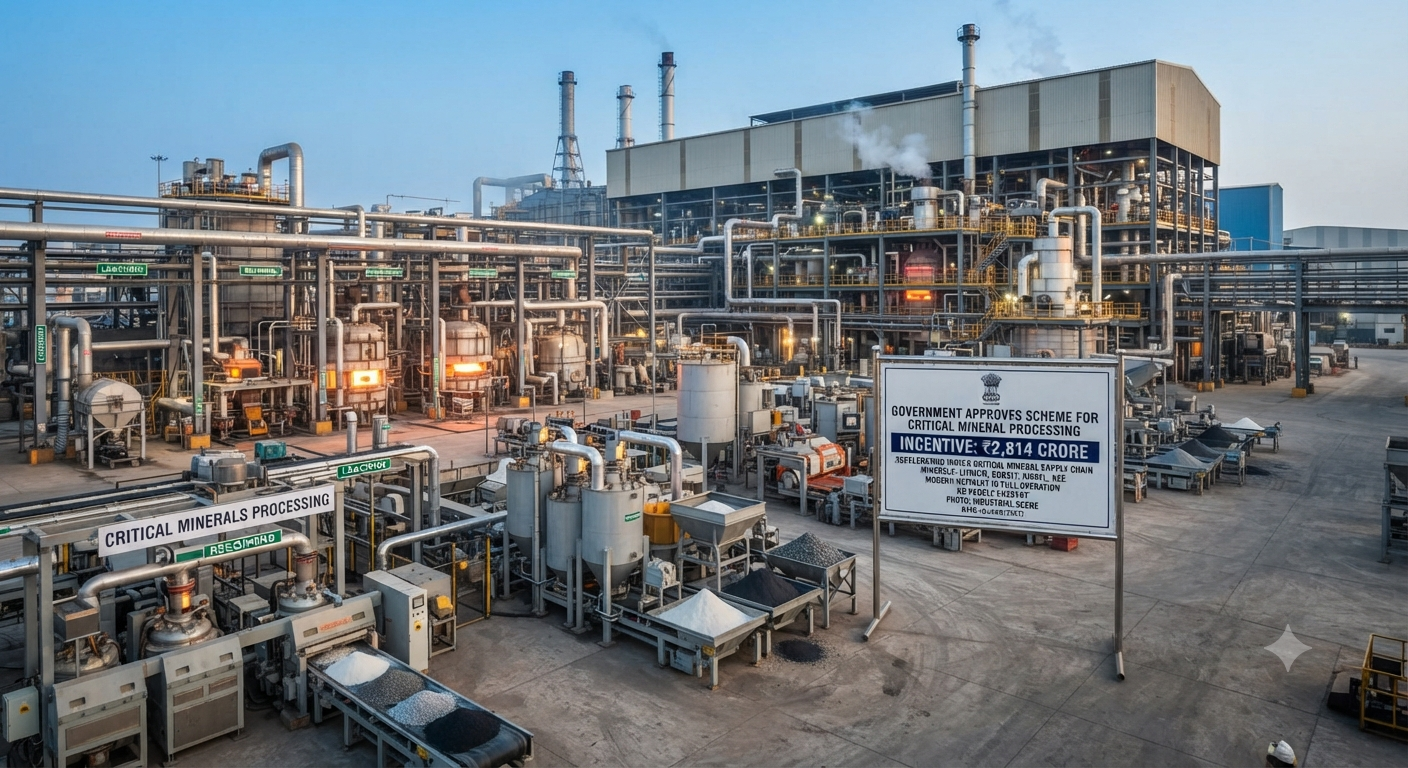
India has taken another step towards strengthening its domestic critical mineral industry, with the Union Cabinet approving a ₹2,814 crore Capital Expenditure (CAPEX) Support Scheme to promote lithium and nickel processing. The five-year initiative aims to reduce dependence on imported refined minerals, encourage domestic manufacturing and build more resilient supply chains for strategically important industries.
Approved on November 4, 2026, the scheme will run from FY 2026–27 to FY 2030–31. It will provide capital subsidies to establish four processing plants, comprising two lithium facilities and two nickel facilities.
The initiative is expected to attract approximately ₹10,000 crore in investment and support sectors such as electric vehicles (EVs), battery energy storage, electronics, defence and speciality steel.
₹2,814 Crore Scheme Focuses on Lithium and Nickel
The government’s new programme is designed to address a major gap in India’s critical mineral value chain: domestic processing capacity.
Although India has identified 24 critical minerals as strategically important, its requirements for several refined intermediates and high-purity materials continue to depend substantially on imports.
The scheme specifically targets lithium and nickel processing because both minerals are essential to modern manufacturing and clean energy technologies.
Lithium is a key raw material for rechargeable batteries used in electric vehicles and energy storage systems. Nickel is used in several battery chemistries and is also important for stainless steel and speciality industrial applications.
The programme will support the development of four processing facilities:
- Two lithium processing plants: Each will have a minimum processing capacity of 30,000 tonnes.
- Two nickel processing plants: Each will have a minimum processing capacity of 50,000 tonnes.
The facilities will process lithium and nickel ores or intermediate products into high-purity materials suitable for industrial applications. Nickel processing is also expected to enable the recovery of cobalt as a by-product.
How the 30% Capital Subsidy Will Work
A central feature of the programme is the provision of a capital subsidy covering 30% of eligible investment in the selected processing projects.
The government has established separate financial limits for lithium and nickel facilities.
| Project category | Maximum capital support |
|---|---|
| Lithium processing beneficiary | ₹500 crore |
| Nickel processing beneficiary | ₹900 crore |
| Total support for four plants | ₹2,800 crore |
| Administrative expenses | ₹14 crore |
| Total scheme outlay | ₹2,814 crore |
The scheme will be fully funded through government budgetary support.
The financial assistance is intended to reduce the high initial investment required to establish commercial-scale processing facilities. Such projects often involve specialised equipment, advanced processing technologies, technical expertise and reliable access to raw materials.
By reducing part of the initial capital burden, the government hopes to make domestic processing projects more commercially attractive and encourage private-sector participation.
Competitive Selection and Milestone-Based Payments
The government will select beneficiaries through a two-stage competitive process.
In the first stage, applications will undergo technical evaluation. Only companies meeting the required technical qualifications will be allowed to participate in the financial bidding stage.
In the second stage, eligible applicants will submit bids based on the amount of capital support they require. Selection will follow a least-cost criterion, giving preference to qualified bidders seeking the lowest government assistance.
Two beneficiaries will be selected for each mineral, resulting in four supported processing projects.
The incentives will be released in three instalments linked to the achievement of specified project milestones. This approach is intended to connect financial assistance with actual progress in project development and implementation.
The milestone-based structure also provides a mechanism for monitoring project execution and ensuring that public funds support the establishment of operational processing capacity.
Reducing India’s Dependence on Imported Critical Minerals
India’s dependence on imported refined mineral materials creates vulnerabilities for industries that require consistent supplies of high-purity inputs.
Critical mineral processing remains geographically concentrated in a limited number of countries. This concentration exposes international supply chains to geopolitical tensions, export restrictions, price fluctuations and disruptions in transportation or trade.
For India, expanding domestic processing capacity could help reduce some of these vulnerabilities.
However, establishing processing plants is only one part of building a complete mineral value chain. The country will also need reliable access to mineral resources, suitable extraction and beneficiation technologies, infrastructure, skilled workers and long-term supply agreements.
The new scheme is therefore aimed at strengthening domestic value addition rather than simply increasing mineral extraction.
Developing processing capabilities within India could allow more value to be retained domestically before refined materials enter manufacturing supply chains.
Opportunities for Electric Vehicles and Battery Manufacturing
The electric vehicle industry is among the major potential beneficiaries of stronger domestic lithium and nickel processing.
Lithium-based batteries are widely used in electric cars, two-wheelers, buses and stationary energy storage systems. Nickel is an important material in several high-energy-density battery chemistries.
A more reliable domestic supply of processed materials could support battery manufacturers and reduce exposure to international supply disruptions.
The scheme may also complement India’s broader efforts to expand battery manufacturing, electric mobility infrastructure and renewable energy storage.
For companies operating in the battery ecosystem, the availability of locally processed inputs could create opportunities to develop stronger domestic sourcing networks.
Nevertheless, the impact will depend on the eventual commissioning of the supported facilities, the quality and cost competitiveness of their products, and the ability of manufacturers to secure consistent raw material supplies.
Strategic Importance for Electronics and Defence
Beyond electric mobility, lithium and nickel processing has wider industrial and strategic importance.
Electronics manufacturers require specialised materials for components, energy storage systems and advanced equipment. Reliable access to critical minerals can therefore contribute to the resilience of electronics manufacturing supply chains.
The defence sector also depends on specialised materials used in equipment, advanced systems and industrial applications. Reducing external supply vulnerabilities can support domestic production capabilities in strategically important areas.
Nickel processing and the expected recovery of cobalt may also contribute to the availability of materials required by battery, metallurgical and other industrial applications.
The initiative could therefore benefit multiple sectors rather than being limited to the electric vehicle market.
Investment Opportunities and Challenges
The scheme is expected to anchor approximately ₹10,000 crore in investment, potentially creating opportunities for engineering companies, industrial equipment manufacturers, technology providers and project developers.
Businesses involved in mineral processing equipment, chemical engineering, industrial automation, environmental management and infrastructure development may benefit from new project requirements.
However, several challenges will influence the programme’s success.
First, domestic processing facilities will require access to suitable lithium and nickel feedstock. The availability of raw materials and reliable procurement arrangements will be essential for maintaining plant utilisation.
Second, processing technologies must meet industrial quality standards while remaining cost-effective. Indian companies may need to develop technical partnerships and acquire specialised expertise.
Third, projects must comply with environmental regulations, including requirements relating to water consumption, waste management and industrial emissions.
Finally, domestic processors will need to compete with established international suppliers. Government support can reduce initial investment costs, but long-term competitiveness will depend on productivity, technology and operating efficiency.
The Worldonomics Times View
The ₹2,814 crore CAPEX Support Scheme represents an important move towards building India’s domestic critical mineral processing ecosystem. Its focus on lithium and nickel addresses two important materials required by the country’s growing electric mobility, battery storage and advanced manufacturing industries.
The 30% capital subsidy, competitive selection process and milestone-linked disbursement mechanism provide a structured framework for encouraging private investment in processing infrastructure.
The expected investment of approximately ₹10,000 crore also indicates the potential scale of industrial activity that the programme could support.
However, reducing import dependence will require more than establishing four processing plants. India must also strengthen raw material sourcing, technology capabilities, environmental standards and commercial competitiveness.
Conclusion: The Union Cabinet’s approval of the ₹2,814 crore incentive scheme marks a significant step towards strengthening India’s critical mineral supply chain. By supporting two lithium and two nickel processing plants, the programme aims to increase domestic value addition, reduce reliance on imported refined materials and support industries ranging from electric vehicles and battery manufacturing to electronics and defence. Its long-term success will depend on timely project execution, reliable mineral supplies and the ability of domestic processors to compete in global markets.