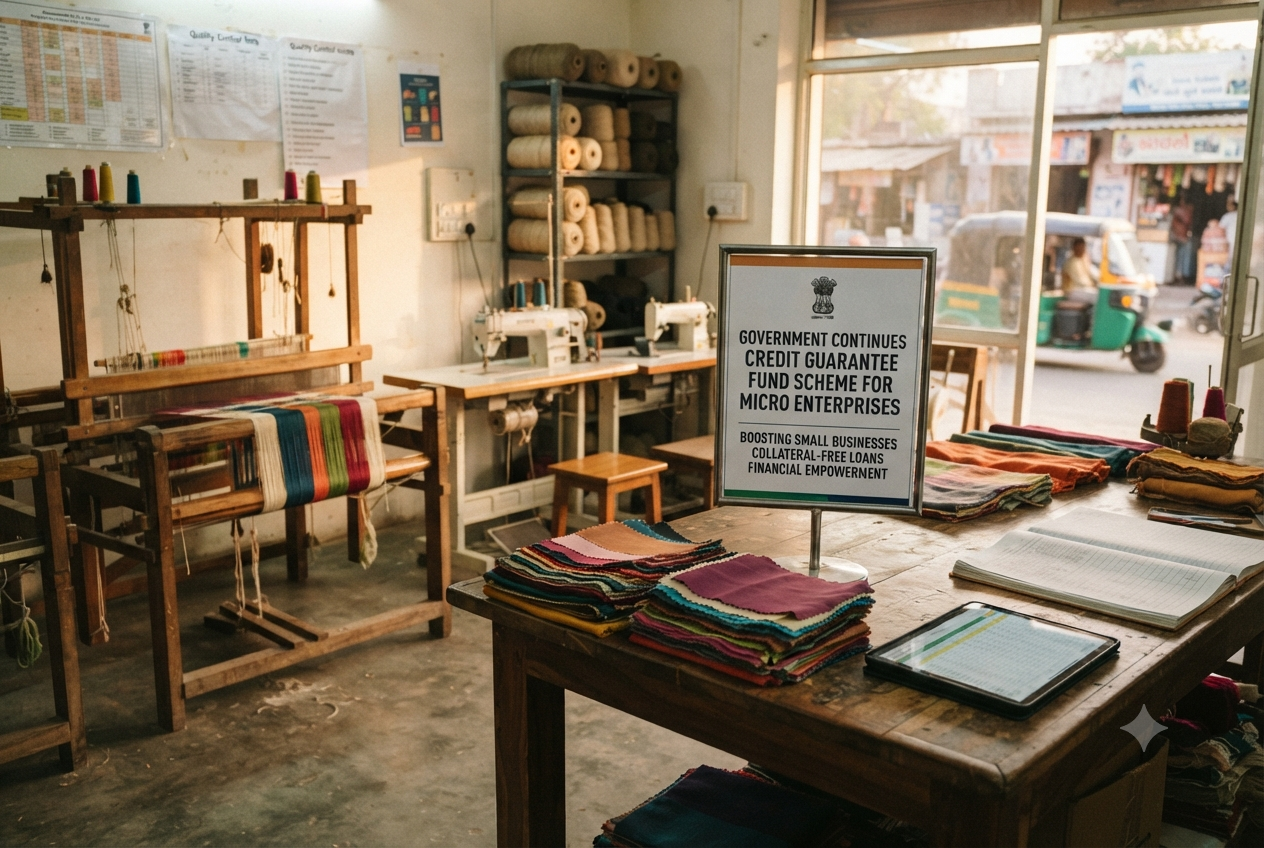
India’s efforts to strengthen credit access for small businesses and micro-enterprises have received a fresh boost, with the Union Cabinet approving the continuation of the Credit Guarantee Fund for Micro Units (CGFMU) for another five years until March 31, 2031. The initiative is designed to encourage lending to micro-enterprises by providing credit guarantee support to financial institutions against the risk of loan defaults.
Approved on November 11, 2026, the extension includes a ₹5,000 crore corpus and is expected to facilitate approximately ₹12.6 lakh crore in loans under the Pradhan Mantri Mudra Yojana (PMMY) over the next five years. The decision aims to strengthen collateral-free lending, expand formal credit access and encourage entrepreneurship across India’s micro-business sector.
Five-Year Extension with a ₹5,000 Crore Corpus
The Credit Guarantee Fund for Micro Units was launched in January 2016 to support the expansion of credit to micro-businesses under the Pradhan Mantri Mudra Yojana.
Under the extended framework, the scheme will remain applicable to eligible loans sanctioned during the 16th Finance Commission period, covering FY 2026–27 to FY 2030–31.
The approved ₹5,000 crore corpus will support the credit guarantee mechanism managed through the National Credit Guarantee Trustee Company Limited (NCGTC). Rather than directly providing loans to businesses, the fund offers guarantee coverage to eligible lending institutions against specified credit defaults.
This arrangement is intended to give banks and other financial institutions greater confidence when extending loans to small businesses that may not have sufficient collateral or established credit histories.
The government expects the extended scheme to facilitate ₹12.6 lakh crore in PMMY lending during the five-year period, creating opportunities for new and existing micro-enterprises to access institutional finance.
Which Loans Are Covered Under the Scheme?
The continued CGFMU framework provides guarantee support for specified credit facilities. These include:
- PMMY micro-enterprise loans: Eligible loans of up to ₹20 lakh extended under the Pradhan Mantri Mudra Yojana.
- Jan Dhan overdraft facilities: Overdrafts of up to ₹10,000 provided by banks through Pradhan Mantri Jan Dhan Yojana accounts.
- Self-Help Group loans: Eligible loans where the SHG portfolio is between ₹10 lakh and ₹20 lakh.
For PMMY loans above ₹10 lakh and up to ₹20 lakh, eligibility is subject to the applicable Tarun-category repayment condition. Borrowers must have previously availed a Tarun loan and successfully repaid it.
The scheme covers eligible lending by banks, non-banking financial companies, microfinance institutions and other qualifying financial intermediaries.
This broad framework connects credit guarantee support with different forms of small-scale economic activity, including individual micro-businesses and group-based enterprises.
Lower Guarantee Fees to Encourage Lending
One of the notable changes under the extended scheme is the reduction in the annual guarantee fee for PMMY micro loans.
The fee has been reduced from 1% per annum to 0.75% per annum. The government has retained the existing fee structure for eligible Self-Help Group loans.
| Loan category | Annual guarantee fee |
|---|---|
| PMMY micro loans | 0.75% per annum |
| Eligible SHG loans – first year | 0.25% |
| Eligible SHG loans – subsequent years | 0.50% |
The lower guarantee fee is intended to make the guarantee mechanism more affordable for lending institutions and support continued credit flow to micro-enterprises.
The guarantee calculation will also reflect the actual exposure of lenders. For working capital facilities, coverage will be linked to the amount disbursed, while for term loans it will be linked to the outstanding loan amount.
This approach is designed to align guarantee support more closely with the financial risk carried by lending institutions.
Strengthening the Pradhan Mantri Mudra Yojana
The continuation of CGFMU is closely connected to the broader objectives of the Pradhan Mantri Mudra Yojana, which seeks to provide formal credit to small and micro-businesses.
Since the launch of PMMY in 2015, lending institutions had sanctioned more than 60.36 crore loans amounting to ₹43.34 lakh crore as of September 2026, according to government figures.
The credit guarantee mechanism has supported this expansion by helping lenders extend collateral-free loans to eligible borrowers.
For small entrepreneurs, access to formal finance can help meet business requirements such as purchasing equipment, acquiring inventory, managing working capital and setting up commercial operations.
The continuation of the scheme is expected to maintain this support and encourage more entrepreneurs to approach formal financial institutions rather than depending entirely on informal sources of credit.
Opportunities for Micro Enterprises and Small Businesses
Micro-enterprises form an important part of India’s business ecosystem. They operate across manufacturing, services, retail trade and agriculture-related activities, contributing to local employment and economic activity.
However, many small businesses face challenges in obtaining institutional loans because of limited collateral, irregular cash flows or a lack of formal financial documentation.
The CGFMU framework seeks to address part of this financing gap by reducing the risk faced by eligible lenders.
Greater access to formal credit could help businesses:
- Establish new commercial operations.
- Purchase machinery, tools and business equipment.
- Expand inventory and working capital.
- Improve production capacity and service delivery.
- Build a formal banking and credit history.
The scheme may also benefit first-generation entrepreneurs who have viable business ideas but limited access to traditional financing.
Role of Banks and Financial Institutions
Banks and other eligible financial institutions will remain central to the implementation of the scheme.
They will assess loan applications, evaluate repayment capacity and determine whether borrowers meet the relevant lending criteria. The credit guarantee provides protection against a specified portion of eligible default risk, but it does not eliminate the need for proper credit assessment.
The guarantee mechanism is also not a direct subsidy or a waiver of repayment obligations. Borrowers remain responsible for repaying their loans according to the agreed terms.
For the scheme to achieve its objectives, financial institutions will need to improve awareness, simplify application processes where possible and reach eligible entrepreneurs in smaller towns and underserved areas.
Employment Generation and Inclusive Economic Growth
Improved access to micro-enterprise finance can have wider economic implications.
Small businesses often create employment opportunities within local communities and support networks of suppliers, distributors and service providers. When businesses obtain finance to establish or expand operations, they may increase production, hire additional workers and serve new markets.
The extended credit guarantee scheme could therefore contribute to employment generation and local economic development.
Its impact will depend on whether loans reach businesses with viable plans and whether borrowers receive the financial and operational support needed to sustain their enterprises.
Monitoring loan performance, business growth and employment outcomes will be important in assessing the effectiveness of the extended framework.
The Worldonomics Times View
The continuation of the Credit Guarantee Fund for Micro Units represents an important step in maintaining institutional credit support for India’s micro-enterprise sector. The ₹5,000 crore corpus, five-year extension and reduction in the annual guarantee fee for PMMY loans provide a framework intended to encourage further lending to small businesses.
The projected ₹12.6 lakh crore in PMMY loans highlights the scale of financing the government expects the mechanism to facilitate. However, the success of the scheme should not be measured by loan volumes alone.
Ensuring that credit reaches viable businesses, particularly first-time entrepreneurs and enterprises with limited access to formal finance, will be equally important. Responsible lending, financial awareness and timely repayment will remain essential to the long-term sustainability of the programme.
Conclusion: The Union Cabinet’s approval to continue the Credit Guarantee Fund for Micro Units until March 31, 2031, reinforces India’s efforts to expand collateral-free institutional finance for micro-enterprises. With a ₹5,000 crore corpus and an expected ₹12.6 lakh crore in loans under PMMY over five years, the initiative aims to support business creation, strengthen small enterprises and encourage employment generation. Its long-term impact will depend on effective implementation, responsible lending and the ability of micro-businesses to convert access to finance into sustainable growth.