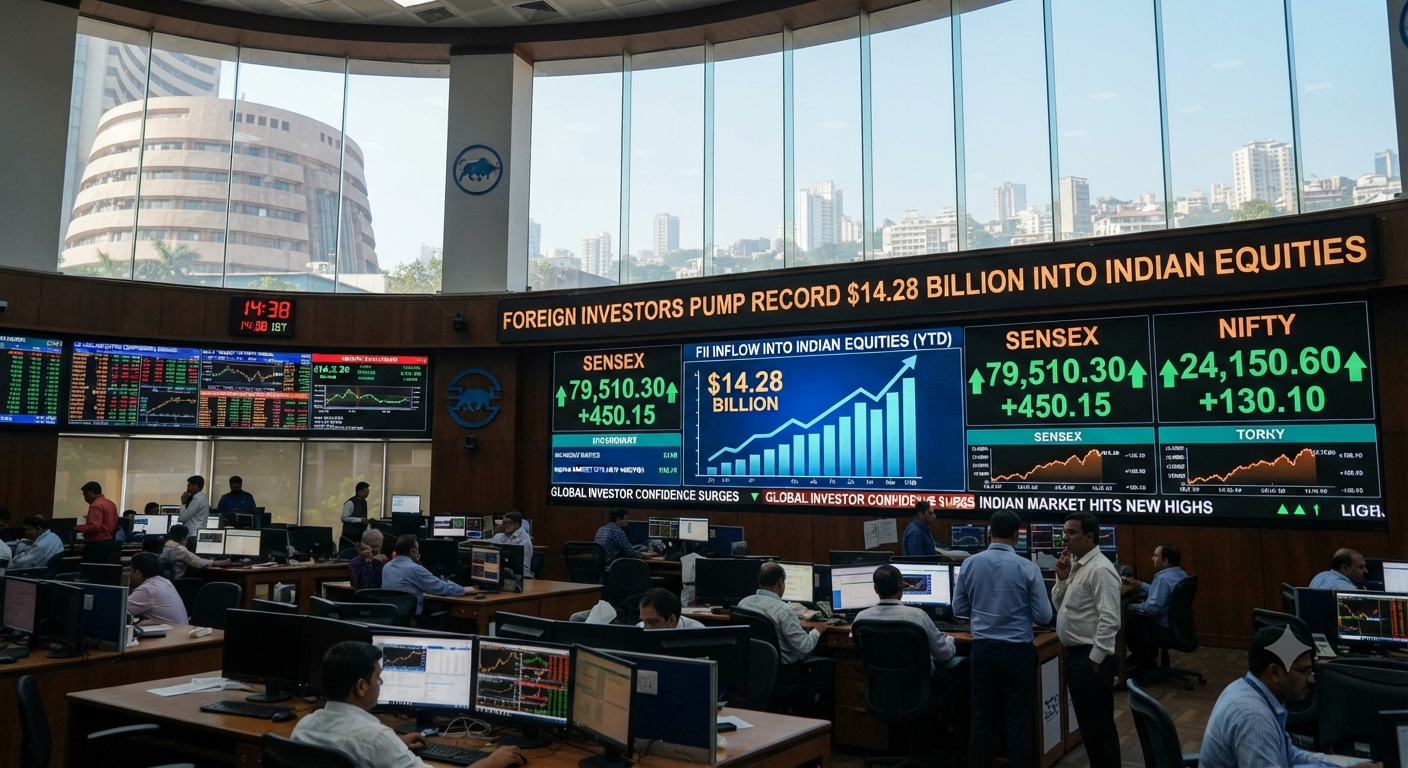
Foreign institutional investors have made a powerful return to the Indian stock market, investing a record $14.28 billion in Indian equities during November 2026 so far. The renewed inflows signal a significant shift in global investment sentiment, with international funds increasingly looking towards India as they reassess their exposure to artificial intelligence-linked stocks and other overseas markets.
The record investment has provided a major boost to domestic equities, supporting a recovery in benchmark indices and strengthening demand for large-cap companies. According to Reuters, the November inflows had reached $14.28 billion by November 25, making the month one of the strongest periods for foreign investment in India’s equity market.
The development is particularly significant because foreign investors had withdrawn substantial capital from Indian equities over the preceding months. Their return suggests that changing global market dynamics, improving corporate earnings and India’s economic growth prospects are influencing international investment decisions.
Record Foreign Investment Inflows During November
Foreign portfolio investors (FPIs) have emerged as major net buyers of Indian equities during November.
Data compiled from NSDL reporting showed net foreign equity inflows of approximately ₹1.34 lakh crore, equivalent to around $14.28 billion, during the month up to November 23. The figures indicate a sharp reversal from the selling pressure that characterised much of the earlier part of 2026.
The scale of the investment is notable when compared with the previous months. Foreign investors recorded net equity outflows during several months of 2026, including substantial withdrawals in March, April, June, September and October.
The latest buying trend therefore represents more than a short-term increase in market participation. It reflects a broader change in the allocation of international investment capital towards Indian equities.
However, the $14.28 billion figure represents inflows recorded during November up to the reported date, rather than a final full-month total.
Global Funds Rotate Away from AI-Linked Stocks
One of the important factors behind the renewed foreign interest in India is the changing investment environment in global markets.
Over the past two years, international funds had directed substantial capital towards companies and markets associated with artificial intelligence, semiconductor manufacturing and advanced technology infrastructure.
However, concerns over valuations, market concentration and the sustainability of AI-related investment returns have encouraged some investors to reconsider their portfolios.
Reuters reported that foreign investors were returning to India after previously shifting capital towards markets closely connected with the global AI supply chain. The latest investment trend indicates that some funds are seeking to diversify their exposure and identify opportunities outside highly concentrated technology-related positions.
India’s relatively broad domestic economy, expanding consumption market and established financial services sector make it an alternative destination for international investors seeking geographical diversification.
This does not necessarily mean that global funds are abandoning artificial intelligence investments altogether. Rather, investors appear to be reassessing the balance between technology-heavy markets and economies offering different sources of growth.
India’s Economic and Corporate Earnings Outlook Supports Confidence
Improving corporate earnings have also contributed to the renewed interest in Indian equities.
Reuters reported that Indian corporate earnings recorded their strongest performance in four years, providing an important foundation for the market’s recovery.
Stronger earnings can improve investor confidence by demonstrating that listed companies are generating better financial results and maintaining growth opportunities. For foreign institutional investors, earnings visibility is an important consideration when deciding where to allocate capital.
India’s domestic consumption, infrastructure investment, financial services expansion and manufacturing activity continue to provide potential growth opportunities across multiple sectors.
The country’s economic growth outlook is another factor supporting investor interest. Reuters reported that India’s economy was forecast to expand by 7.6% in the July-September quarter, reinforcing expectations of relatively strong economic activity.
Nevertheless, investors will continue to assess whether earnings growth can be sustained and whether corporate valuations remain attractive compared with other international markets.
Banking and Financial Stocks Benefit from Foreign Buying
The renewed foreign investment has supported several major sectors of the Indian stock market, particularly banking and financial services.
Large financial institutions are important components of benchmark indices and often attract significant institutional investment because of their market size, liquidity and role in the domestic economy.
During Wednesday’s market rally on November 25, HDFC Bank and ICICI Bank each gained approximately 3.5%, while financial stocks led sectoral advances. The broader recovery also included gains in information technology shares.
Foreign buying in large-cap companies can improve market liquidity and support benchmark performance. It can also strengthen sentiment towards related businesses, particularly when investment flows are accompanied by improving earnings expectations.
However, the impact of foreign inflows is not always uniform. Mid-cap and small-cap companies may experience different market conditions depending on their valuations, earnings outlook and investor participation.
Lower Crude Oil Prices Add to India’s Investment Appeal
Declining international crude oil prices have provided another favourable factor for Indian markets.
India relies heavily on imported crude oil, making its economy sensitive to changes in international energy prices. Lower oil prices can reduce the country’s import expenditure, ease pressure on the current account and help contain inflation.
Reuters reported that Brent crude had fallen below $90 per barrel during the November 25 market rally and had declined approximately 24% during the month. The softer oil market has contributed to improving investor sentiment towards India.
Lower energy costs can also benefit industries that depend heavily on fuel and petroleum-based raw materials. These include aviation, chemicals, paints and several manufacturing businesses.
A combination of lower crude prices, stronger foreign investment and improving corporate earnings has therefore helped create a more supportive environment for Indian equities.
Can Foreign Investment Momentum Continue?
Despite the record inflows, the sustainability of foreign investment remains an important question.
International capital flows can change quickly in response to movements in global interest rates, currency markets, geopolitical developments and investor risk appetite.
If global technology stocks recover strongly or international investors become more confident about other markets, some capital could move away from India again.
Valuations will also remain important. Foreign investors generally compare expected corporate earnings and market prices across different countries before making investment decisions.
India will need to maintain strong economic growth, improve corporate profitability and provide a stable investment environment to sustain international interest.
Domestic institutional investors may also continue to play an important role in supporting market liquidity during periods of changing foreign investment activity.
The Worldonomics Times View
The record $14.28 billion foreign investment in Indian equities during November marks a significant development for the country’s financial markets. The return of international capital reflects changing global portfolio strategies, improving corporate earnings and India’s continuing appeal as a major emerging-market investment destination.
The shift away from concentrated AI-linked investments has created opportunities for markets such as India, although it would be premature to interpret the latest inflows as a permanent change in global investment preferences.
The long-term strength of Indian equities will depend on sustainable earnings growth, reasonable valuations, macroeconomic stability and the ability of domestic companies to deliver consistent business performance.
Conclusion: Foreign investors have poured a record $14.28 billion into Indian equities during November 2026 so far, providing strong support to domestic stock markets. Global portfolio diversification, renewed interest beyond AI-linked stocks, improving corporate earnings and lower crude oil prices have contributed to the investment recovery. While the inflows signal renewed international confidence in India, sustaining this momentum will require continued economic growth, attractive valuations and consistent corporate performance.