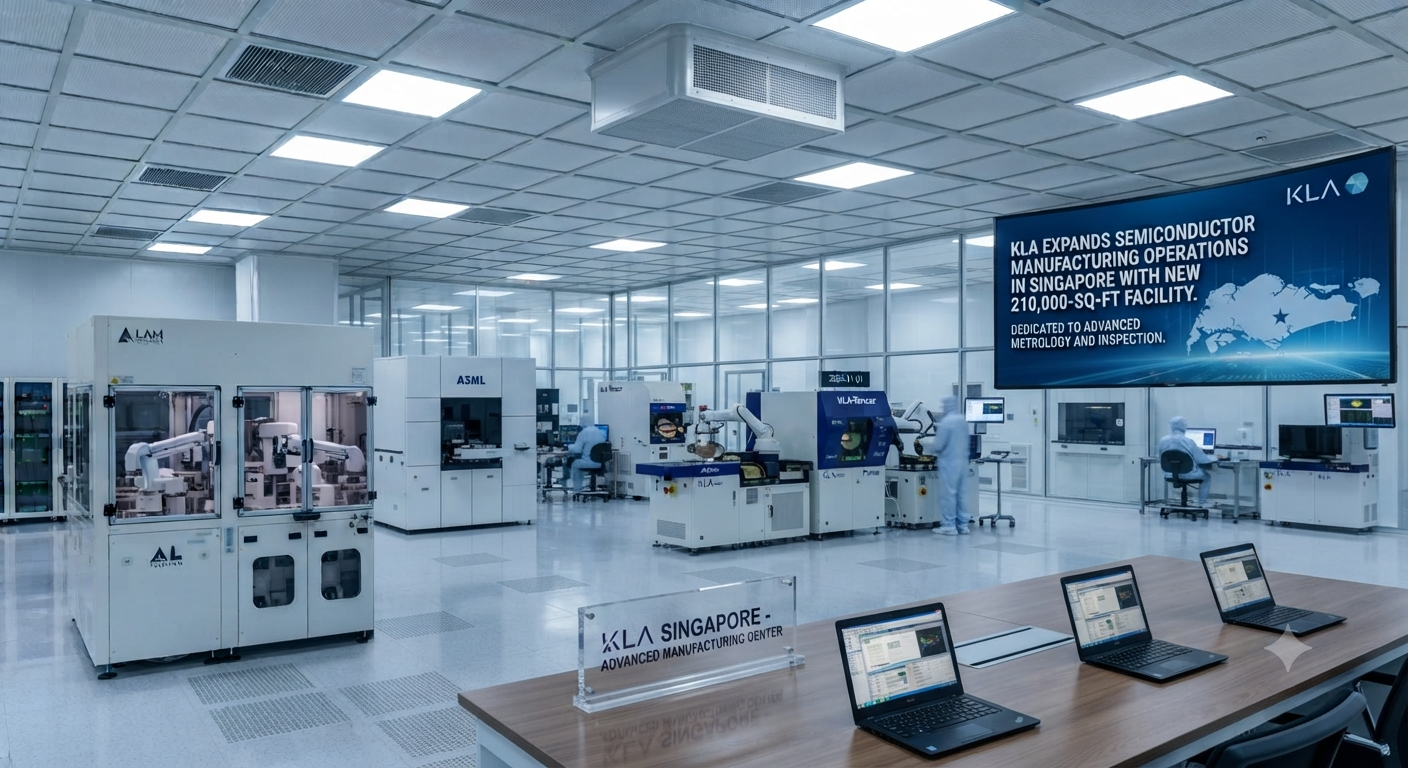
US-based semiconductor equipment manufacturer KLA Corporation has expanded its manufacturing operations in Singapore with the opening of a new 210,000-square-foot facility in Ang Mo Kio. The development strengthens the company’s global production capabilities and reinforces Singapore’s position as an important hub for semiconductor equipment manufacturing, engineering and research.
The new facility, known as Building 22B, became operational following its official opening on November 20, 2026. It represents the second phase of a major expansion programme announced by KLA in October 2024. Together with the earlier Building 22A, the two facilities now provide approximately 420,000 square feet of operational space at the company’s Ang Mo Kio site.
KLA has also outlined plans for another expansion phase in Singapore, subject to the finalisation of land arrangements and relevant approvals. Building 22B and the proposed next phase are expected to support approximately 1,000 new jobs over the longer term across research and development, manufacturing engineering and supply-chain functions.
The investment reflects growing demand for advanced semiconductor manufacturing equipment as the global chip industry expands to support artificial intelligence, advanced computing and next-generation electronic applications.
New Facility Strengthens KLA’s Manufacturing Capacity
Building 22B adds approximately 210,000 square feet of new operational space to KLA’s Singapore operations. The facility has been designed to support the manufacturing of advanced semiconductor process-control equipment, which is used by chipmakers to monitor production processes, detect defects and improve manufacturing precision.
The building includes specialised infrastructure such as:
- Class 100 (ISO 5) precision cleanrooms
- Dedicated engineering and laboratory spaces
- Integrated office facilities
- Warehouse and operational areas
The cleanroom environment is particularly important for semiconductor equipment manufacturing because even small particles or contamination can affect sensitive components and precision systems.
The new facility is expected to accelerate production of KLA’s advanced equipment for applications involving advanced packaging, silicon photonics and artificial intelligence-driven semiconductor technologies.
By increasing its manufacturing footprint, the company aims to improve its ability to meet customer requirements and support the development of increasingly sophisticated chip manufacturing processes.
Further Expansion Planned in Singapore
The opening of Building 22B is not the final stage of KLA’s expansion strategy in Singapore.
The company has outlined plans for an additional development phase, although the project is still being evaluated and depends on land arrangements and relevant government approvals.
KLA Singapore country president and senior vice-president of global operations Theo Kneepkens indicated that the next phase of growth is expected to be larger than the current expanded site.
The proposed development reflects KLA’s long-term confidence in Singapore as a strategic location for semiconductor manufacturing, engineering and access to regional customers and suppliers.
The company established its Singapore presence in 1996 through a sales and service office and began manufacturing operations in the country in 2006. Over the years, Singapore has developed into an important part of KLA’s international manufacturing and engineering network.
Its local operations now include manufacturing, research and development, corporate functions and one of the company’s largest global technical training centres.
Expansion Expected to Support Around 1,000 Jobs
Employment generation is another important outcome of KLA’s investment programme.
Building 22B alone is expected to create at least 400 new jobs, including positions in mechanical design engineering, materials evaluation and product testing.
When combined with the proposed next expansion phase, the two developments are expected to support approximately 1,000 new jobs over the longer term.
The planned employment opportunities will cover several specialised functions:
Research and development: Engineers and technical professionals will contribute to the development and improvement of semiconductor equipment and manufacturing technologies.
Manufacturing engineering: Skilled employees will support precision manufacturing, equipment assembly, testing and production processes.
Supply-chain operations: Additional roles will support procurement, supplier coordination, logistics and the management of complex manufacturing requirements.
KLA already employs more than 2,200 people in Singapore across multiple shifts. The company has also indicated that approximately 90% of its Singapore workforce comprises local employees, including citizens and permanent residents.
The expansion is therefore expected to create opportunities for local talent while supporting technical training and workforce development.
Supporting Singapore’s Semiconductor Industry
KLA’s investment comes at a time when Singapore is strengthening its position in the global semiconductor industry.
The semiconductor sector contributes approximately 6% of Singapore’s gross domestic product and employs more than 35,000 people, according to figures cited by the Singapore Economic Development Board.
The country has developed a strong industrial ecosystem covering semiconductor fabrication, equipment manufacturing, research, advanced materials and precision engineering.
Singapore’s strategic location, established infrastructure, skilled workforce and access to international markets have helped attract major global semiconductor companies.
The government has also emphasised the importance of developing specialised engineering capabilities and strengthening partnerships between multinational companies, research institutions and domestic suppliers.
At the opening of Building 22B, Singapore Deputy Prime Minister and Minister for Energy, Trade and Industry Gan Kim Yong highlighted the importance of advanced semiconductor equipment in producing increasingly powerful and specialised chips.
Equipment capable of measuring process variations and identifying defects at early stages is becoming more important as semiconductor manufacturing requirements grow more demanding.
Advanced Packaging and AI Drive Equipment Demand
The expansion also reflects changes taking place across the global semiconductor industry.
Artificial intelligence systems, high-performance computing, data centres and advanced electronic devices require increasingly sophisticated chips. Producing these semiconductors involves complex manufacturing processes that demand precise measurement, inspection and process-control technologies.
Advanced packaging is gaining importance as chipmakers integrate multiple components and semiconductor dies into increasingly sophisticated systems.
Silicon photonics is another developing area, combining optical technologies with semiconductor manufacturing to support high-speed data transmission and communication applications.
KLA’s new facility is intended to support equipment production for these and other next-generation applications.
As semiconductor manufacturers invest in advanced production capabilities, demand for specialised equipment suppliers is expected to remain an important part of the industry’s growth.
Stronger Supplier Ecosystem and Technical Capabilities
KLA’s expansion is also expected to create opportunities for Singapore-based suppliers and engineering companies.
Advanced semiconductor equipment manufacturing requires a network of specialised suppliers providing precision components, materials, mechanical assemblies and technical services.
As KLA expands its manufacturing operations, local suppliers may have opportunities to upgrade their capabilities, improve production standards and participate in more technologically demanding assignments.
The Singapore government has highlighted the importance of these partnerships in strengthening the domestic industrial ecosystem.
The company also plans to continue working with local universities and polytechnics to support internships, technical training and curriculum development. These initiatives could help prepare students and existing workers for specialised careers in semiconductor manufacturing and engineering.
The Worldonomics Times View
KLA’s new manufacturing facility represents more than an increase in industrial floor space. It strengthens Singapore’s role in the global semiconductor equipment supply chain at a time when demand for advanced chipmaking technologies is increasing.
The additional 210,000 square feet of operational space, combined with the earlier Building 22A, gives KLA a substantial manufacturing and engineering base in Ang Mo Kio. The proposed next expansion phase also signals the company’s long-term confidence in Singapore’s business environment and technical workforce.
The employment outlook is another important aspect of the investment. While Building 22B is expected to create at least 400 jobs, the combined impact of the new facility and the proposed next phase could support approximately 1,000 new positions over time.
However, the proposed expansion remains subject to approvals and land arrangements. Its eventual impact will depend on investment execution, workforce development and the ability of local suppliers to meet increasingly demanding manufacturing requirements.
Conclusion: KLA Corporation’s opening of its 210,000-square-foot Building 22B facility marks a significant expansion of its semiconductor manufacturing operations in Singapore. With approximately 420,000 square feet now available across Buildings 22A and 22B, the company is strengthening its capacity to produce advanced equipment for next-generation chip manufacturing. Alongside plans for another expansion phase and the potential creation of around 1,000 jobs over the longer term, the development reinforces Singapore’s ambitions to remain a leading global semiconductor manufacturing and technology hub.