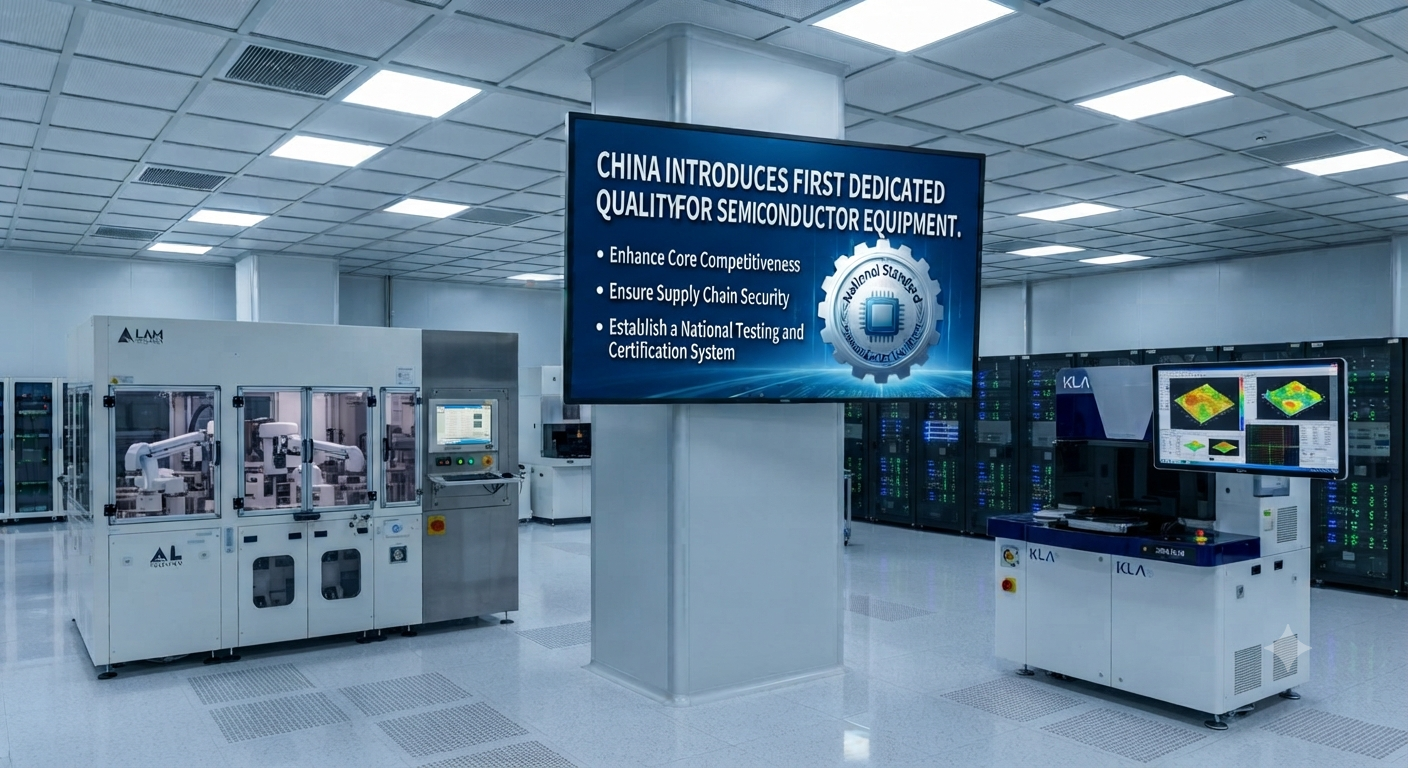
China has introduced its first dedicated quality management system standard for semiconductor equipment and components, marking an important step towards strengthening domestic chip manufacturing capabilities and improving supply-chain reliability. The new standard, titled Quality Management System for Semiconductor Equipment and Components, carries the designation SJ/T 12425–2026 and is scheduled to take effect on May 1, 2027.
Released on November 24, 2026, at the 2026 Integrated Circuit Industry Quality Conference and Semiconductor Equipment and Components Industry Standards Promotion Meeting in Beijing, the standard establishes specialised quality management requirements for companies involved in designing, manufacturing, installing and servicing semiconductor equipment and related components.
The initiative addresses a long-standing gap in China’s semiconductor industry, where manufacturers have largely relied on general quality management frameworks such as ISO 9001. The new standard introduces requirements tailored to the industry’s demanding production environment, including high precision, strict cleanliness, component reliability and specialised supplier management.
The development is expected to support China’s efforts to improve domestic semiconductor equipment quality, strengthen manufacturing consistency and build a more resilient industrial supply chain.
What Is SJ/T 12425–2026?
SJ/T 12425–2026 is China’s first dedicated industry quality management system standard specifically designed for semiconductor equipment and components.
It was proposed and administered by the National Technical Committee for Standardization of Semiconductor Equipment and Materials. The standard was developed under the guidance of China’s Ministry of Industry and Information Technology (MIIT), with NAURA Technology Group taking the lead alongside more than 40 companies from across the semiconductor supply chain.
The standard is designed to address the specific characteristics of semiconductor equipment manufacturing, where production often involves:
- High-precision engineering and demanding technical specifications
- Multiple product varieties and relatively small production batches
- Highly customised equipment and components
- Strict cleanliness and contamination-control requirements
- Complex supplier networks and specialised materials
- Long-term reliability requirements for critical manufacturing equipment
Unlike a general quality management framework, the new standard establishes industry-specific expectations covering the entire product lifecycle, from research and development to manufacturing, delivery, installation and after-sales service.
Importantly, SJ/T 12425–2026 is a recommended voluntary industry standard. Companies can choose to adopt it, rather than being automatically subject to a compulsory certification requirement.
Stronger Supplier Qualification and Component Verification
One of the central objectives of the new standard is to improve the quality of components entering semiconductor manufacturing equipment.
Semiconductor equipment relies on numerous specialised components, including precision mechanical parts, electronic systems, sensors, valves and other critical assemblies. A defect in even a relatively small component can affect equipment performance, production consistency or manufacturing yields.
The new framework introduces more detailed requirements for supplier evaluation, qualification and ongoing performance monitoring.
Companies are expected to strengthen supplier assessments, conduct second-party audits where appropriate and verify components before incorporating them into production systems.
First-article and initial-batch verification will also play an important role. Newly introduced supplier products and significant changes to manufacturing processes are expected to undergo appropriate validation and approval before regular procurement or mass production.
These measures could help reduce repeated testing, improve consistency between suppliers and equipment manufacturers, and lower the risk of component failures during semiconductor production.
Focus on Reliability, Traceability and Production Quality
The standard also introduces a stronger emphasis on product reliability throughout the manufacturing lifecycle.
Rather than concentrating only on final product inspection, companies are expected to establish quality controls covering design requirements, engineering validation, manufacturing processes, delivery and field performance.
Several important areas receive particular attention:
1. Product safety and design validation
Safety reviews and design verification are intended to become integral parts of product development and release processes. This can help identify technical weaknesses before equipment reaches customers.
2. Manufacturing process control
The standard addresses production quality through requirements involving material certification, first-piece inspection, measurement system analysis and process monitoring.
3. Batch-level traceability
Manufacturers are expected to improve the traceability of components and production batches. This can help identify the source and scope of defects and support faster corrective action.
4. Cleanroom and contamination management
Semiconductor manufacturing requires tightly controlled environments. The framework reinforces quality management practices related to cleanliness and contamination prevention.
5. Continuous reliability improvement
Companies are expected to collect feedback from equipment operation and customer sites, using the information to identify recurring problems and improve product reliability.
Together, these requirements aim to establish a more consistent quality management approach across semiconductor equipment manufacturers and their component suppliers.
Supply-Chain Continuity and Export-Control Compliance
Another important feature of SJ/T 12425–2026 is its focus on supply-chain resilience and regulatory compliance.
Semiconductor manufacturing depends on specialised suppliers, making production vulnerable to disruptions involving critical components, equipment failures, labour shortages, infrastructure problems and cybersecurity incidents.
The standard encourages companies to establish contingency plans for supply interruptions and other operational risks. It also emphasises the importance of communicating potential disruptions to customers, including their likely duration and recovery arrangements.
The framework incorporates export-control compliance into quality management as well. Companies are expected to monitor relevant international trade restrictions and regulatory requirements and consider compliance risks when evaluating suppliers.
For products subject to export controls, relevant classification and licensing information may need to be provided to customers.
This is particularly significant for China’s semiconductor industry, which operates amid growing international competition and restrictions affecting access to advanced chipmaking equipment and technologies.
By incorporating supply-chain and compliance considerations into quality management, the standard seeks to strengthen operational preparedness alongside product reliability.
NAURA Leads Development With More Than 40 Industry Participants
The development of the standard involved collaboration across different parts of China’s semiconductor ecosystem.
NAURA Technology Group led the drafting process, while more than 40 companies and institutions from the equipment, component and semiconductor manufacturing industries participated.
The initiative brought together equipment manufacturers, component suppliers and semiconductor manufacturers to establish a common quality management framework.
This cooperation is important because semiconductor equipment quality depends on coordination between several layers of the supply chain. Equipment manufacturers need reliable components, suppliers need clear technical expectations, and chipmakers require consistent performance from the machinery used in their production facilities.
A shared standard could help reduce differences in testing methods and supplier qualification procedures, making collaboration more efficient.
It may also encourage domestic component manufacturers to improve their quality systems to meet the expectations of major equipment producers and semiconductor fabrication facilities.
What the Standard Means for China’s Semiconductor Industry
China has been investing heavily in developing its domestic semiconductor manufacturing ecosystem, including chipmaking equipment, materials and specialised components.
The introduction of a dedicated quality standard adds an important institutional layer to these efforts.
Improved supplier qualification and component verification could help domestic equipment manufacturers reduce quality inconsistencies and strengthen confidence among semiconductor fabrication companies.
Better traceability and reliability management may also reduce equipment downtime, production interruptions and the costs associated with repeated component validation.
However, the standard alone cannot eliminate the technological challenges facing China’s semiconductor equipment industry. Advanced manufacturing still depends on engineering capabilities, precision technologies, research investment, skilled personnel and access to specialised materials.
Its effectiveness will therefore depend on how widely companies adopt the framework and how consistently its requirements are implemented.
The Worldonomics Times View
China’s introduction of SJ/T 12425–2026 represents an important move from general quality management towards industry-specific standards for semiconductor equipment and components.
The framework recognises that semiconductor manufacturing requires more than basic quality checks. It depends on highly reliable components, controlled production environments, rigorous supplier qualification and continuous monitoring throughout the product lifecycle.
Its emphasis on supplier audits, component verification, traceability and supply-chain continuity could improve coordination between domestic equipment manufacturers and semiconductor producers. The inclusion of export-control compliance also reflects the increasingly complex regulatory environment surrounding the global chip industry.
However, the standard’s voluntary nature means that its impact will depend on adoption across the supply chain. Companies will need to invest in quality systems, testing capabilities, documentation and workforce training to implement its requirements effectively.
Conclusion: China’s first dedicated semiconductor equipment and components quality management standard, SJ/T 12425–2026, is scheduled to take effect on May 1, 2027. By establishing specialised requirements for supplier qualification, component reliability, production quality, traceability and supply-chain resilience, the framework aims to strengthen domestic semiconductor manufacturing. While it does not guarantee technological self-sufficiency, widespread adoption could provide China’s semiconductor industry with a more consistent quality foundation and improve the reliability of its domestic equipment ecosystem.