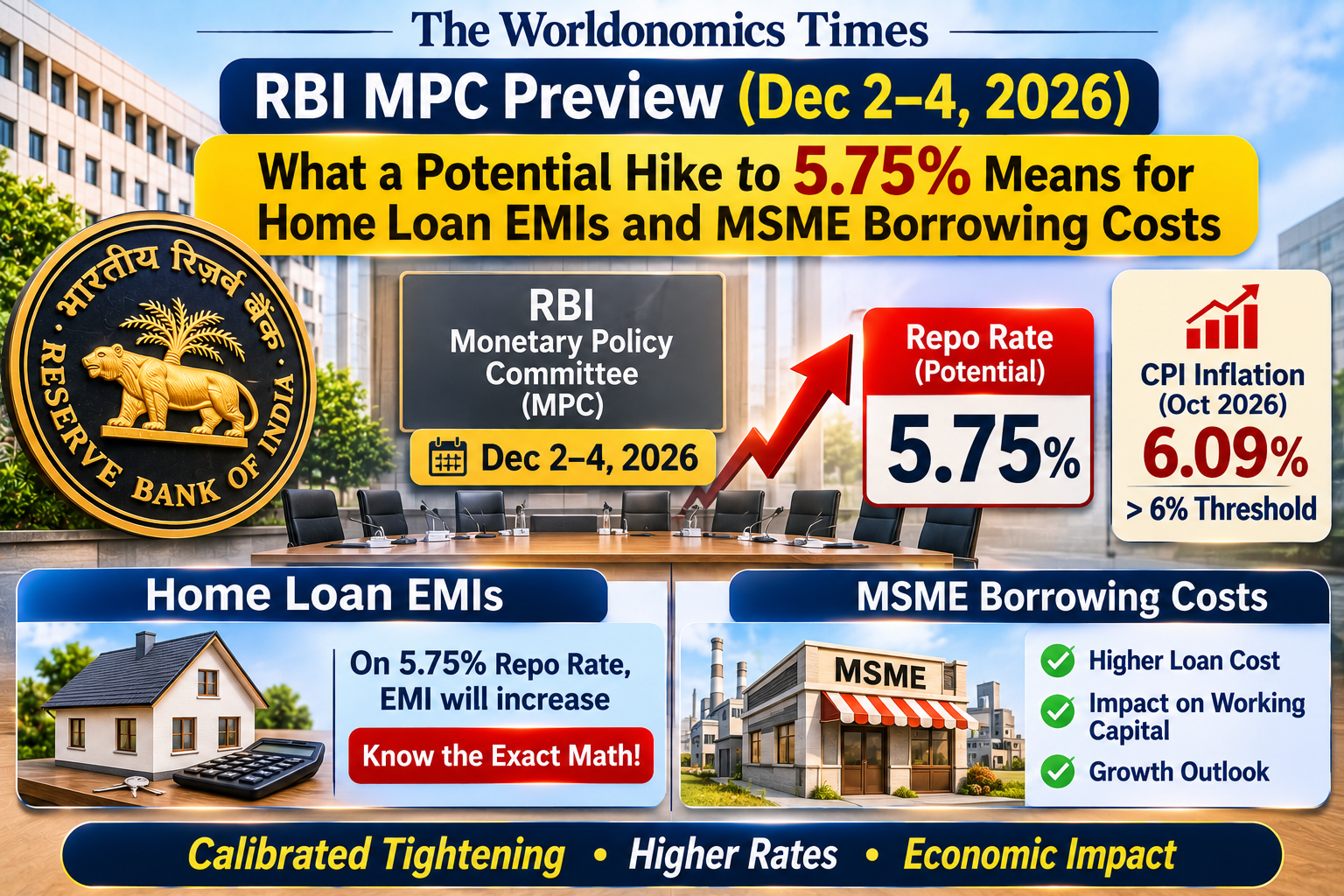
Just one week before the Reserve Bank of India’s Monetary Policy Committee (MPC) convenes for its pivotal December 2–4, 2026 policy review, borrowers across India are bracing for another turn of the interest-rate screw. In October 2026, the MPC broke a nearly four-year pause by unanimously raising the policy repo rate by 25 basis points to 5.50% and shifting its monetary policy stance to “calibrated tightening.”
Now, with India’s headline Consumer Price Index (CPI) retail inflation surging to 6.09% in October 2026—officially breaching the RBI’s upper tolerance threshold of 6%—a second consecutive 25 bps hike to 5.75% has emerged as the consensus base case among economists and rating agencies. While monetary policy announcements often dominate television panels in abstract macroeconomic terms, a 5.75% repo rate translates into immediate, measurable cash-flow consequences for two critical segments of the Indian economy: salaried homebuyers and credit-dependent MSMEs.
1. Why the RBI’s Hand Is Being Forced
The central bank’s October policy statement had already telegraphed that price pressures were broadening beyond isolated seasonal vegetables. Food and beverages inflation climbed steadily through the second half of 2026, with protein items, eggs, sugar, and spices recording stubborn double-digit prints. Simultaneously, core inflation (excluding food, fuel, and precious metals) has been ticking upward, while the diffusion index—the weighted share of CPI basket items recording inflation above 4%—expanded sharply.
In its October projections, the RBI estimated full-year FY 2026–27 CPI inflation at 5.2%, with Q3 2026–27 averaging 6.0%. October’s 6.09% print confirms those upside risks are materializing. Meanwhile, domestic growth and credit demand remain remarkably resilient: bank credit grew at a brisk 18.1% year-on-year as of mid-September 2026, backed by healthy manufacturing and services PMI readings (53.8 and 54.2 respectively) and robust foreign exchange reserves of $734.6 billion. With the RBI already absorbing excess liquidity through 55 Variable Rate Reverse Repo (VRRR) auctions and ₹1.0 lakh crore in Open Market Operation (OMO) sales, a 25 bps hike to 5.75% (moving the Standing Deposit Facility to 5.50% and the Marginal Standing Facility to 6.00%) allows the MPC to anchor inflation expectations and defend the rupee without derailing real GDP growth.
2. The Direct Hit on Home Loan Borrowers: Running the Exact EMI Numbers
Unlike the pre-2019 Marginal Cost of Funds-Based Lending Rate (MCLR) era, where rate hikes took quarters to filter down, virtually all retail floating-rate home loans today are pegged to an External Benchmark Lending Rate (EBLR)—specifically the RBI repo rate. Under RBI’s EBLR mandate, banks must reset interest rates at least once every three months. Consequently, a December 4 hike to 5.75% will show up in borrowers’ repayment schedules by Q1 2027.
Consider a standard ₹50 lakh home loan with a 20-year (240-month) tenure, assuming a bank spread of 3.25% over the repo rate:
- Before the October 2026 Hike (Repo at 5.25% | Loan Rate at 8.50%):
- Monthly EMI: ₹43,391
- Total Interest Outflow over 20 years: ₹54.14 lakh
- After the October 2026 Hike (Repo at 5.50% | Loan Rate at 8.75%):
- Monthly EMI: ₹44,186 (+₹795/month)
- Total Interest Outflow over 20 years: ₹56.05 lakh
- If December MPC Hikes to 5.75% (Loan Rate at 9.00%):
- Monthly EMI: ₹44,986 (+₹800/month over Oct; +₹1,595/month cumulative)
- Total Interest Outflow over 20 years: ₹57.97 lakh
A single 25 bps hike adds roughly ₹1.92 lakh in lifetime interest on a ₹50 lakh loan, while the cumulative 50 bps tightening across October and December adds ₹3.83 lakh to the borrower’s total cost. Worse, if a borrower opts to keep their monthly EMI unchanged and lets the bank extend the loan tenure instead, a 50 bps rate increase can stretch a 20-year loan by 18 to 22 additional months.
3. The CMA Perspective: How 5.75% Squeezes MSME Working Capital and Margins
For Indian MSMEs, the pain of a 5.75% repo rate cuts deeper than a home loan EMI. Under RBI’s external benchmark rules, all floating-rate loans to Micro and Small Enterprises (MSEs)—including Cash Credit (CC) limits, Overdraft (OD) facilities, and working capital term loans—are directly linked to the repo rate.
From a Cost and Management Accounting (CMA) standpoint, consecutive rate hikes create a three-way margin squeeze for small manufacturers and traders:
- Immediate Finance Cost Escalation: On a ₹1 crore fully utilized Cash Credit limit, every 25 bps hike adds ₹25,000 per year in direct interest expense (₹50,000 annually across October and December). For a mid-sized MSME carrying ₹5 crore in working capital and term debt, a 50 bps shift erodes ₹2.50 lakh directly off Net Profit Before Tax.
- Compressed Interest Coverage Ratios (ICR): Because MSMEs operate in highly competitive B2B supply chains where passing input inflation onto large OEM buyers takes 60 to 90 days, higher finance costs immediately compress EBITDA-to-Interest ratios. A weaker ICR during Q4 FY 2026–27 financial finalization can trigger stricter bank credit-rating reviews during annual limit renewals.
- Higher Inventory Carrying Costs: When the cost of capital rises, every extra day that raw material sits in a warehouse or finished goods wait for dispatch becomes measurably more expensive.
4. Stakeholder Impact Matrix & Action Plan
| Stakeholder Group | Impact of a 5.75% Repo Rate | Immediate Financial Action Required |
| Floating-Rate Homebuyers | EMI rises ~₹16 per lakh (or tenure extends sharply). | Opt for an EMI increase or a 5% annual principal prepayment rather than extending tenure. |
| MSME Working Capital Borrowers | Direct upward reset on EBLR-linked CC/OD limits. | Tighten debtor collection cycles (DSO) and trim slow-moving inventory to reduce daily CC utilization. |
| Capex-Heavy Businesses | Higher hurdle rates for new machinery/expansion loans. | Re-run Internal Rate of Return (IRR) and DSCR sensitivity models at +50 bps before signing term sheets. |
| Fixed-Income Savers | Banks likely to keep FD rates elevated to attract deposits. | Ladder 1-to-3-year fixed deposits post-December policy to lock in peak yields. |
Whether the MPC delivers a 25 bps hike on December 4 or pairs a hawkish pause with tighter liquidity tools, the era of ultra-cheap credit is firmly behind us. For households, disciplined prepayment is the best hedge against compounding interest. For MSME owners and finance controllers, treating working capital velocity—not just top-line sales—as the primary metric for Q4 FY 2026–27 will determine who protects their bottom line in a calibrated-tightening economy.
Author Bio:Vivek Kumar is a qualified Cost and Management Accountant (ACMA), CA Final, and a B.Com (Accounting Honours) graduate with extensive experience in statutory and tax audits, direct and indirect taxation, and ROC/MCA corporate compliances. He is an author at The Worldonomics Times and the founder of VK Chartered Academy (https://www.cacmacstestseries.com). He specializes in financial statement finalization, GST advisory, and regulatory filings for diverse business entities. Beyond corporate practice, he actively mentors CA, CMA, and CS aspirants by providing structured academic guidance and conceptual clarity, while designing and conducting rigorous, exam-oriented test series and mock evaluations aligned with current statutory standards. He is dedicated to bridging practical industry expertise with focused exam preparation to empower future finance professionals.