When the Goods and Services Tax (GST) framework was introduced, its foundational promise was unequivocal: the “Ease of Doing Business.” The government envisioned a completely paperless, faceless, and automated digital ecosystem. In theory, obtaining a new GST Registration (GSTIN) is marketed as a straightforward, three-step online process where a clean application is automatically approved within days.
However, for tax practitioners, business owners, and new entrepreneurs across India, the ground reality tells a vastly different story. The digital highway of GST registration is frequently bottlenecked by jurisdictional officers operating on hyper-conservative, unwritten rules. Fearing scrutiny over the nationwide menace of fake invoicing, officers often deploy arbitrary hurdles, demanding irrelevant, extra, and non-statutory documents. This triggers a frustrating loop of show-cause notices, rejections, and administrative friction that throttles micro, small, and medium enterprises (MSMEs) before they even commence operations.
Here is a comprehensive breakdown of the massive gap between the theoretical laws of GST registration and the practical harassment faced by taxpayers, alongside the recent CBIC instructions and circulars designed to curb this overreach.
1. The Theory: The Streamlined Legal Framework
Under the Central Goods and Services Tax (CGST) Act, 2017, and the accompanying CGST Rules, the documentation required for a new registration is deliberately kept minimal to encourage formalization and business setup.
- The Statutory Checklist: According to Rule 8 and Rule 9 of the CGST Rules, an applicant needs to submit standardized documents: a PAN card (auto-verified via CBDT), Aadhaar authentication for the primary promoter, proof of the Principal Place of Business (such as a valid rent agreement accompanied by an electricity bill or property tax receipt), and bank account details (which can also be updated post-registration).
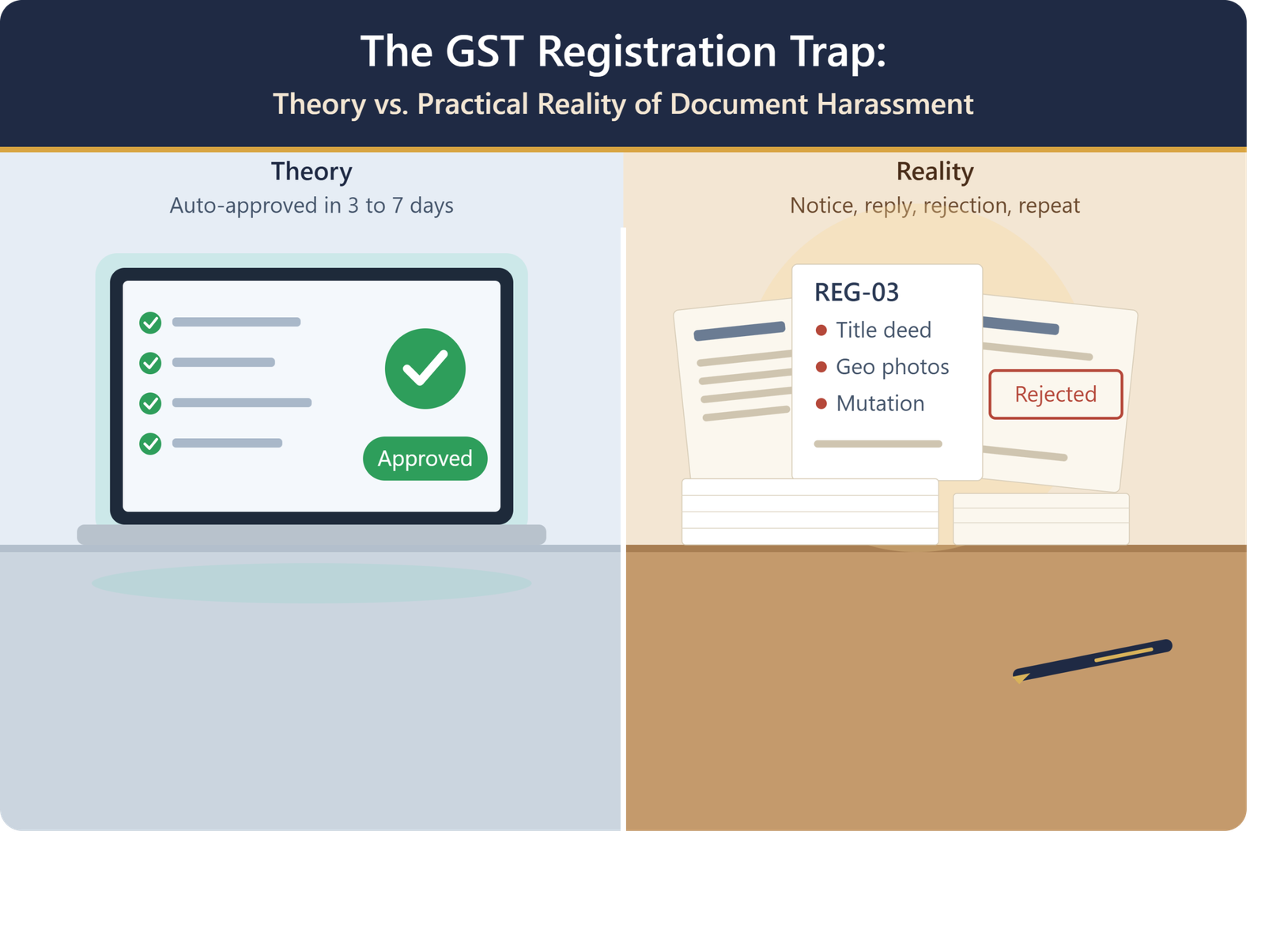
- The Theoretical Timeline: If the applicant successfully completes Aadhaar authentication, the system is designed to grant registration automatically within 3 to 7 working days. If the proper officer finds any genuine deficiency, they must issue a notice in Form GST REG-03 within this window. If no action is taken, the registration is deemed approved.
2. The Practical Reality: The “Faltu” Document Syndrome
In practice, this streamlined process frequently breaks down. To safeguard themselves against potential audit objections regarding fake registrations, jurisdictional officers often adopt an aggressive posture toward every fresh application.
Instead of evaluating the documents submitted under the statutory checklist, officers routinely issue a Form GST REG-03 notice—often right on the final day of the timeline—demanding a laundry list of absurd, non-statutory records.
Common Practical Harassments and Extra Demands:
- The Landlord Title Deed Trap: Even when a taxpayer submits a fully stamped, notarized, and legally executed rent agreement along with a recent electricity bill, officers frequently reject it, demanding the landlord’s original purchase deed, municipal mutation papers, or an unbroken chain of ancestral property documents.
- Arbitrary Geotagged Photographs: Demanding intimate photographs of the applicant standing inside an empty rented shop, snapshots of the surrounding neighborhood street, or selfies with adjacent business owners—even when physical verification (Rule 25) has not been officially initiated.
- The Residential Premises Ban: Officers often summarily reject home-based freelancers, consultants, and digital service providers, insisting that commercial electricity meters and commercial property tax receipts be produced for residential addresses, completely ignoring the legal validity of home-based service operations.
3. The Rejection and Clarification Loop
When a taxpayer receives a REG-03 notice, they are forced to reply through Form GST REG-04 within the stipulated timeline. This is where the practical trial-and-error game begins:
- Scrambling for Extra Files: Taxpayers and consultants often have to scour for additional letters, affidavits, and utility receipts, uploading whatever extra paperwork they can gather just to satisfy the officer’s manual checkbox.
- The Arbitrary Outcome: Sometimes, simply uploading any extra file satisfies the officer that the query was “answered,” leading to sudden approval. In other cases, the officer rejects the application entirely via Form GST REG-05 with a vague remark: “Reply not satisfactory,” forcing the entrepreneur to re-apply from scratch and delaying business launch by weeks.
4. Regulatory Intervention: CBIC Instructions and Circulars
Recognizing that field officers were expanding document checklists beyond statutory bounds and harassing genuine startups, the Central Board of Indirect Taxes and Customs (CBIC) stepped in to enforce administrative discipline.
Key guidelines—reinforced via Instruction No. 03/2025-GST and subsequent operational clarifications like Circular No. 257/03/2026-GST—have explicitly outlined boundaries for processing registrations:
- Strict Adherence to Statutory Checklists: The CBIC has firmly instructed field officers that they cannot wander outside the prescribed documents listed in FORM GST REG-01. If a valid rent agreement and electricity bill are provided, officers cannot arbitrarily demand title deeds or landlord tax receipts.
- Risk-Based Physical Verification, Not Blanket Demands: The department clarified that if an applicant is flagged by backend AI as “High Risk,” the correct procedure is to conduct physical verification under Rule 25 after granting registration or through proper supervisory channels, rather than stalling routine online applications with frivolous photo demands.
- Supervisory Accountability: Senior officials (Joint and Additional Commissioners) have been directed to review REG-03 notices and rejections periodically to ensure that officers do not issue arbitrary notices solely to manipulate processing timelines or avoid deemed approvals.
Navigating the Gap: A Practitioner’s Advice
Until automated systems completely eliminate manual overreach, business owners and consultants must adopt a defensive filing strategy:
- Front-Load Your Documentation: Merge your rent agreement, utility bills, and a self-drafted No Objection Certificate (NOC) into a single, highly legible PDF during initial submission.
- Reply with Legal Precision: If you receive a REG-03 asking for non-statutory documents, reply in REG-04 by politely citing the CGST Rules, reminding the officer that documents beyond the statutory checklist cannot be made a mandatory prerequisite for registration.
The GST registration gateway is designed to welcome legitimate commerce into the formal economy. By understanding the friction between legal theory and ground-level practice—and leveraging official CBIC instructions—taxpayers can successfully push back against administrative overreach and secure their rightful GSTIN without unnecessary harassment.
Author Bio: CMA Vivek Kumar (ACMA), an Associate Member of ICMAI and B.Com (Accounting Honours) graduate, is an author, finance professional, and Founder of VK Chartered Academy (www.cacmacstestseries.com). He specializes in statutory and tax audits, taxation, financial reporting, GST advisory, and corporate compliance. He also mentors CA, CMA, and CS aspirants through structured academic guidance and exam-oriented test series, bridging practical industry expertise with professional education.
Email: cmavivek2026@gmail.com