Notification No. 135/2026 | Dated: 13 October 2026
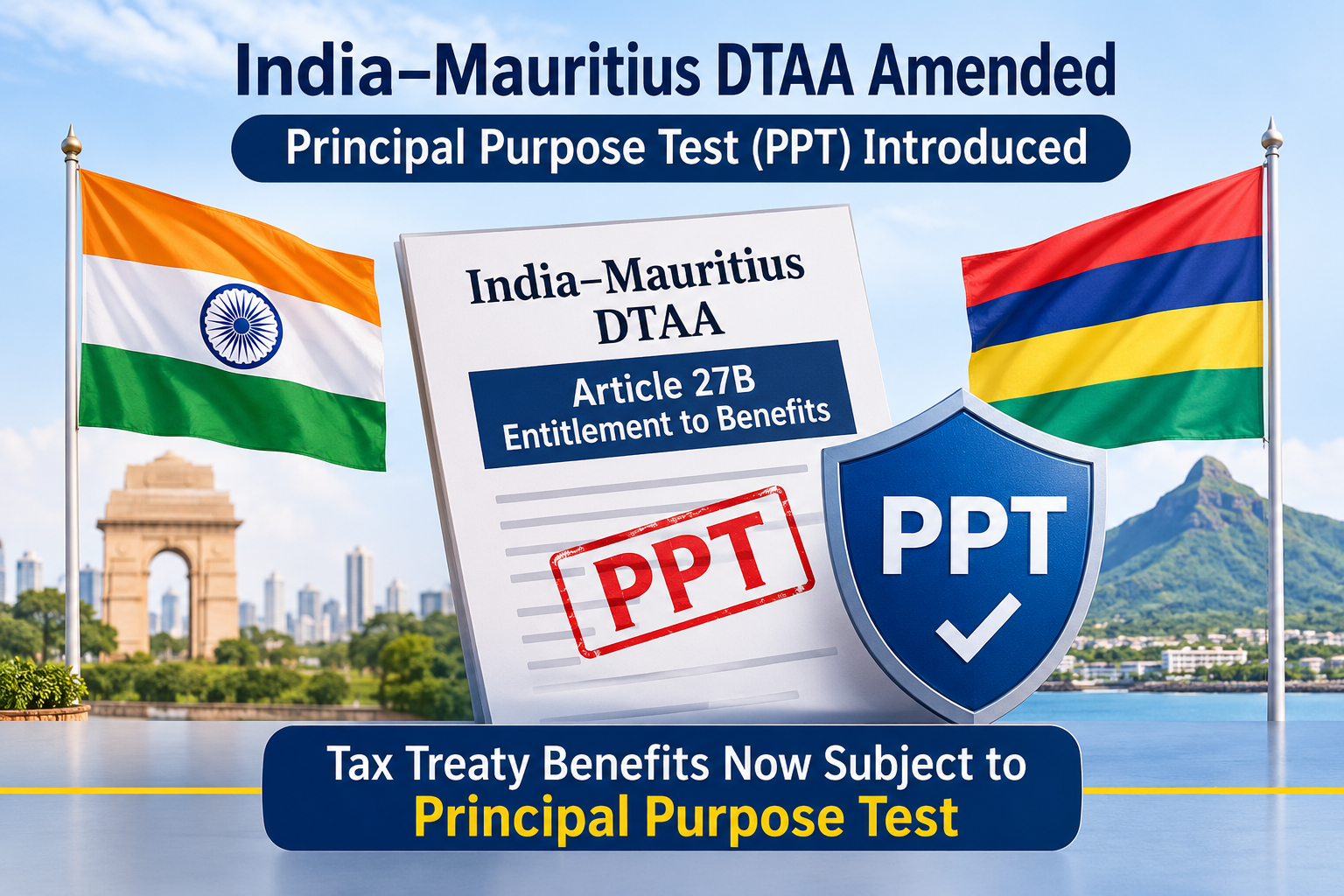
India and Mauritius have taken an important step towards preventing treaty abuse by incorporating the Principal Purpose Test (PPT) into their Double Taxation Avoidance Agreement (DTAA). The amendment introduces a specific anti-abuse provision that may restrict access to treaty benefits where obtaining such benefits is one of the principal purposes of an arrangement or transaction.
The development is particularly significant for foreign investors using Mauritius-based entities to invest in India, as it reinforces the requirement for genuine commercial arrangements and economic substance.
1. Background of the Amendment
India and Mauritius signed a Protocol on 7 March 2024 to amend their existing DTAA. The Protocol seeks to align the tax treaty with international standards on preventing treaty shopping and artificial arrangements.
Through Notification No. 135/2026 dated 13 October 2026, the amendment has been given effect in India. The Protocol entered into force on 10 August 2026.
One of the key amendments is the introduction of Article 27B, titled “Entitlement to Benefits”, which incorporates the Principal Purpose Test.
2. Understanding the Principal Purpose Test (PPT)
The PPT is an anti-abuse mechanism designed to prevent taxpayers from obtaining tax treaty benefits through arrangements that lack genuine commercial objectives.
Under Article 27B, a benefit under the DTAA may be denied if, having regard to all relevant facts and circumstances, it is reasonable to conclude that obtaining that benefit was one of the principal purposes of an arrangement or transaction.
However, the benefit may still be allowed if it is established that granting it would be consistent with the object and purpose of the relevant provisions of the DTAA.
Thus, merely routing investments through Mauritius to obtain a lower tax rate or other treaty advantages may attract scrutiny where the arrangement does not have a genuine commercial rationale.
3. Impact on Mauritius-Based Investments in India
Mauritius has historically been an important jurisdiction for foreign investments into India, particularly in relation to capital gains and other treaty-related tax benefits.
The introduction of the PPT may have significant implications for:
- Foreign investors: Investments routed through Mauritius may face greater scrutiny regarding their commercial rationale and eligibility for treaty benefits.
- Holding companies: Mauritius-based holding structures may need to demonstrate genuine business activities and commercial substance.
- Capital gains taxation: Investors claiming capital gains tax benefits under the DTAA may need to establish that their arrangements are not primarily designed to obtain treaty advantages.
- Investment structures: Existing and newly established structures may require reassessment of their operational and economic substance.
4. Practical Implications for Taxpayers and Professionals
In view of the amended DTAA, businesses, foreign investors and tax professionals should consider the following measures:
- Review existing structures: Examine Mauritius-based investment and holding structures to identify potential PPT-related risks.
- Establish commercial substance: Maintain evidence of genuine business activities, decision-making processes, management and operational presence.
- Document investment rationale: Preserve board resolutions, investment agreements, financial records and other supporting documents demonstrating commercial objectives.
- Review treaty claims: Reassess eligibility for benefits under the India–Mauritius DTAA before claiming concessional tax treatment.
- Assess transaction-specific risks: Evaluate whether the principal purpose of a particular arrangement could be interpreted as obtaining treaty benefits.
5. Conclusion
The introduction of Article 27B marks an important development in India’s approach towards preventing treaty shopping and tax avoidance. It reinforces the principle that tax treaty benefits should be available for genuine commercial arrangements rather than artificial structures established primarily to secure tax advantages.
For investors using Mauritius as an investment jurisdiction, the focus will increasingly shift towards demonstrating commercial substance, business rationale and compliance with treaty conditions.
The key takeaway is that merely routing investments through Mauritius will not automatically ensure entitlement to benefits under the India–Mauritius DTAA. The commercial purpose and substance of the arrangement will play a crucial role in determining treaty eligibility.