Date: 17 November 2026 | Pre-Budget Consultations for FY 2027-28
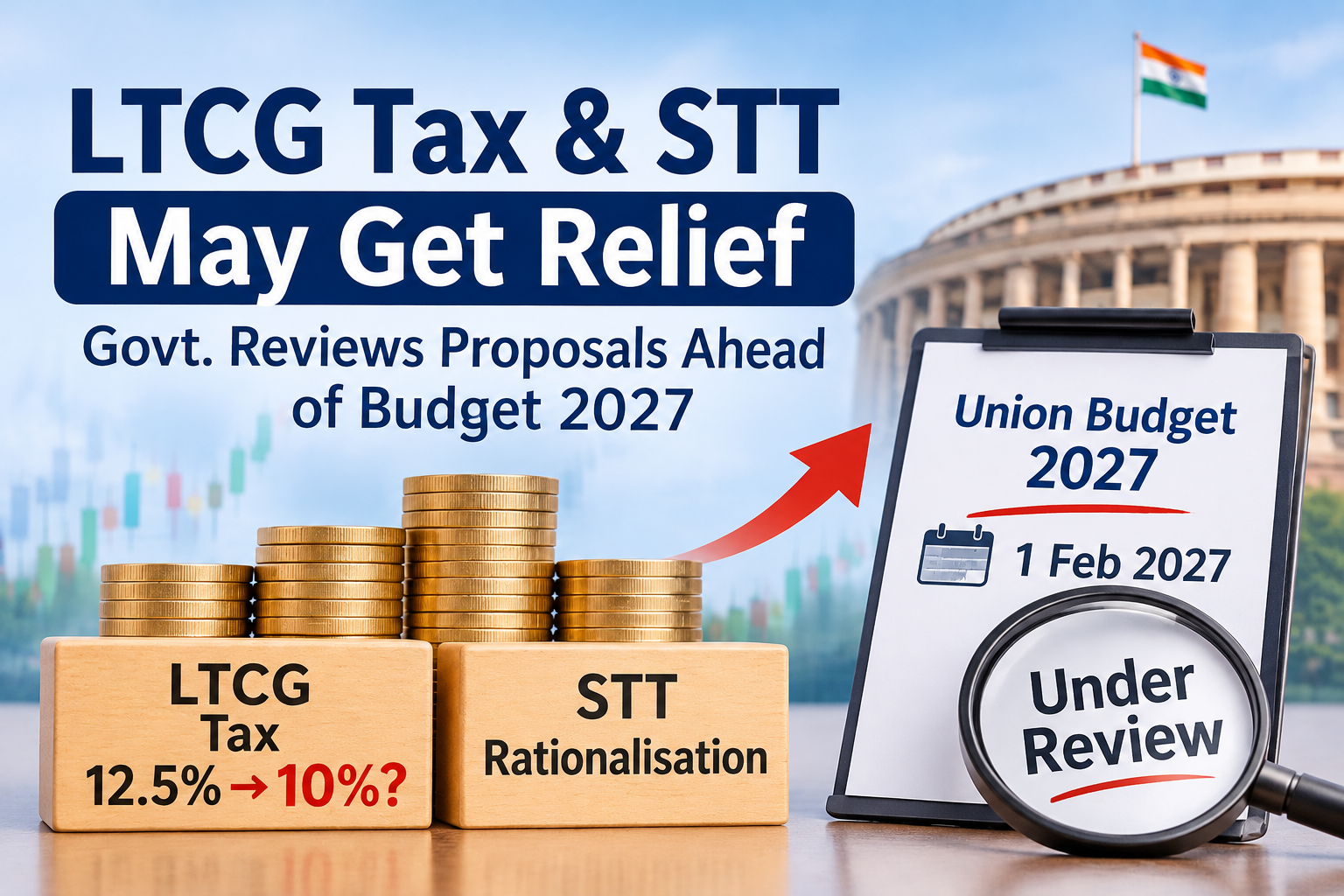
The Government of India is examining proposals for rationalisation of Long-Term Capital Gains (LTCG) tax and Securities Transaction Tax (STT) on equity investments ahead of the Union Budget 2027-28. The development follows representations from industry bodies and market participants seeking a more competitive and investor-friendly taxation framework for the Indian capital market.
CBDT Chairman Ravi Agrawal recently indicated that the Finance Ministry is examining suggestions received during pre-Budget consultations. However, he clarified that any decision regarding changes in the existing tax structure would be announced only during the Union Budget scheduled for 1 February 2027. The Financial Express+1
1. Background: Existing Tax Structure
Under the existing provisions applicable to specified listed equity shares, equity-oriented mutual funds and units of business trusts, the taxation framework provides:
- Long-Term Capital Gains (LTCG): Taxable at 12.5% on eligible gains exceeding ₹1.25 lakh in a financial year, subject to applicable conditions.
- Short-Term Capital Gains (STCG): Taxable at 20% on specified short-term equity transactions, subject to applicable conditions.
- Securities Transaction Tax (STT): Levied on the value of specified securities transactions at prescribed rates.
Following the changes introduced in the Union Budget 2024, the LTCG tax rate on specified listed equity investments was increased from 10% to 12.5%, while the STCG rate was increased from 15% to 20%.
Consequently, investors are subject to both capital gains taxation and STT on eligible transactions, increasing the overall cost of equity investments. The Financial Express+1
2. Key Proposals Submitted by Industry Bodies
Industry organisations, including ASSOCHAM and FICCI, have submitted representations to the Finance Ministry seeking rationalisation of the existing capital gains taxation framework.
The major proposals include:
A. Reduction in LTCG Tax Rate
- Reduce the existing LTCG tax rate from 12.5% to 10% for listed securities held for more than one year but less than two years.
- Introduce a nil tax rate or a concessional rate of approximately 5% for investments held for more than two years.
- Certain industry bodies have also proposed restoring the exemption from LTCG tax on listed equity investments.
B. Rationalisation of STT
Industry representatives have requested a review of STT rates to reduce transaction costs and encourage greater participation in the equity market.
C. Changes for Foreign Portfolio Investors (FPIs)
Certain stakeholders have proposed a separate tax regime for Foreign Portfolio Investors, including reconsideration of LTCG taxation and allowing capital gains to be calculated in US dollar terms.
These proposals aim to improve India’s competitiveness as an investment destination and encourage long-term participation in domestic capital markets. The Financial Express+2
3. Government’s Position and Expected Timeline
CBDT Chairman Ravi Agrawal confirmed that the Government is examining the representations received from various stakeholders as part of the ongoing pre-Budget consultation process.
He indicated that the suggestions, including their potential revenue implications, are being analysed and that any decision would be communicated in the Union Budget on 1 February 2027.
Accordingly, no immediate amendment or reduction in LTCG or STT rates has been announced. Business Standard+1
4. Practical Implications for Investors and Tax Professionals
If these proposals are accepted, they could have significant implications:
- Long-term investors: Reduced LTCG rates may encourage investors to hold listed securities for longer periods.
- Market participation: Rationalisation of STT may reduce transaction costs for equity market participants.
- Foreign investments: A differentiated tax regime could make Indian equity markets more attractive to foreign investors.
- Tax planning: Investors may need to reconsider investment holding periods and capital gains realisation strategies if the proposed changes are implemented.
5. Conclusion
The Government’s review of LTCG taxation and STT represents an important development in India’s capital market taxation framework. The proposals indicate a growing demand for a more rational and competitive tax structure that balances investor interests with Government revenue requirements.
However, until any formal amendment is announced through the Union Budget or subsequent legislative changes, taxpayers must continue to follow the existing provisions.
The key takeaway is that the proposed reduction in LTCG tax and rationalisation of STT are still under consideration and should not be treated as approved tax relief. The Union Budget 2027 will be crucial in determining whether these industry expectations translate into actual legislative changes.