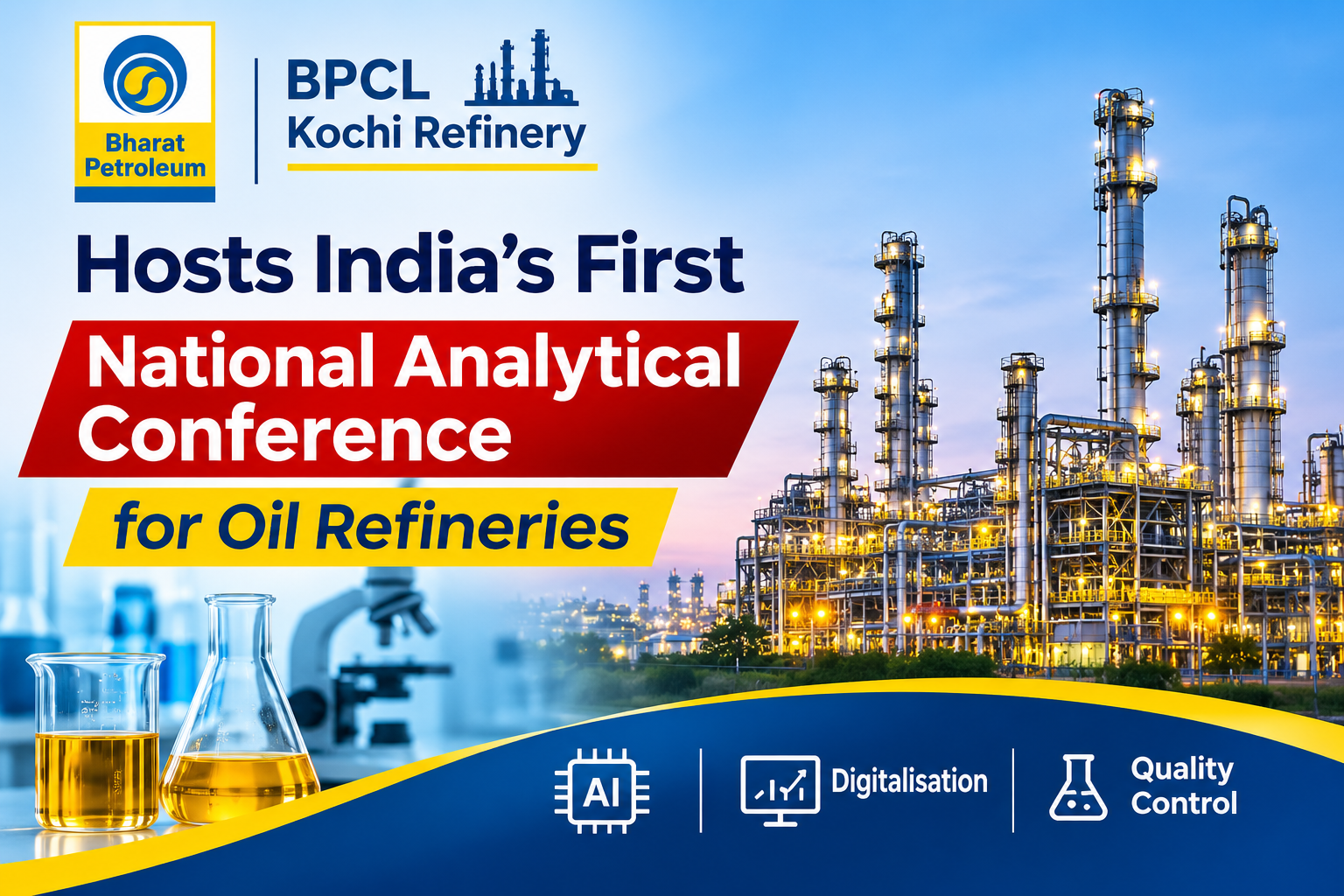
Around 60 experts from the petroleum refining industry and academia participate in a landmark conference to strengthen analytical science, laboratory standards and technological innovation.
By The Worldonomics Times Business Desk
Date: 15 November 2026
Introduction
Bharat Petroleum Corporation Limited (BPCL) has achieved an important milestone in India’s petroleum refining sector as its Kochi Refinery hosted the country’s first National Analytical Conference by Oil Refineries. The conference, held in November 2026, brought together approximately 60 delegates from the petroleum refining industry and academic institutions to discuss advancements in analytical science, quality control, digitalisation and Artificial Intelligence (AI).
The initiative provided a common platform for technical experts, laboratory professionals and industry representatives to exchange knowledge, discuss operational challenges and explore emerging technologies that can improve analytical capabilities across India’s refining industry.
The conference also highlighted the growing importance of technology-driven quality management in ensuring that petroleum products meet stringent standards of safety, performance and environmental compliance.
BPCL Kochi Refinery Takes the Lead in Technical Collaboration
The National Analytical Conference was organised at BPCL’s Kochi Refinery, one of the major refining facilities of Bharat Petroleum Corporation Limited.
The conference was inaugurated by Shri Chacko M. Jose, Executive Director (Kochi Refinery) and Director (Refineries), Designate.
Addressing the gathering, he emphasised that quality is the foundation of trust in the petroleum industry. Every petroleum product must consistently meet prescribed standards to ensure safety, reliability, performance and environmental compliance.
He also highlighted the increasing role of digitalisation, automation, advanced analytics and Artificial Intelligence in transforming Quality Control Laboratories.
According to the discussions at the conference, the adoption of these technologies can improve laboratory efficiency, strengthen analytical accuracy and support more reliable quality management across refinery operations.
Around 60 Delegates Participate from Industry and Academia
The conference witnessed participation from approximately 60 delegates representing different oil refining organisations and academic institutions.
Technical experts and laboratory professionals from several leading petroleum companies participated in the knowledge-sharing sessions.
Organisations represented included:
- Bharat Petroleum Corporation Limited (BPCL)
- Indian Oil Corporation Limited (IOCL)
- Hindustan Petroleum Corporation Limited (HPCL)
- HPCL-Mittal Energy Limited (HMEL)
- Mangalore Refinery and Petrochemicals Limited (MRPL)
Expert presentations from these organisations formed an important part of the technical programme.
The participation of multiple refining companies provided an opportunity to share operational experiences, discuss laboratory practices and identify areas where common analytical standards and technological improvements could benefit the industry.
The conference also reinforced the importance of collaboration between public sector oil companies, private refining organisations and academic institutions.
Artificial Intelligence and Digitalisation in Quality Control
One of the major themes of the conference was the increasing use of Artificial Intelligence and digital technologies in refinery laboratories.
Traditionally, refinery Quality Control Laboratories have relied on sophisticated analytical instruments, standard testing procedures and experienced technical personnel to evaluate the quality of petroleum products.
However, the growing complexity of refining operations and increasing quality requirements are creating opportunities for more advanced digital systems.
The conference highlighted several emerging areas:
1. Artificial Intelligence in Laboratory Operations
AI-based technologies can support analytical data interpretation, identify unusual patterns and assist laboratory professionals in improving testing workflows.
2. Digitalisation of Quality Control
Digital laboratory systems can improve data management, testing documentation, traceability and reporting processes.
3. Automation of Analytical Processes
Automation can help reduce repetitive manual activities, improve consistency and increase laboratory productivity.
4. Advanced Analytical Techniques
Modern analytical instruments and methods can support more detailed evaluation of petroleum products, feedstocks and refinery process streams.
5. Data-Driven Decision-Making
Integrating analytical data with refinery operating systems can help technical teams identify quality variations and take timely corrective action.
neral Manager (Technology), and Shri Ravindra K. Kubade, Chief General Manager (Operations), participated in the felicitation programme.
Their participation highlighted BPCL’s emphasis on recognising technical contributions and encouraging professional collaboration across refinery operations.
The presence of senior officials and technical experts also provided an opportunity for participants to discuss practical challenges and share experiences from their respective organisations.
BPCL Kochi Refinery: A Major Energy Infrastructure Facility
BPCL’s Kochi Refinery, located at Ambalamugal near Kochi in Kerala, is one of India’s important petroleum refining facilities.
The refinery began operations in 1966 with an initial capacity of 50,000 barrels per day. It has since undergone substantial expansion and modernisation.
Its present crude oil refining capacity is approximately 15.5 million metric tonnes per annum (MMTPA), equivalent to around 310,000 barrels per day.
The facility produces a wide range of petroleum products, petrochemical feedstocks and speciality products.
The Integrated Refinery Expansion Project (IREP) was a major step in strengthening the refinery’s capacity and technological capabilities.
The refinery also undertakes initiatives related to operational efficiency, environmental management, energy conservation and technology development.
Hosting India’s first National Analytical Conference by Oil Refineries adds another dimension to its contribution to the country’s petroleum sector by encouraging knowledge-sharing and technical innovation.
Significance for India’s Petroleum and Petrochemical Industry
India’s refining industry is expanding its technological capabilities to meet increasing domestic energy requirements and changing international quality standards.
With rising demand for transportation fuels, petrochemicals and speciality petroleum products, refineries need to continuously improve operational efficiency and product quality.
The adoption of AI, automation and advanced analytical technologies can support this transformation.
Industry-wide knowledge-sharing platforms are particularly valuable because they allow professionals from different organisations to exchange experiences, understand emerging challenges and explore common technological solutions.
The National Analytical Conference at BPCL Kochi Refinery represents an initiative towards strengthening this collaborative approach.
It also highlights the growing importance of analytical science and laboratory professionals in India’s energy industry.
Conclusion
BPCL’s Kochi Refinery hosting India’s first National Analytical Conference by Oil Refineries marks an important development in technical collaboration across India’s petroleum refining sector.
With approximately 60 delegates from industry and academia participating, the conference created a platform for discussing quality control, advanced analytical technologies, digitalisation, automation and Artificial Intelligence.
The participation of experts from BPCL, IOCL, HPCL, HMEL and MRPL further strengthened the industry-wide character of the initiative.
As India’s petroleum sector moves towards greater digital integration and technological advancement, analytical laboratories will continue to play a critical role in maintaining product quality, operational reliability and regulatory compliance.
The initiative also reinforces BPCL’s contribution to knowledge-sharing and technical excellence within the country’s refining industry.
The Worldonomics Times will continue to cover major developments in BPCL, IOCL, HPCL and other public sector energy companies, with a focus on technology, innovation, financial performance and India’s evolving energy landscape.