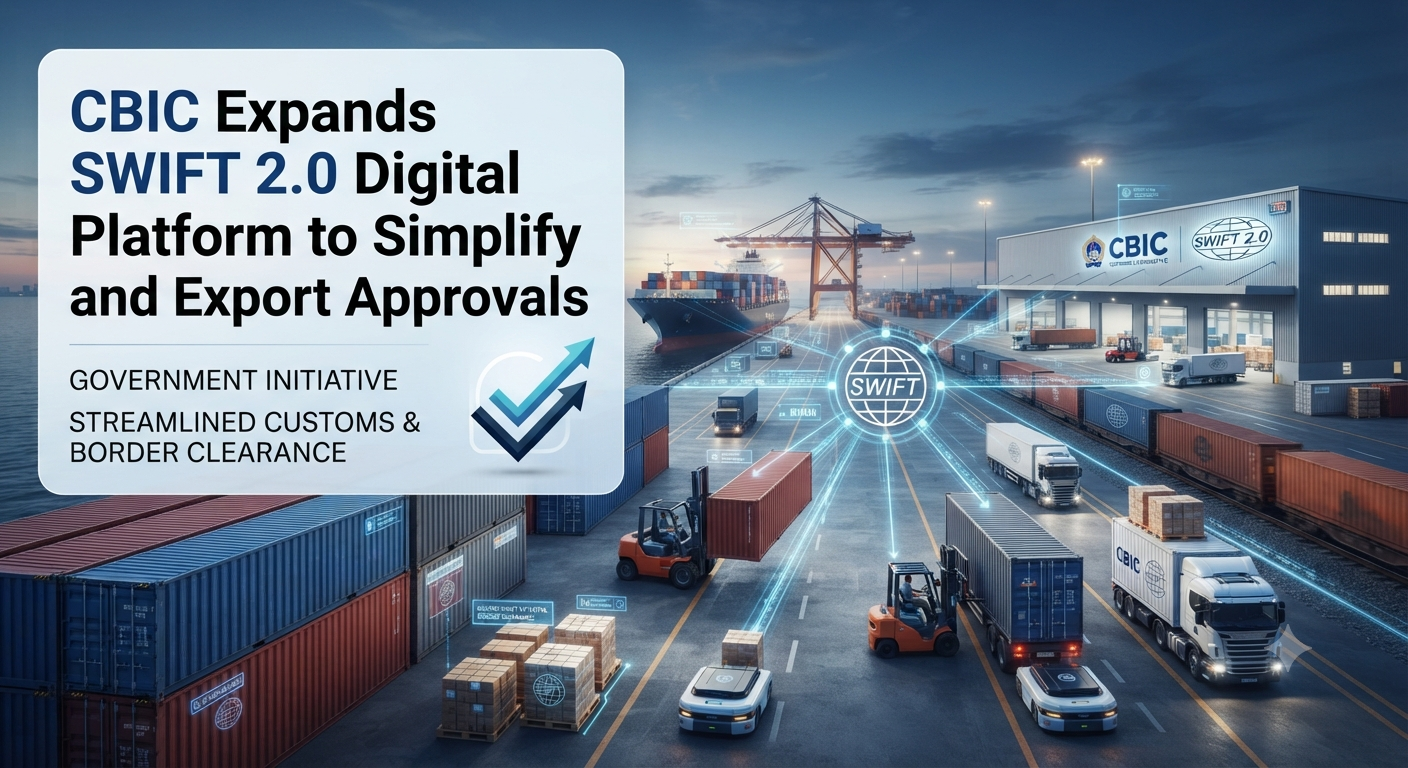
India’s international trade ecosystem is undergoing a digital transformation as the Central Board of Indirect Taxes and Customs (CBIC) expands the Single Window Interface for Facilitating Trade (SWIFT) 2.0. The upgraded platform is designed to provide importers, exporters and other trade stakeholders with a unified digital interface for customs-related approvals, certificates, licences and regulatory clearances.
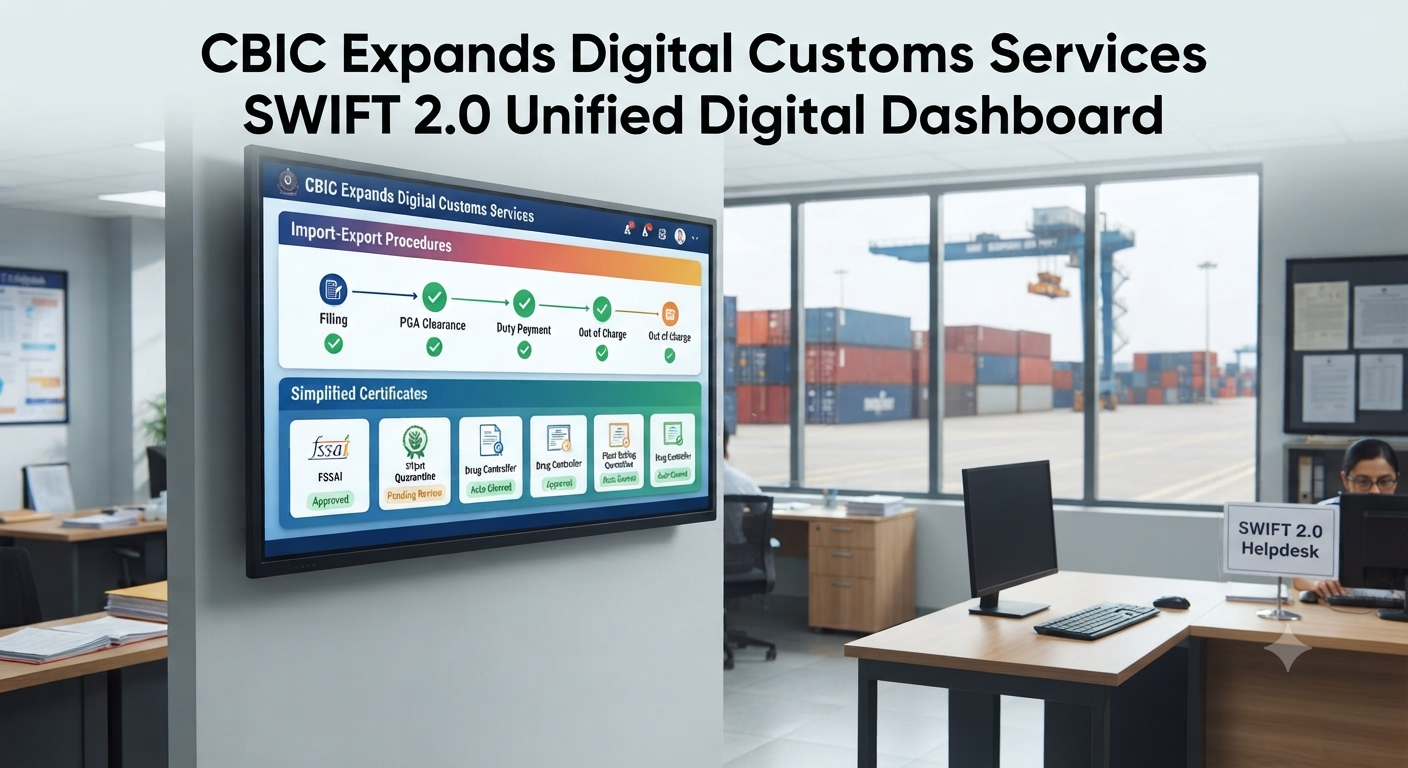
Integrated with the Indian Customs Electronic Gateway (ICEGATE), SWIFT 2.0 aims to reduce paperwork, improve transparency and simplify interactions with multiple Partner Government Agencies (PGAs). Instead of navigating several departmental systems, businesses can increasingly access relevant services through a common dashboard.
The initiative forms part of the government’s broader efforts to improve the ease of doing business, strengthen digital governance and make India’s international trade procedures more efficient.
What Is SWIFT 2.0?
SWIFT stands for Single Window Interface for Facilitating Trade. Its upgraded version represents a shift from a largely document-repository-based arrangement towards a more integrated, data-driven digital platform.
CBIC introduced the expanded framework through Circular No. 29/2025-Customs, dated November 21, 2025. The initial rollout focused on integrating the Animal Quarantine and Certification Services (AQCS), Plant Quarantine Management System (PQMS) and Food Safety and Standards Authority of India (FSSAI).
Under the platform, importers and exporters can submit additional information and supporting documents required for regulatory approvals. They can also view application status, respond to departmental queries, receive SMS and email alerts, make online payments and download approved No Objection Certificates (NOCs).
The system also provides information about scheduled inspections by participating agencies, helping businesses coordinate their shipments and compliance activities.
The objective is to establish a single digital touchpoint for trade-related regulatory interactions while allowing participating agencies to retain their respective approval responsibilities.
Expansion to More Government Agencies
CBIC has progressively expanded SWIFT 2.0 to cover additional regulatory bodies.
Circular No. 05/2026-Customs, dated February 1, 2026, outlined the expansion to include the Central Drugs Standard Control Organisation (CDSCO) and the Wildlife Crime Control Bureau (WCCB), alongside the earlier agencies.
The circular also addressed integration with the Ministry of Electronics and Information Technology (MeitY) and the Textile Committee.
Under the arrangement, certain certificates issued by MeitY, including Concessional Rate of Customs Duty Certificates and Compulsory Registration Order exemption certificates, can be generated and accessed through the SWIFT 2.0 dashboard. Their digital integration with the Bill of Entry helps Customs authorities validate the documents without requiring separate physical production.
Textile Committee test reports can also be made accessible through the dashboard, with provision for online payment of applicable fees.
The broader plan envisages phased onboarding of more than 60 Partner Government Agencies, with the integration process targeted for completion by March 31, 2027.
Recent Integrations Strengthen the Unified Dashboard
The platform’s development has continued through the integration of additional trade-facing services.
Recent implementation updates include:
- Tea Board: Importers and exporters can access selected licensing services through the unified dashboard, including temporary and permanent export licences and the business licence for distributors. Applications, fee payments, amendments and certificate downloads are supported through the integrated workflow.
- GJEPC: The Gem and Jewellery Export Promotion Council’s certificate services include tracking and downloading facilities for Kimberley Process certificates and Trade Permission Certificates.
- SGEPC: The Sports Goods and Toys Export Promotion Council’s import certificate application process has been incorporated into the unified dashboard.
- Archaeological Survey of India: The digital system has been made mandatory for Non-Antiquity Certificates relating to handicrafts and artworks intended for export, replacing the earlier manual application process.
These developments demonstrate that SWIFT 2.0 is gradually extending beyond the initial regulatory agencies to cover a wider range of import and export documentation requirements.
How the Unified Dashboard Benefits Businesses
One of the most important advantages of SWIFT 2.0 is the consolidation of compliance-related activities.
Importers and exporters frequently require approvals from multiple authorities depending on the nature of their products. Food items, pharmaceuticals, agricultural commodities, textiles, wildlife-related products and other regulated goods may require separate certificates or NOCs.
Previously, businesses could face the inconvenience of navigating different departmental portals, submitting similar information repeatedly and following up with multiple authorities.
The unified dashboard is intended to reduce these difficulties through:
1. Centralised application management: Trade users can access participating agencies’ services through a common interface.
2. Real-time application tracking: Businesses can monitor application progress, view pending queries and receive notifications about required actions.
3. Digital certificate access: Approved licences, permits and certificates can be viewed and downloaded online.
4. Online payments: Applicable departmental fees can be paid through integrated digital facilities.
5. Reduced paperwork: Electronic transmission of approved documents can reduce the need for duplicate physical submissions.
6. Improved transparency: Centralised application histories and status updates can make compliance activities easier to monitor.
Together, these features can improve coordination between businesses, Customs authorities and participating government departments.
ICEGATE Integration Further Improves Compliance
SWIFT 2.0 operates within the wider ICEGATE digital infrastructure, which provides electronic services for India’s customs operations.
An additional development is the Compliance Repository, where registered trade users can access licences, permits, certificates and other authorisations issued by participating agencies.
ICEGATE has also clarified that documents already transmitted electronically through SWIFT 2.0 do not need to be uploaded again separately on eSanchit, where the prescribed system-generated Image Reference Number is available.
Importers and exporters should use the relevant reference number and document codes while filing their customs declarations, following the applicable instructions. Incorrect or duplicate document uploads can create inconsistencies during compliance verification.
This integration is particularly important because digital transformation is effective only when information moves accurately between regulatory agencies and the customs clearance system.
Challenges and the Road Ahead
Despite its potential, the success of SWIFT 2.0 will depend on consistent implementation across agencies and customs locations.
Businesses may initially face challenges involving portal familiarity, digital documentation, data accuracy and changes in existing compliance procedures. Smaller importers and exporters may require additional guidance to adapt to the new workflows.
Government agencies will also need to ensure reliable system performance, timely processing of applications and coordination between their respective departments.
The phased onboarding approach provides an opportunity to address operational difficulties while expanding the platform’s coverage.
The Worldonomics Times View
CBIC’s expansion of SWIFT 2.0 represents an important step towards modernising India’s customs and international trade infrastructure. A unified digital dashboard can reduce administrative duplication, improve visibility into regulatory approvals and make import-export procedures more predictable.
However, technology alone cannot eliminate delays. The benefits will depend on how effectively participating agencies process applications, exchange information and resolve queries.
Businesses should familiarise themselves with the dashboard, maintain accurate digital documentation and follow the latest instructions issued by CBIC and individual regulatory agencies.
Ultimately, a well-integrated single-window system can strengthen India’s trade competitiveness by reducing procedural friction while preserving regulatory oversight. As more agencies and services become part of SWIFT 2.0, the platform has the potential to become a central pillar of India’s paperless and technology-driven trade ecosystem.