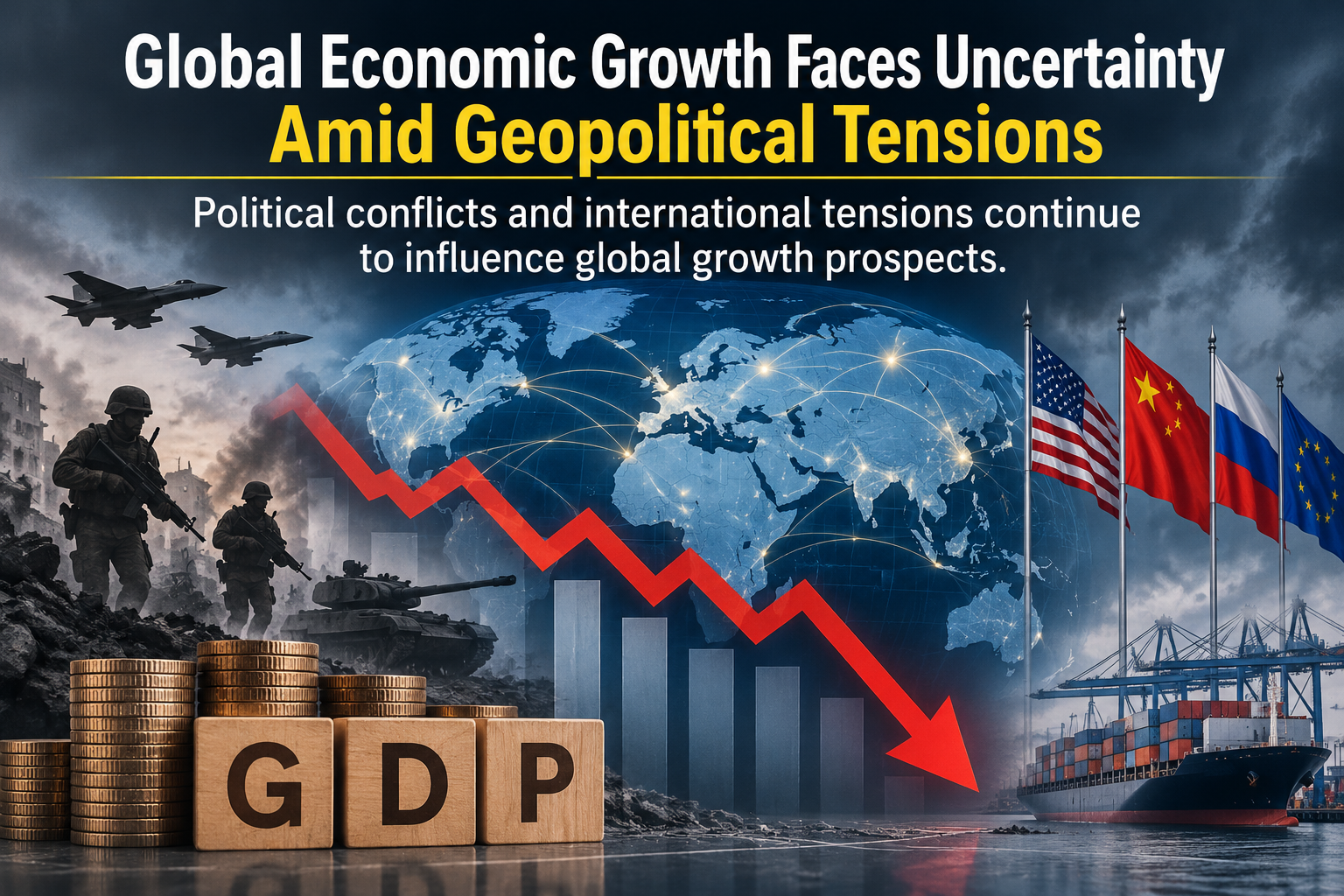
Political conflicts, trade rivalries and international tensions continue to reshape the global economic landscape, putting growth, investment and financial stability under pressure.
The global economy is navigating an increasingly complex environment as geopolitical tensions, regional conflicts, trade disputes and shifting international alliances continue to influence economic growth. While technological advancements, consumer demand and emerging markets offer opportunities for expansion, rising uncertainty is making it difficult for governments, businesses and investors to plan confidently for the future. The interconnected nature of modern economies means that political developments in one region can quickly generate consequences across global markets.
Geopolitical Tensions and Their Economic Impact
Political instability and conflicts have become significant factors shaping global economic performance. Wars, diplomatic disagreements, sanctions and strategic rivalries among major economies have disrupted international trade, weakened investor confidence and created uncertainty across financial markets. Businesses increasingly face unpredictable operating conditions, particularly those dependent on international supply chains, energy imports, raw materials and cross-border transportation.
Geopolitical tensions can also influence government spending priorities. Countries experiencing security challenges often increase defence expenditure, potentially redirecting resources away from infrastructure, education, healthcare and other areas that support long-term economic development. Although defence spending may stimulate certain industries and employment opportunities, its broader economic implications depend on fiscal capacity, priorities and the sustainability of public finances.
Trade Disruptions and Supply Chain Challenges
International trade remains one of the most important engines of global economic growth. However, rising trade restrictions, tariffs, export controls and political disagreements are reshaping the movement of goods and services across borders. Businesses are increasingly reconsidering their supply-chain strategies to reduce exposure to geopolitical risks.
The shift towards diversification, regional manufacturing and alternative sourcing has become a growing priority for multinational companies. Strategies such as nearshoring, friend-shoring and building additional supplier networks can improve resilience, but they may also increase production costs in the short term.
Industries such as electronics, automobiles, pharmaceuticals, energy and manufacturing are particularly vulnerable to disruptions in global supply chains. Delays in the availability of essential components, higher transportation costs and uncertainty surrounding trade policies can affect production schedules, pricing decisions and profitability.
These disruptions may ultimately translate into higher prices for consumers, adding to inflationary pressures and potentially slowing economic activity.
Energy Markets and Inflationary Pressures
Energy markets remain highly sensitive to geopolitical developments. Conflicts affecting major oil-producing regions, shipping routes or energy infrastructure can trigger fluctuations in oil, natural gas and other commodity prices. Such volatility creates challenges for both energy-importing and energy-exporting countries.
Higher energy prices can increase manufacturing expenses, transportation costs and household expenditure. For economies already facing inflationary pressures, sudden energy price increases can complicate monetary policy decisions and limit the scope for interest-rate reductions.
Central banks must carefully balance inflation control with economic growth. Maintaining higher interest rates for extended periods may discourage borrowing, investment and consumption, while premature monetary easing could risk reigniting inflation. This delicate balance adds another layer of uncertainty to the global economic outlook.
Investment, Financial Markets and Business Confidence
Geopolitical uncertainty often influences investor behaviour, encouraging a cautious approach towards capital allocation. Financial markets may experience increased volatility as investors respond to changing political conditions, economic sanctions, trade negotiations and security developments.
Businesses may postpone major investment decisions when the future regulatory environment, access to markets or supply of resources remains uncertain. Such delays can affect infrastructure projects, manufacturing expansion, technology development and employment creation.
Nevertheless, uncertainty does not necessarily eliminate investment opportunities. Industries associated with renewable energy, cybersecurity, defence technology, infrastructure resilience, logistics diversification and digital transformation may benefit from changing global priorities. The challenge for investors is to distinguish sustainable growth opportunities from temporary market reactions.
Emerging Economies Face Both Risks and Opportunities
Emerging economies are particularly exposed to external shocks because many depend heavily on international trade, foreign investment, imported energy and commodity markets. Currency volatility, rising borrowing costs and capital outflows can place pressure on financial stability.
However, changing global supply chains may also create opportunities for countries capable of attracting manufacturing investment, strengthening infrastructure and improving business conditions. Economies that invest in logistics, technological capabilities, workforce development and regulatory stability could benefit from companies seeking diversified production locations.
The ability of emerging markets to capitalise on these shifts will depend largely on policy consistency, economic reforms, institutional strength and long-term investment in productive capacity.
The Worldonomics Times View
The Worldonomics Times believes that geopolitical uncertainty is becoming a defining influence on the global economic outlook. Economic growth in the coming years will depend not only on monetary policies, technological innovation and consumer demand, but also on the ability of nations to manage political tensions and preserve international economic cooperation.
Although countries and businesses must strengthen resilience against geopolitical risks, excessive fragmentation of the global economy could undermine efficiency, raise costs and limit opportunities for growth. A balance between national security, economic competitiveness and international collaboration is essential.
The global economy has repeatedly demonstrated its capacity to adapt to crises. However, resilience requires more than short-term responses. Governments must prioritise stable policies, diversified supply chains, sustainable investments and constructive diplomatic engagement. Businesses must adopt flexible strategies, while international institutions should encourage dialogue and cooperation.