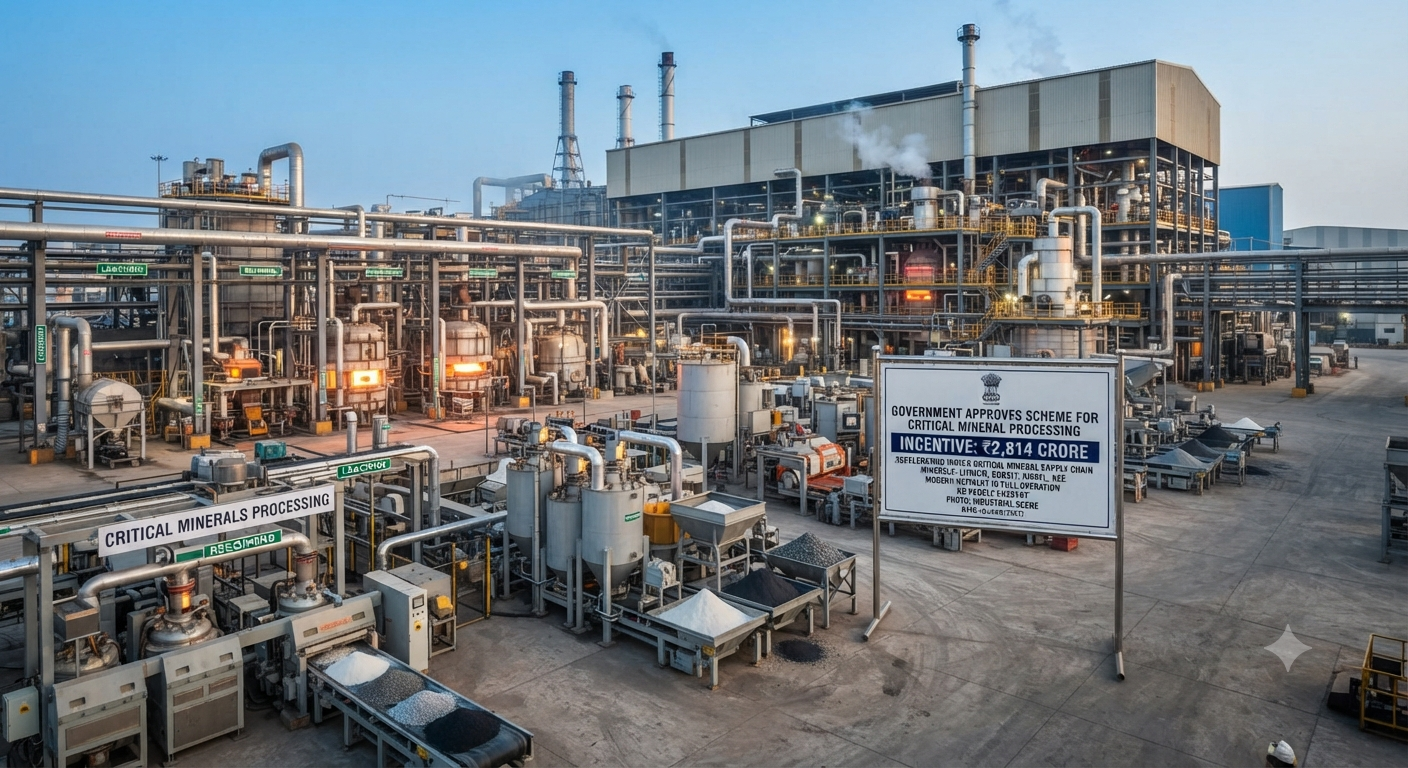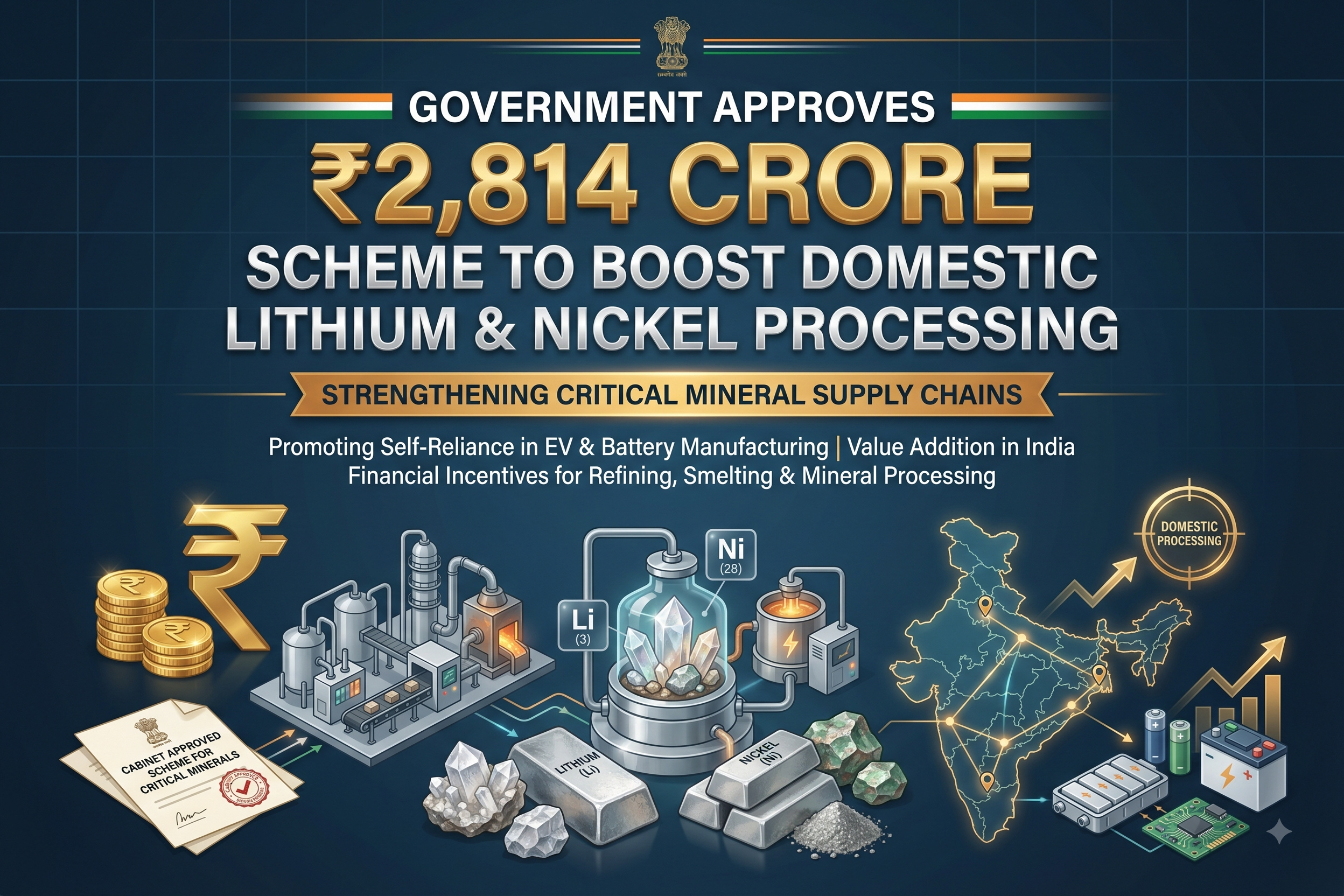
The Union Cabinet has approved a ₹2,814 crore capital support scheme to strengthen India’s domestic critical mineral processing capabilities, marking an important step towards reducing dependence on imported refined minerals and building a more resilient industrial supply chain.
The Capex Support Scheme to Promote Critical Mineral Processing was approved on November 4, 2026, and will operate for five years, from FY2026–27 to FY2030–31. It aims to encourage investment in domestic lithium and nickel processing facilities through capital subsidies covering 30% of eligible investment.
The initiative is expected to support the establishment of four processing plants and attract approximately ₹10,000 crore in total investment. It is also designed to strengthen India’s position in industries that depend on critical minerals, including electric vehicles, battery storage, electronics, defence and speciality steel.
Why Critical Mineral Processing Matters for India
Critical minerals are essential inputs for several industries that are central to economic growth, technological development and national security.
Lithium is a key raw material used in rechargeable batteries for electric vehicles, consumer electronics and energy storage systems. Nickel is widely used in battery manufacturing, stainless steel and other industrial applications. Cobalt, which can be recovered as a by-product of nickel processing, is also an important material in certain battery chemistries and industrial applications.
Despite growing demand, India remains substantially dependent on imports for refined intermediates and high-purity materials. Domestic processing capacity is still at an early stage, with companies facing challenges such as high initial investment requirements, access to suitable technologies and the availability of appropriate raw materials.
The concentration of mineral processing in a limited number of countries also creates supply-chain vulnerabilities. Geopolitical tensions, export restrictions, international price movements and logistics disruptions can affect the availability and cost of these materials.
The new scheme seeks to address this gap by encouraging investment in domestic processing rather than relying predominantly on imported refined products.
₹2,814 Crore Financial Support Structure
The scheme provides a capital subsidy of 30% of eligible investment for establishing four critical mineral processing plants.
The proposed facilities will include:
- Two lithium processing plants: Each with a minimum capacity of 30,000 tonnes per annum of lithium carbonate equivalent (LCE).
- Two nickel processing plants: Each with a minimum capacity of 50,000 tonnes per annum of nickel metal content.
The maximum government support will be capped at ₹500 crore per lithium processing beneficiary and ₹900 crore per nickel processing beneficiary.
The overall allocation is structured as follows:
| Component | Government support |
|---|---|
| Two lithium processing plants | ₹1,000 crore |
| Two nickel processing plants | ₹1,800 crore |
| Administrative expenses | ₹14 crore |
| Total outlay | ₹2,814 crore |
The entire scheme will be funded through budgetary support from the Government of India.
The financial structure is intended to reduce the upfront investment burden on companies and improve the commercial viability of projects that may otherwise face significant capital and technology-related barriers. <Cite refs={[“turn178869search2″,”turn178869search4”]}/>
Competitive Selection to Ensure Efficient Allocation
The government will select beneficiaries through a two-stage competitive process.
In the first stage, applicants will undergo technical evaluation. Only companies that satisfy the specified technical requirements will qualify for the financial bidding stage.
In the second stage, eligible applicants will compete based on the amount of capital support they seek. Selection will follow a least-cost criterion, favouring applicants requiring the lowest government support for the proposed investment.
Two beneficiaries will be selected for each mineral, resulting in four supported processing facilities.
The incentives will be disbursed in three instalments linked to the achievement of specified project milestones. This approach is intended to connect government assistance with actual progress in establishing and operationalising the facilities.
The milestone-based mechanism is important because it encourages project completion and helps ensure that public funds support tangible manufacturing capacity rather than remaining tied up in delayed projects.
What the Scheme Means for Electric Vehicles and Battery Storage
The expansion of electric mobility and renewable energy storage is increasing the importance of reliable access to battery materials.
India’s electric vehicle market is developing rapidly, while the integration of renewable electricity into the national grid is increasing demand for battery energy storage systems.
Both developments require dependable supply chains for critical minerals and processed materials.
By supporting domestic lithium processing, the government aims to create greater value addition within India and strengthen the availability of battery-grade materials. Nickel processing can also support battery manufacturing and other industrial applications, while enabling the recovery of cobalt as a by-product.
However, establishing processing facilities is only one part of the supply chain. Consistent access to mineral feedstock, competitive energy costs, advanced processing technology and environmental compliance will also determine whether domestic facilities can operate successfully.
Strengthening India’s Critical Mineral Value Chain
The scheme complements the government’s wider efforts under the National Critical Mineral Mission, approved in January 2025.
The mission focuses on strengthening the critical mineral ecosystem through exploration, mining, beneficiation, processing and recycling.
The new capital support initiative addresses a particularly important gap in this chain: the conversion of mineral ores and intermediate products into high-purity materials suitable for industrial use.
For lithium, the scheme supports processing lithium concentrate obtained from mineral deposits, excluding brine sources, into products such as lithium carbonate, lithium hydroxide monohydrate or lithium metal.
For nickel, eligible processing routes include conversion of nickel ore and intermediate products into nickel metal or nickel sulphate hexahydrate.
Developing these capabilities could increase domestic value addition, encourage technology partnerships and create opportunities for Indian engineering and chemical-processing companies.
The initiative is also expected to support the broader manufacturing ecosystem through demand for specialised equipment, industrial infrastructure, technical services and skilled employment.
Investment Opportunities and Implementation Challenges
The scheme is expected to anchor approximately ₹10,000 crore in investment, substantially exceeding the direct government financial support.
This could create opportunities for companies involved in mineral processing, industrial engineering, chemical manufacturing, battery materials and associated infrastructure.
Nevertheless, the success of the programme will depend on several practical factors.
First, selected companies must secure reliable supplies of lithium and nickel feedstock. Domestic processing capacity cannot operate sustainably without access to suitable raw materials, whether sourced locally or through international partnerships.
Second, advanced processing facilities require specialised technologies, technical expertise and strict environmental safeguards. Project developers must ensure that production is commercially competitive while meeting environmental and regulatory standards.
Third, global mineral prices can fluctuate significantly. A fall in international prices could affect project economics, while supply disruptions could increase operating costs.
Finally, the government will need to monitor project implementation, milestone completion and the effective use of financial assistance.
The Worldonomics Times View
The ₹2,814 crore critical mineral processing scheme is a strategically important initiative because it focuses on a part of the supply chain that is essential but often overlooked: domestic refining and processing.
Securing access to mineral resources is not enough to establish industrial self-reliance. Countries also need the technological and manufacturing capabilities to convert those resources into high-purity materials used by modern industries.
India’s ambitions in electric mobility, battery storage, electronics and advanced manufacturing will depend partly on the reliability and affordability of these inputs.
The decision to support two lithium and two nickel processing plants is a targeted approach rather than a broad subsidy across the entire mineral sector. Its competitive selection process and milestone-linked payments could help direct public funding towards projects with stronger technical and financial prospects.
However, the government must ensure that the facilities are commercially sustainable after the initial subsidy support. Long-term competitiveness will require efficient technology, dependable raw-material supplies, environmental responsibility and strong industrial partnerships.
The scheme should also be viewed as one component of a larger critical mineral strategy. Mining, overseas resource partnerships, recycling and processing must develop together if India is to build a resilient supply chain.
If implemented effectively, the initiative could help India move beyond import-dependent consumption towards greater domestic value addition in materials that will shape the next generation of industrial and energy technologies.
Conclusion
The Union Cabinet’s approval of ₹2,814 crore for domestic lithium and nickel processing represents an important step towards strengthening India’s critical mineral ecosystem.
With a 30% capital subsidy, support for four processing plants and an implementation period extending to FY2030–31, the scheme aims to attract private investment, improve domestic processing capacity and reduce dependence on imported refined materials.
Its success will ultimately depend on the timely establishment of facilities, reliable access to raw materials and the ability of Indian manufacturers to produce high-quality materials at competitive costs.
As global demand for critical minerals continues to grow, building domestic processing capabilities could become an important advantage for India’s manufacturing, energy and technology sectors.