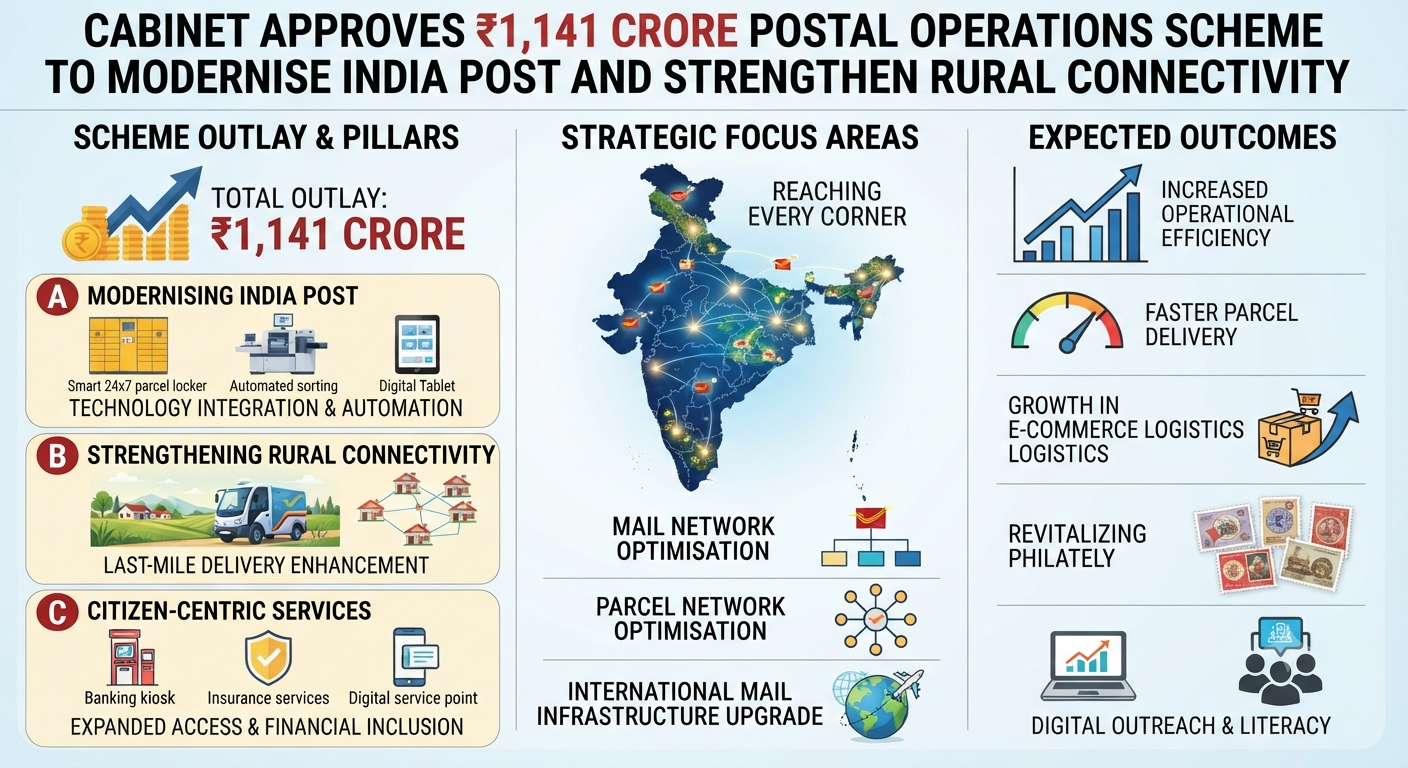
The Union Cabinet has approved an outlay of ₹1,141 crore for the continuation of the Postal Operations Scheme during the five-year period from FY2026–27 to FY2030–31. The initiative aims to modernise India’s extensive postal network, improve mail and parcel delivery, strengthen rural connectivity and expand technology-enabled public services.
Approved on November 25, 2026, the scheme forms part of the government’s broader effort to transform India Post into a more efficient, digitally connected and customer-oriented service network. It will focus on six areas, including rural postal access, mail network optimisation, parcel logistics, international mail infrastructure, service quality and philately operations.
The programme is particularly important as India Post continues to serve millions of people across urban centres, villages and remote regions, where access to reliable delivery and essential citizen services remains critical.
₹1,141 Crore to Support Six Key Areas
The Postal Operations Scheme has been structured into six sub-schemes, each addressing a specific operational requirement.
The largest allocation of ₹575 crore has been earmarked for Mail Network Optimisation. Another ₹278 crore will support Parcel Network Optimisation, while ₹120 crore has been allocated to Rural Business and Access to the Postal Network.
The remaining funds will be distributed across international mail infrastructure, marketing and quality-of-service initiatives, and philately operations.
The allocation is designed to strengthen both the physical infrastructure and digital capabilities required for efficient postal services.
Modernising Rural Post Offices and Expanding Last-Mile Access
A major focus of the initiative is improving postal infrastructure in rural and underserved areas.
Under the Rural Business and Access to Postal Network component, ₹120 crore will be invested in infrastructure upgrades, standardised branding and better resource utilisation. The objective is to transform rural post offices into efficient service hubs capable of supporting a wider range of citizen-centric activities.
India Post operates approximately 1.65 lakh post offices, including around 1,49,655 rural post offices. This extensive network provides an important channel for reaching communities that may have limited access to conventional banking, logistics and government services.
The scheme aims to strengthen financial inclusion, digital connectivity and local economic development while improving access to postal services and last-mile delivery.
For rural households, small businesses and local entrepreneurs, improved postal infrastructure could make it easier to access delivery services, financial products and other essential facilities.
₹575 Crore for Mail Network Optimisation
Mail Network Optimisation will receive the largest share of the scheme’s budget, reflecting the importance of improving the efficiency of traditional postal operations.
The ₹575 crore allocation will support centralised delivery systems, mechanisation, upgraded mail-handling infrastructure and advanced information technology solutions under Advanced Postal Technology (APT 2.0).
The programme also includes modernisation of 160 Mail Hubs, 7,000 delivery post offices and 17 Mail Motor Service workshops. Improvements to the road transport network and the introduction of 10,000 smart 24×7 letter boxes are also envisaged.
GIS-based services and technology-enabled operational systems are expected to improve tracking, transparency and delivery management.
These upgrades could help reduce operational bottlenecks, improve the movement of mail between locations and make postal services more reliable for customers.
Strengthening Parcel Operations for E-Commerce Growth
The expansion of online shopping has increased demand for efficient parcel collection, sorting, packaging and delivery networks.
To address this opportunity, the government has allocated ₹278 crore for Parcel Network Optimisation.
The component envisages the development of 67 Parcel Hubs and 510 Parcel Packaging Units (PPUs). These facilities are expected to improve parcel handling capacity, streamline sorting operations and support more efficient movement of consignments.
The investment could strengthen India Post’s position in the competitive logistics market, particularly in areas where private delivery networks may have limited reach.
Small businesses, rural sellers and e-commerce enterprises could benefit from improved parcel infrastructure and more standardised packaging facilities.
A stronger parcel network may also support the movement of products from smaller towns and rural markets to customers across India and international destinations.
International Mail Infrastructure and Service Quality
The scheme also includes ₹8 crore for upgrading international mail infrastructure, particularly Foreign Post Offices and Sub Foreign Post Offices.
The objective is to improve the processing of international consignments and strengthen India’s postal logistics capabilities in cross-border trade.
Another ₹100 crore has been allocated for marketing functions, including quality-of-service improvements. The programme will support promotional campaigns, customer engagement, Dak Chaupal activities, market research and service evaluation.
These measures are intended to increase awareness of India Post’s services and improve customer experience across different regions.
Additionally, ₹60 crore has been earmarked for philately operations. The component will support stamp exhibitions, educational initiatives, new stamp designs and the modernisation of philately-related facilities.
Supporting Digital India and Financial Inclusion
India Post has evolved beyond its traditional role as a mail delivery organisation. Its network supports a range of public-facing services, including Post Office Savings Bank facilities, India Post Payments Bank services, Postal Life Insurance, Aadhaar enrolment and updates, and passport-related services through designated post offices.
The Postal Operations Scheme aims to strengthen the infrastructure through which these services reach citizens.
Technology integration, improved connectivity and better operational systems could make service delivery more accessible, particularly for people living in remote and underserved locations.
The initiative also aligns with the government’s broader objectives of Digital India, Atmanirbhar Bharat and Viksit Bharat.
The Worldonomics Times View
The ₹1,141 crore Postal Operations Scheme represents an important investment in an institution that continues to play a major role in India’s public-service and logistics ecosystem.
While private logistics companies have expanded rapidly with the growth of e-commerce, India Post possesses a significant advantage through its extensive geographical reach. Its network of approximately 1.65 lakh post offices provides an established platform for delivering services across both urban and rural India.
The scheme’s allocation priorities are noteworthy. The ₹575 crore investment in mail network optimisation and ₹278 crore for parcel infrastructure demonstrate that the government recognises the need to modernise traditional operations while responding to changing logistics demand.
However, financial allocation alone will not guarantee better service outcomes. The success of the programme will depend on timely infrastructure upgrades, effective technology implementation, trained personnel and measurable improvements in delivery performance.
India Post will also need to strengthen its competitiveness in parcel logistics through reliable tracking, predictable delivery timelines and convenient customer services.
The rural component deserves particular attention. Modernised post offices can become valuable local access points for financial and government services, helping bridge the gap between digital infrastructure and communities with limited access to formal service networks.
If implemented effectively, the scheme could strengthen India Post’s relevance in a rapidly changing economy while improving the quality and reach of essential public services.
Conclusion
The Cabinet’s approval of ₹1,141 crore for the Postal Operations Scheme marks a significant step towards modernising India’s postal infrastructure over the next five years.
With investments in rural post offices, mail handling, parcel hubs, international mail facilities and digital systems, the programme aims to make India Post more efficient, accessible and responsive to changing customer requirements.
The long-term impact will depend on effective execution and the ability to translate infrastructure investment into faster deliveries, better logistics services and wider access to citizen-centric facilities across the country.