New Delhi | 10 November 2026
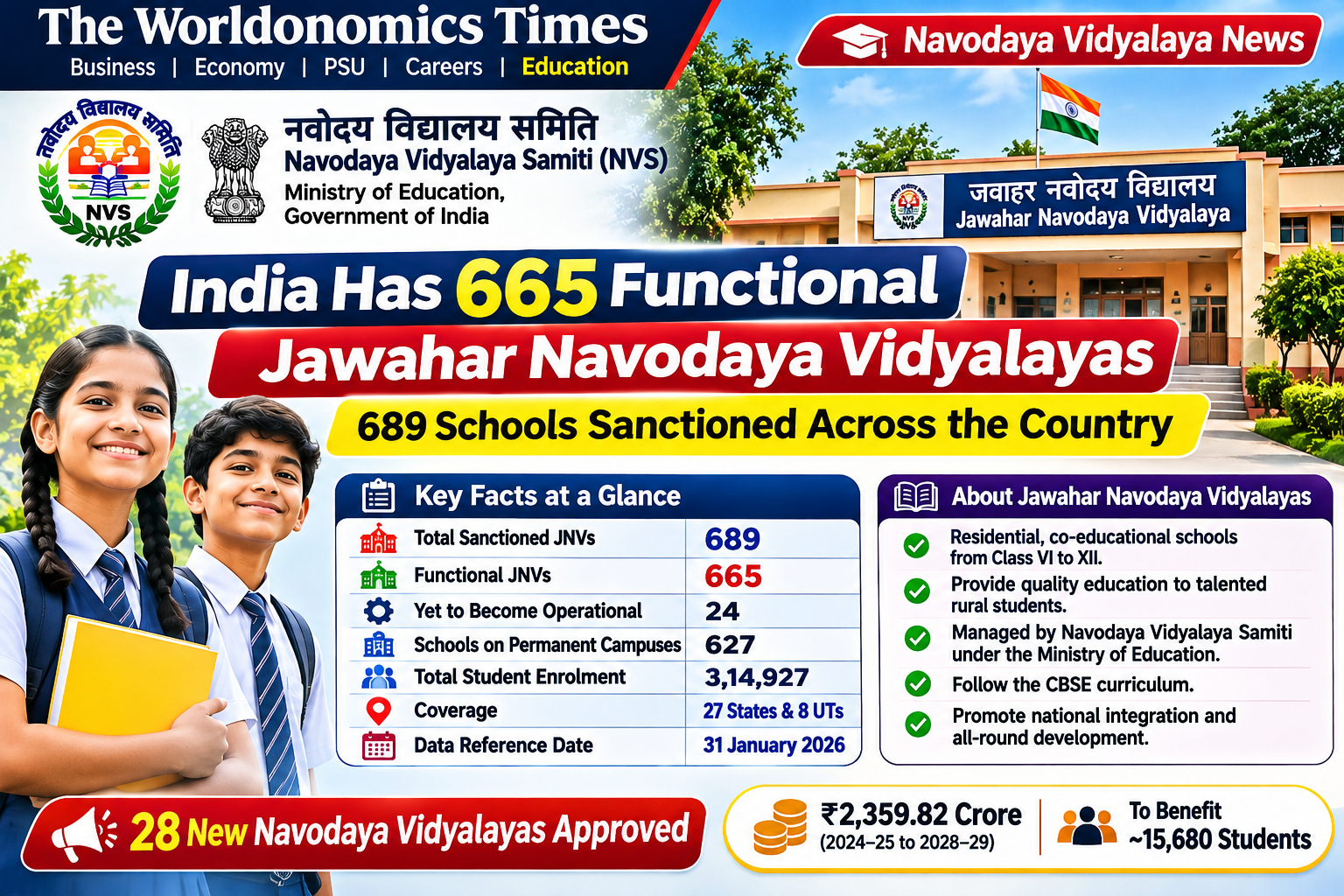
India has a network of 665 functional Jawahar Navodaya Vidyalayas (JNVs), while a total of 689 schools have been sanctioned across the country, according to the Navodaya Vidyalaya Samiti’s Perspective Academic Plan 2026–27.
The figures highlight the continued expansion of India’s residential school education system, which aims to provide quality education to talented children, particularly from rural backgrounds, irrespective of their socio-economic circumstances.
Out of the 689 sanctioned schools, 665 are operational, while 24 are yet to become functional. The development of the remaining schools depends on factors including land availability, infrastructure and arrangements made by the concerned State Governments and Union Territory administrations.
Jawahar Navodaya Vidyalayas: Key Statistics
| Particulars | Details |
|---|---|
| Total sanctioned JNVs | 689 |
| Functional JNVs | 665 |
| Non-functional / Yet to become operational | 24 |
| Schools operating from permanent campuses | 627 |
| Total student enrolment | 3,14,927 |
| States and UTs covered | 27 States and 8 UTs |
| Academic plan reference | 2026–27 |
| Data reference date | 31 January 2026 |
Source: NVS Perspective Academic Plan 2026–27.
What Are Jawahar Navodaya Vidyalayas?
Jawahar Navodaya Vidyalayas are co-educational residential schools established under the Navodaya Vidyalaya Scheme, launched in 1986.
These schools are managed by Navodaya Vidyalaya Samiti (NVS), an autonomous organisation functioning under the Ministry of Education, Government of India.
The primary objective of the scheme is to identify talented children, predominantly from rural areas, and provide them with quality modern education in a residential environment.
JNVs provide education from Class VI to Class XII and follow the Central Board of Secondary Education (CBSE) curriculum.
Free Residential Education for Rural Students
One of the most significant features of Jawahar Navodaya Vidyalayas is the provision of residential education.
Students receive education along with boarding and lodging facilities without regard to their family’s socio-economic background, subject to the applicable admission and school rules.
The schools aim to develop academic excellence, leadership qualities, national integration, cultural awareness and all-round personality development.
The Navodaya system also promotes linguistic and cultural integration through its student migration programme, under which eligible students experience education in different linguistic regions of the country.
Government Approves 28 New Navodaya Vidyalayas
In December 2024, the Union Cabinet approved the establishment of 28 additional Navodaya Vidyalayas in uncovered districts across the country.
The project carries an estimated financial requirement of ₹2,359.82 crore over five years, from 2024–25 to 2028–29.
According to the Government, these 28 schools are expected to benefit approximately 15,680 students, with each fully developed school having a capacity of 560 students.
The expansion is expected to strengthen access to quality residential education in districts that were previously not covered under the scheme.
Why Are Some Sanctioned Schools Not Yet Functional?
Although 689 Navodaya Vidyalayas have been sanctioned, not all have become operational.
The establishment of a new JNV requires the concerned State Government or Union Territory administration to provide approximately 30 acres of suitable land free of cost, along with temporary accommodation and other necessary facilities until the permanent campus is developed.
Delays in land availability, construction and temporary infrastructure arrangements can affect the operationalisation of sanctioned schools.
The Government has stated that opening new Navodaya Vidyalayas is a continuous process, subject to approval and fulfilment of the prescribed requirements.
Navodaya Vidyalayas and the Future of Rural Education
The expansion of the JNV network represents an important component of India’s efforts to improve educational opportunities for talented students in rural and underserved regions.
With 665 functional schools and more than 3.14 lakh students enrolled, the Navodaya system continues to provide a residential education pathway for students seeking quality academic opportunities.
Further operationalisation of the sanctioned schools could expand access to education and help bridge the gap between rural and urban educational opportunities.
The Worldonomics Times – Education News Desk
Sources
- Ministry of Education – Navodaya Vidyalaya Samiti, Perspective Academic Plan 2026–27.
- Press Information Bureau – Cabinet approval for 28 new Navodaya Vidyalayas, 6 December 2024.
- Government of India – Ministry of Education, Rajya Sabha information on sanctioned Navodaya Vidyalayas.
Note: School statistics are based on the NVS academic plan data as of 31 January 2026. Figures may change as additional schools become operational.