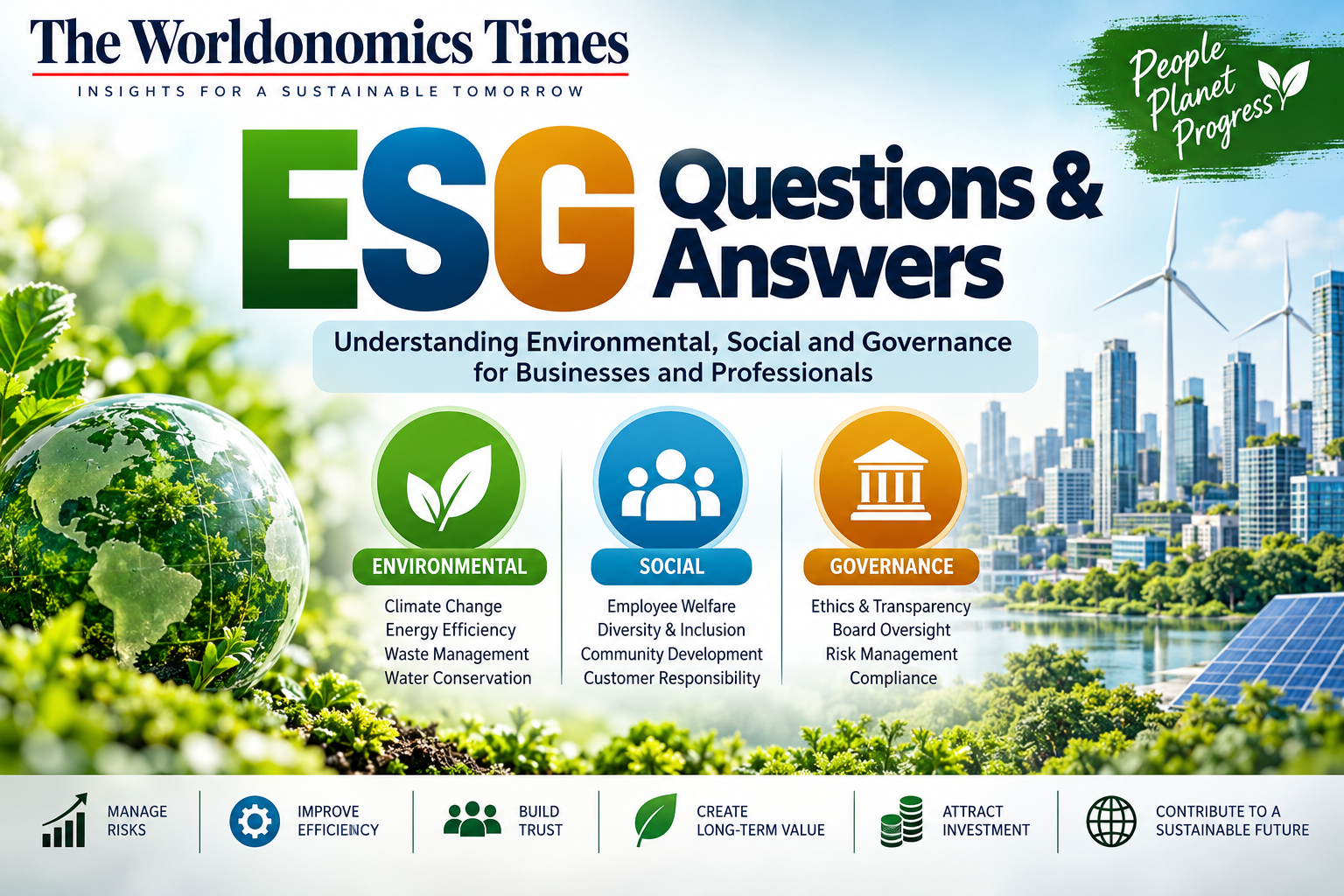
Understanding UK ESG, Sustainability and Climate Disclosure Requirements
1. What is ESG reporting in the UK?
ESG reporting in the UK refers to the disclosure of information relating to environmental, social and governance matters that may be relevant to a company’s stakeholders, investors, regulators and other users of corporate reports.
The UK does not have one single ESG reporting law. Instead, requirements arise from company law, FCA rules, environmental reporting requirements and sector-specific regulations.
2. Is ESG reporting mandatory in the UK?
ESG reporting is mandatory for certain categories of UK companies and financial institutions, but not for every business.
The exact requirements depend on factors such as company size, listing status, sector, financial position and applicable regulation.
3. What are the major components of mandatory ESG reporting in the UK?
Important areas include:
- Climate-related financial disclosures
- Greenhouse-gas emissions
- Energy consumption
- Environmental matters
- Employee information
- Social matters
- Human rights
- Anti-corruption and anti-bribery
- Governance
- Sustainability-related financial risks and opportunities
4. What is the role of the Companies Act 2006 in ESG reporting?
The Companies Act 2006 contains requirements for certain companies to include environmental, employee, social, human-rights and anti-corruption information in their strategic reporting.
Section 414CB also contains requirements relating to climate-related financial disclosures for companies within its scope.
5. What is climate-related financial disclosure?
Climate-related financial disclosure involves reporting information about how climate-related risks and opportunities may affect a company’s business, strategy, governance and financial prospects.
6. Which companies are subject to UK climate-related reporting requirements?
The UK framework covers certain publicly quoted companies, large private companies and large LLPs, subject to the applicable size and other criteria.
Companies should therefore assess their individual circumstances rather than assuming that every UK business has identical requirements.
7. What is TCFD?
TCFD stands for Task Force on Climate-related Financial Disclosures.
Its framework was built around four major areas:
- Governance
- Strategy
- Risk Management
- Metrics and Targets
These concepts have strongly influenced the UK’s climate-disclosure regime.
8. Is TCFD still the main UK sustainability reporting framework?
The UK is transitioning toward the UK Sustainability Reporting Standards (UK SRS).
For UK listed companies, the FCA has finalised rules replacing the existing TCFD-based requirements with UK SRS requirements from accounting periods beginning 1 January 2027.
9. What are UK Sustainability Reporting Standards?
UK SRS are the UK’s sustainability disclosure standards based on the international ISSB standards.
The UK Government published:
- UK SRS S1 – General Requirements for Disclosure of Sustainability-related Financial Information
- UK SRS S2 – Climate-related Disclosures
in February 2026.
10. Are UK SRS currently mandatory?
Not universally.
The UK Government states that UK SRS are currently available for voluntary use. However, the FCA has finalised rules requiring listed companies within scope to report against UK SRS on a comply-or-explain basis from accounting periods beginning 1 January 2027.
11. What does “comply or explain” mean?
A comply-or-explain approach means a company is expected to make the required disclosures or provide an appropriate explanation where it has not complied with the relevant reporting requirement.
This provides some flexibility while maintaining transparency for investors.
12. What is UK SRS S1?
UK SRS S1 deals with general sustainability-related financial disclosures.
It requires information about sustainability-related risks and opportunities that could reasonably be expected to affect an entity’s prospects.
13. What is UK SRS S2?
UK SRS S2 focuses specifically on climate-related risks and opportunities.
It covers areas such as governance, strategy, risk management and metrics and targets relating to climate.
14. Are UK SRS based on international standards?
Yes.
UK SRS S1 and S2 were developed by assessing and endorsing the ISSB’s global sustainability reporting baseline, with modifications considered appropriate for the UK.
15. What is ISSB?
ISSB stands for International Sustainability Standards Board.
It develops global sustainability disclosure standards designed primarily to provide investors with comparable and decision-useful information.
16. Why is the UK adopting ISSB-based standards?
The UK aims to improve comparability and consistency of sustainability information and support the country’s sustainable-finance market.
Using an internationally aligned framework can also reduce fragmentation for multinational businesses.
17. What information does UK SRS S1 require?
UK SRS S1 addresses sustainability-related risks and opportunities through areas including:
- Governance
- Strategy
- Risk management
- Metrics and targets
It also incorporates industry-specific disclosure considerations.
18. What information does UK SRS S2 require?
UK SRS S2 focuses on climate-related matters, including:
- Climate governance
- Climate strategy
- Climate risks and opportunities
- Climate resilience
- Emissions
- Climate-related targets
- Metrics
19. What are Scope 1 emissions?
Scope 1 emissions are direct greenhouse-gas emissions from sources owned or controlled by an organisation.
Examples include fuel burned in company-owned vehicles, boilers or industrial facilities.
20. What are Scope 2 emissions?
Scope 2 emissions generally arise from the generation of purchased or acquired electricity, steam, heating or cooling consumed by the organisation.
21. What are Scope 3 emissions?
Scope 3 covers other indirect greenhouse-gas emissions occurring across an organisation’s value chain.
Examples can include supplier emissions, business travel, purchased goods, transportation and use of sold products.
22. Is Scope 3 reporting mandatory in the UK?
The answer depends on the specific reporting regime applicable to the organisation.
Scope 3 requirements should not be assumed to be identical across all UK companies. Under the UK’s climate-reporting framework, different requirements and materiality considerations apply to different categories of disclosures.
23. What is SECR?
SECR stands for Streamlined Energy and Carbon Reporting.
It is a UK reporting framework requiring qualifying companies and LLPs to disclose specified information concerning energy use and carbon emissions.
24. Who is covered by SECR?
SECR applies to qualifying large companies and LLPs, as well as quoted companies within the relevant rules, subject to specific exemptions and thresholds.
25. What information can SECR require?
Depending on the entity and applicable rules, reporting can include:
- Energy consumption
- Greenhouse-gas emissions
- Energy-efficiency measures
- Methodologies used for calculating emissions
26. Is SECR the same as ESG reporting?
No.
SECR primarily addresses energy and carbon reporting. ESG is much broader and includes environmental, social and governance issues.
27. Does UK ESG reporting include employee information?
Yes.
Certain UK corporate reporting requirements cover employee matters, including information relevant to employee policies and the company’s approach to workforce issues.
28. Does UK ESG reporting include human rights?
Yes.
For companies within the relevant reporting requirements, human-rights matters can form part of non-financial and sustainability reporting.
29. Does ESG reporting include anti-corruption?
Yes.
Certain companies are required to provide information relating to anti-corruption and anti-bribery matters within their strategic reporting framework.
30. What is the role of the FCA in UK ESG reporting?
The Financial Conduct Authority (FCA) regulates financial markets and has an important role in sustainability disclosures by listed companies and regulated financial firms.
The FCA has finalised UK SRS-related rules for listed companies.
31. Which listed companies are covered by the new FCA UK SRS rules?
The FCA’s final rules cover issuers with specified UK listing categories, including equity shares of commercial companies, certain international commercial companies with secondary listings and certain depositary receipts.
The requirements apply on a comply-or-explain basis.
32. When do the new FCA UK SRS requirements start?
The new rules come into force for accounting periods beginning 1 January 2027.
33. What is the difference between TCFD and UK SRS?
TCFD is a climate-disclosure framework, while UK SRS S1 covers sustainability-related financial information more broadly and UK SRS S2 focuses on climate-related disclosures.
The UK is moving from its TCFD-based listed-company regime toward UK SRS.
34. What is materiality in UK ESG reporting?
Materiality generally focuses on sustainability-related information that could reasonably be expected to influence investors’ assessments of an entity’s prospects.
Materiality is therefore central to sustainability-related financial disclosures.
35. What is double materiality?
Double materiality considers both:
- How sustainability matters affect the company; and
- How the company’s activities affect people and the environment.
The UK SRS/ISSB approach is primarily investor-focused rather than adopting the EU’s broader double-materiality model.
36. What is climate-risk reporting?
Climate-risk reporting communicates how physical and transition risks associated with climate change may affect the company’s strategy, operations and financial prospects.
37. What are physical climate risks?
Physical risks can include:
- Flooding
- Extreme heat
- Storms
- Drought
- Wildfires
- Water stress
These risks can disrupt operations, supply chains and assets.
38. What are transition risks?
Transition risks arise from the shift toward a lower-carbon economy.
They can include:
- Policy changes
- Carbon pricing
- Technological changes
- Changing consumer preferences
- New market requirements
39. What is a climate transition plan?
A climate transition plan describes how an organisation intends to adapt its strategy, operations and investment decisions to a changing climate and the transition toward a lower-carbon economy.
40. Why is ESG reporting important for UK investors?
Reliable ESG information can help investors evaluate:
- Long-term risks
- Climate exposure
- Business resilience
- Governance quality
- Sustainability-related opportunities
- Capital allocation decisions
41. How does ESG reporting affect UK CFOs?
CFOs increasingly need to connect ESG information with:
- Financial reporting
- Budgeting
- Risk management
- Capital expenditure
- Internal controls
- Investor communication
- Business planning
42. What role can accountants play in UK ESG reporting?
Accountants can contribute through:
- ESG data controls
- Sustainability reporting
- Carbon accounting
- Internal audit
- Assurance
- Risk management
- Financial impact analysis
- ESG performance measurement
43. What role can management accountants play?
Management accountants can connect sustainability performance with financial decision-making through:
- Environmental cost accounting
- Carbon costing
- ESG budgeting
- Capital investment analysis
- ESG KPIs
- Performance measurement
- Scenario analysis
44. Why is ESG data governance important?
ESG information increasingly needs to be reliable, consistent and auditable.
Companies therefore need appropriate systems for collecting, validating, documenting and reporting sustainability data.
45. What is ESG assurance?
ESG assurance involves an independent assessment of specified sustainability information or processes.
Its purpose is to increase confidence in the reliability of ESG disclosures.
46. Is ESG assurance mandatory in the UK?
Requirements vary according to the applicable reporting framework.
The UK is also developing an oversight framework for assurance of sustainability-related financial disclosures.
47. What is greenwashing?
Greenwashing occurs when sustainability or environmental claims are misleading, exaggerated or inadequately supported.
48. Why is greenwashing relevant to UK companies?
Companies making sustainability claims to investors, customers or financial markets need credible evidence supporting those claims.
Poor-quality claims can create regulatory, legal and reputational risks.
49. Will UK ESG reporting become more important?
Yes.
The UK is moving toward greater alignment with international sustainability reporting standards, particularly ISSB-based standards.
The FCA’s adoption of UK SRS requirements for listed companies from 2027 is an important development.
50. What is the future of mandatory ESG reporting in the UK?
The UK’s direction is toward a more standardised, investor-focused and internationally aligned sustainability reporting system.
The key framework is increasingly centred around UK SRS S1 and S2, while existing company-law, climate and energy-reporting requirements continue to apply according to the relevant scope.
Conclusion
The UK’s ESG reporting framework is not based on one single ESG law. Instead, mandatory requirements arise from several sources, including the Companies Act 2006, SECR, FCA rules and climate-related reporting requirements.
The next major development is the transition to UK Sustainability Reporting Standards S1 and S2. The standards were finalised by the UK Government in February 2026, and the FCA has finalised rules requiring in-scope listed companies to report against UK SRS on a comply-or-explain basis from accounting periods beginning 1 January 2027.
For finance professionals, ESG reporting is therefore becoming an increasingly important area involving financial reporting, carbon accounting, internal controls, risk management, assurance and strategic decision-making.