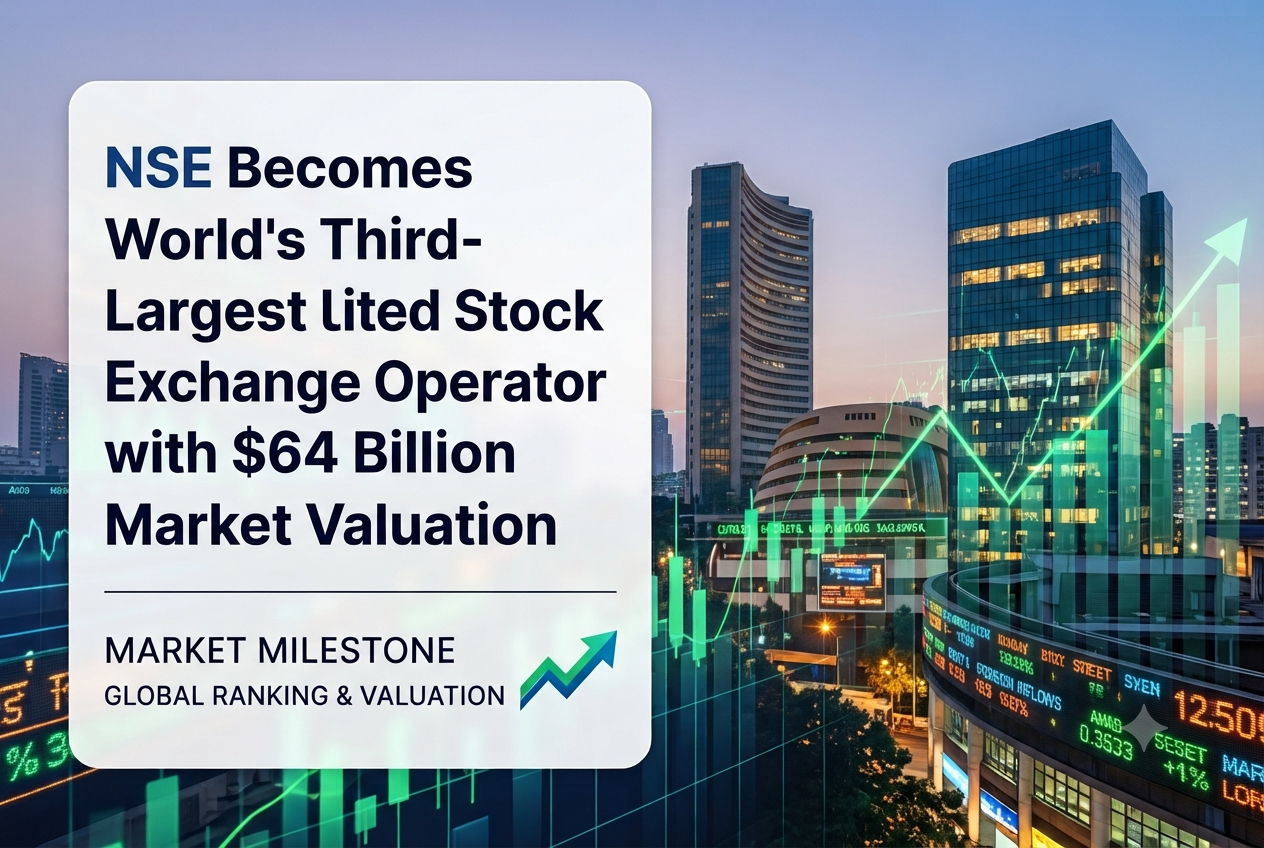
India’s National Stock Exchange (NSE) has achieved a major milestone in global financial markets, emerging as the world’s third-largest listed stock exchange operator by market capitalisation. The exchange’s valuation climbed to approximately US$64.1 billion, allowing it to overtake Germany’s Deutsche Börse and the UK’s London Stock Exchange Group (LSEG).
The milestone was reached on Thursday, November 26, 2026, following a continued rise in NSE shares after their stock market debut in September. The development highlights the growing scale of India’s capital markets and the increasing financial value of its leading market infrastructure institutions.
According to market data reported during Thursday’s trading session, NSE’s valuation stood ahead of Deutsche Börse at approximately US$63.4 billion and London Stock Exchange Group at around US$62.4 billion. The global ranking remained led by US-based CME Group and Intercontinental Exchange (ICE).
NSE Enters the Global Top Three
NSE’s market capitalisation reached approximately ₹6 lakh crore, equivalent to US$64.1 billion, as its shares advanced to a fresh post-listing high.
The global ranking placed the exchange behind:
- CME Group: Approximately US$111.6 billion.
- Intercontinental Exchange (ICE): Approximately US$99.4 billion.
- National Stock Exchange of India: Approximately US$64.1 billion.
NSE moved ahead of Deutsche Börse and London Stock Exchange Group, which had market valuations of approximately US$63.4 billion and US$62.4 billion, respectively.
The comparison concerns publicly listed exchange operators ranked by market capitalisation, rather than every stock exchange worldwide. Market values also fluctuate with share prices and currency movements, meaning the ranking may change over time.
Nevertheless, the achievement represents an important moment for India’s financial services industry, placing a domestic exchange operator among the most valuable publicly traded businesses in the global exchange sector.
Strong Share Performance Drives the Milestone
The increase in NSE’s valuation has been supported by strong performance in its shares since listing.
NSE made its stock market debut on September 24, 2026, following its initial public offering. The shares were issued at ₹1,785 and listed at ₹1,800 on the BSE.
On November 26, the stock advanced to an intraday high of approximately ₹2,400, extending its gains for a second consecutive trading session. The rally helped lift its market capitalisation close to ₹6 lakh crore.
The stock’s performance during November has been particularly strong, with gains recorded in 14 of the first 18 trading sessions of the month, according to market reports.
Its rise reflects investor interest in the exchange’s dominant position in India’s capital markets, its established trading infrastructure and its potential to benefit from the country’s expanding investor base.
Why NSE Holds a Strong Position in India’s Financial Markets
Established in 1992, the National Stock Exchange began operations in 1994 and transformed India’s securities market through the introduction of nationwide electronic trading.
Before electronic trading became widespread, India’s equity markets relied heavily on traditional floor-based systems. NSE helped introduce a technology-driven framework that improved transparency, accessibility and efficiency in securities transactions.
Today, the exchange provides trading facilities across several market segments, including equities, equity derivatives, debt instruments, currencies and commodities. Its ecosystem also includes clearing and settlement infrastructure through its associated institutions.
NSE’s large trading volumes and broad participation from domestic and international investors have made it one of the most important components of India’s financial system.
Its scale is particularly visible in the derivatives market, where the exchange has established a substantial global presence. The company’s Draft Red Herring Prospectus for its public issue highlighted its significant share of worldwide equity derivatives trading, reflecting the scale of its operations and technological infrastructure.
What Makes Exchange Operators Valuable?
Stock exchange operators generate revenue through several business activities. These include transaction charges, listing fees, data services, technology solutions, clearing-related services and other market infrastructure offerings.
Their financial performance is influenced by trading volumes, market participation, new listings, derivatives activity and demand for financial information.
NSE benefits from India’s expanding equity investment culture, growing participation by retail investors and the development of domestic capital markets. Increased trading activity can support transaction-related revenue, although earnings are also influenced by market conditions, regulation and the mix of products traded.
Technology is another important competitive advantage. Exchanges must maintain reliable trading systems capable of processing substantial volumes of orders while ensuring security, transparency and operational continuity.
As India’s financial markets become more sophisticated, demand for advanced trading infrastructure, risk-management systems and data services is likely to remain important.
Implications for India’s Financial Market Position
NSE’s rise in the global valuation ranking is more than a corporate market-capitalisation milestone. It also reflects the growing international significance of India’s financial markets.
A highly valued domestic exchange operator can strengthen investor confidence in India’s market infrastructure and demonstrate the commercial potential of its financial services sector.
The development may also improve India’s visibility among global institutional investors assessing opportunities in financial technology, market infrastructure and capital-market services.
However, the ranking should not be interpreted as a direct measure of the overall size or quality of a country’s financial markets. Market capitalisation reflects investor expectations, profitability, growth prospects and share-price movements. Trading volumes, liquidity, regulatory standards and market resilience remain equally important measures of an exchange’s strength.
The Worldonomics Times View
NSE’s emergence as the world’s third-largest listed exchange operator is a significant achievement for India’s financial ecosystem. It demonstrates how domestic market infrastructure has developed into a valuable business sector with international relevance.
The milestone also underlines the importance of technology, market participation and institutional credibility in building competitive financial exchanges. NSE’s position has been supported by its extensive trading network and its central role in India’s equity and derivatives markets.
However, a rising market valuation also brings greater expectations. Investors will look for sustainable earnings growth, operational resilience, strong corporate governance and continued investment in technology.
The exchange must also maintain a careful balance between commercial growth and its responsibility as a critical market institution. Reliable systems, fair market access and investor protection should remain central to its long-term strategy.
For India, the broader opportunity lies in strengthening the entire capital-market ecosystem, including exchanges, clearing corporations, brokers, asset managers and regulatory institutions.
Conclusion
NSE’s rise to the third position among the world’s largest listed exchange operators, with a market capitalisation of approximately US$64.1 billion, marks an important achievement for India’s financial services sector.
By overtaking Deutsche Börse and London Stock Exchange Group, the Indian exchange has strengthened its position on the global financial map. Sustaining this standing will depend on continued market development, technological innovation, regulatory confidence and consistent financial performance.
The milestone offers a strong indication of India’s growing capital-market influence, while reinforcing the importance of building a resilient and globally competitive financial infrastructure.