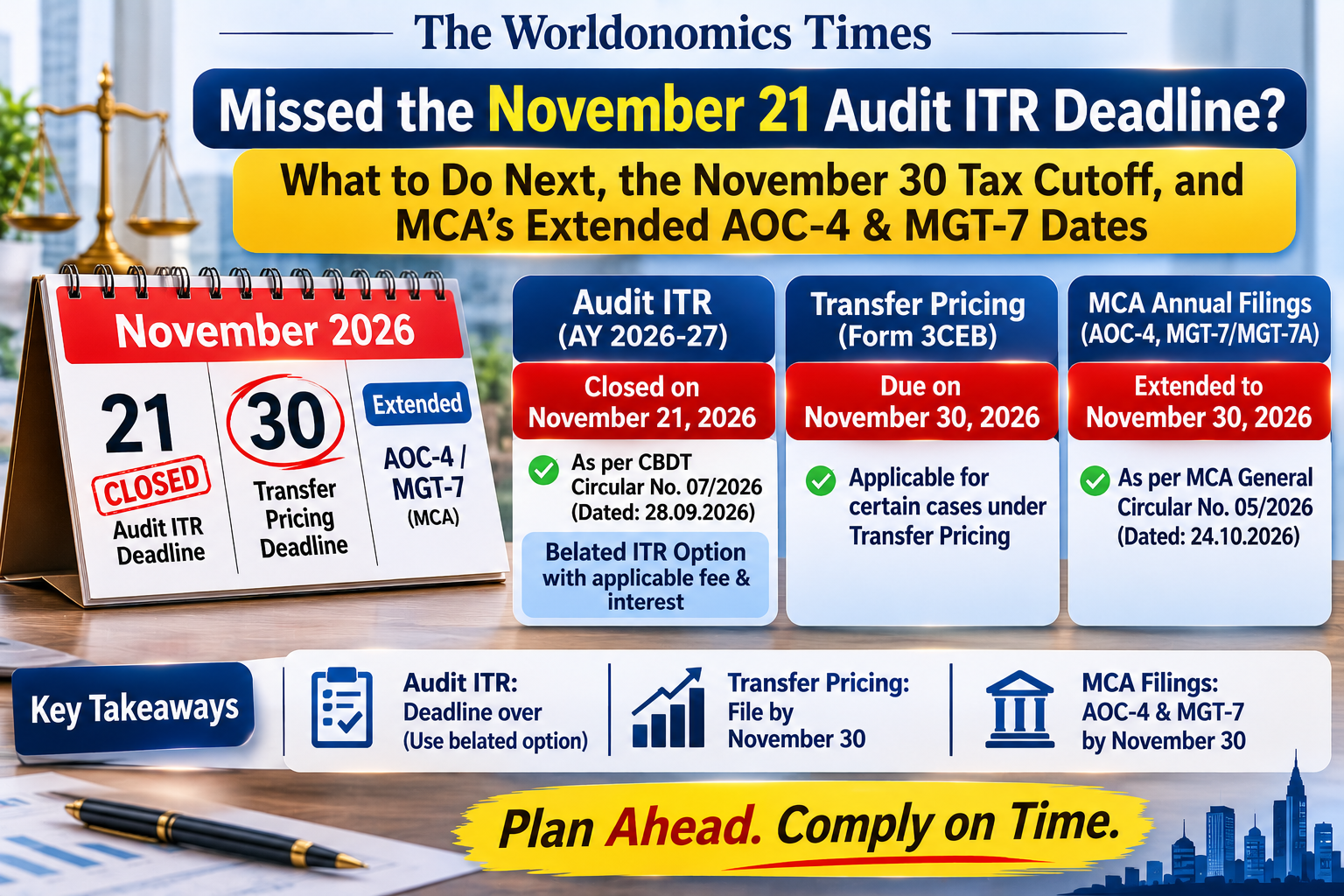
Missed the November 21 Audit ITR Deadline? What to Do Next, the November 30 Tax Cutoff, and MCA’s Extended AOC-4 & MGT-7 Dates
November 2026 has been a packed month for Indian companies, auditors, and tax professionals. Two days ago, on November 21, 2026, the extended due date for filing Income Tax Returns (ITRs) for audit taxpayers (Assessment Year 2026-27) came to an end. Earlier, the Central Board of Direct Taxes (CBDT) had issued Circular No. 07/2026 (dated September 28, 2026), pushing the regular October 31 filing date to November 21, 2026 (after setting the Section 44AB tax audit report due date at October 21, 2026).
While audit ITRs are now closed, finance teams still have two very different timelines to manage: a strict November 30, 2026 Income Tax deadline for Transfer Pricing cases, and a welcome relief window for MCA annual filings (AOC-4 and MGT-7/MGT-7A) under MCA General Circular No. 05/2026 (dated October 24, 2026). Here is a clear, plain-English guide on where every deadline stands today and what you should do next.
Part 1: If You Missed the November 21 Audit ITR Deadline
Missing the Section 139(1) due date does not lock you out of filing your return. You can still file a Belated Return under Section 139(4) of the Income-tax Act, 1961, on or before December 31, 2026. However, filing late comes with four real costs that you need to handle immediately:
- Late Filing Fee (Section 234F): If your total income is above ₹5 lakh, you must pay a flat late fee of ₹5,000. If your total income is up to ₹5 lakh, the fee is ₹1,000.
- Monthly Interest on Unpaid Tax (Section 234A): If any self-assessment tax is still unpaid, you must pay 1% simple interest per month (or part of a month) from the day after the due date until the date of filing. Paying your balance tax via Challan 280 right away stops further interest.
- Loss of Carry-Forward Rights (Section 80): This hurts businesses and startups the most. If your company had a business loss or capital loss in FY 2025-26 and missed November 21, you cannot carry that loss forward to reduce future taxable profits. (Only unabsorbed depreciation under Section 32(2) and loss from house property can still be carried forward on a late return.)
- Tax Regime Lock-In: For non-corporate audit taxpayers who wanted to opt out of the default New Tax Regime (Section 115BAC), choosing the Old Regime is only allowed on returns filed on or before the Section 139(1) due date. A belated return defaults to the New Tax Regime.
Next step: Do not wait until late December. Pay any pending tax now and file your belated ITR well before December 31, 2026. If you miss December 31 too, your only remaining option is an Updated Return (ITR-U) under Section 139(8A), which carries 25% to 50% extra tax and cannot be used to claim refunds or report losses.
Part 2: The Hard November 30, 2026 Deadline (Transfer Pricing ITR)
Unlike regular audit taxpayers, companies that have international transactions or specified domestic transactions under Section 92E (requiring a Form 3CEB report) have their ITR due date on November 30, 2026. There is no extension for this deadline.
Finance teams at Indian subsidiaries of foreign companies, export-focused IT firms, and group companies with cross-border related-party transactions must complete three checks this week:
- Ensure Form 3CEB is verified and matches the exact numbers reported in the ITR.
- File Form 3CEAA (Master File) under Rule 10DA on or before November 30, 2026, if your group crosses the turnover and transaction thresholds.
- Reconcile related-party disclosures in the audited balance sheet with your transfer pricing file to avoid automated notices later.
Part 3: MCA Relief — Extended Deadlines for AOC-4, MGT-7, and MGT-7A
There is good news on the corporate law side. Recognizing that companies needed more time to complete FY 2025-26 annual filings, the Ministry of Corporate Affairs issued General Circular No. 05/2026 (File No. Policy-17/111/2022-CL-V-MCA, dated October 24, 2026).
Under this official circular, companies get a full waiver of additional fees (late fees) for FY 2025-26 annual filings within the following relaxed calendar windows:
- Financial Statements — Up to December 31, 2026: Covers Form AOC-4, AOC-4 (CFS), AOC-4 (XBRL), AOC-4 NBFC (Ind AS), and AOC-4 CFS NBFC (Ind AS) under Section 137 of the Companies Act, 2013. (Normally, for a September 30 AGM, these were due by October 30, 2026.)
- Annual Returns — Up to January 31, 2027: Covers Form MGT-7 (for regular companies) and Form MGT-7A (for Small Companies and One Person Companies) under Section 92 of the Companies Act, 2013. (Normally, for a September 30 AGM, these were due by November 29, 2026.)
Four Hidden Traps in MCA General Circular No. 05/2026
Many directors and accountants misread MCA extensions and end up paying heavy penalties anyway. Keep these four official rules in mind:
- The Retroactive Late Fee Trap (Paragraph 4): This is the most important rule in the circular. If you file AOC-4 on January 1, 2027 (just one day after the December 31 cutoff) or MGT-7 on February 1, 2027, the ₹100-per-day additional fee does not start from January 1 or February 1. The system calculates ₹100 per day back from the original statutory due date (October 30, 2026 for AOC-4, and November 29, 2026 for MGT-7/7A). Missing the relaxed window by even one day instantly triggers over ₹6,000 in backdated late fees per form.
- AGM Deadlines Are Not Extended: The circular clearly states that it does not extend the statutory due date for holding an Annual General Meeting (AGM) under Section 96. Your AGM still had to be held on time (typically by September 30, 2026).
- Other ROC Forms Are Not Covered: The waiver applies only to the specified FY 2025-26 AOC-4 and MGT-7/7A forms. Forms such as ADT-1 (auditor appointment), DIR-12 (director changes), DPT-3 (return of deposits), MGT-14, MSME-1, and LLP annual filings are not covered and continue to attract normal late fees.
- Normal Government Fees Still Apply: Only the ₹100/day additional fee is waived during the extended window; standard statutory filing fees remain payable.
Updated Compliance Calendar at a Glance
| Compliance Item | Official Circular / Section | Revised / Active Deadline | Consequence of Missing Deadline |
|---|---|---|---|
| Audit ITR (AY 2026-27) | CBDT Circular No. 07/2026 & Sec. 139(4) | Closed Nov 21; Belated open till Dec 31, 2026 | ₹5,000 fee (Sec. 234F), 1%/month interest, no business/capital loss carry-forward |
| Transfer Pricing ITR | Sec. 139(1) & Sec. 92E (Form 3CEB) | November 30, 2026 (No extension) | Late fee, interest, and loss of carry-forward rights |
| MCA Financial Statements | MCA General Circular No. 05/2026 (AOC-4 & variants) | December 31, 2026 (Zero additional fee) | ₹100/day calculated from original due date (e.g., Oct 30, 2026) |
| MCA Annual Return | MCA General Circular No. 05/2026 (MGT-7 / MGT-7A) | January 31, 2027 (Zero additional fee) | ₹100/day calculated from original due date (e.g., Nov 29, 2026) |
Use the extra time wisely. Finish your Transfer Pricing filings before November 30, clear any pending belated audit ITRs and AOC-4 forms by mid-December, and avoid last-day rush on the MCA V3 portal where Digital Signature (DSC) and OTP delays are common.
Official References and Websites
- MCA Extension Circular: MCA General Circular No. 05/2026 (File No. Policy-17/111/2022-CL-V-MCA, dated October 24, 2026) — available under Acts & Rules → Circulars on https://www.mca.gov.in
- CBDT Audit ITR Circular: CBDT Circular No. 07/2026 (F. No. 225/128/2026/ITA-II, dated September 28, 2026) — https://www.incometax.gov.in/iec/foportal/sites/default/files/2026-09/Circular-7-2026.pdf
- Statutes: Sections 92E, 139(1), 139(4), 234A, 234F, and 80 of the Income-tax Act, 1961; Sections 92, 96, and 137 of the Companies Act, 2013.
- Official Portals: Income Tax e-Filing Portal — https://www.incometax.gov.in | Ministry of Corporate Affairs (MCA V3) — https://www.mca.gov.in
Author Bio:
CMA Vivek Kumar is a qualified Cost and Management Accountant (ACMA) and B.Com (Accounting Honours) graduate specializing in statutory and tax audits, direct and indirect taxation, and ROC/MCA corporate compliances. Alongside his active corporate finance practice, he mentors CA, CMA, and CS aspirants by designing exam-oriented test series that bridge practical industry expertise with academic preparation.