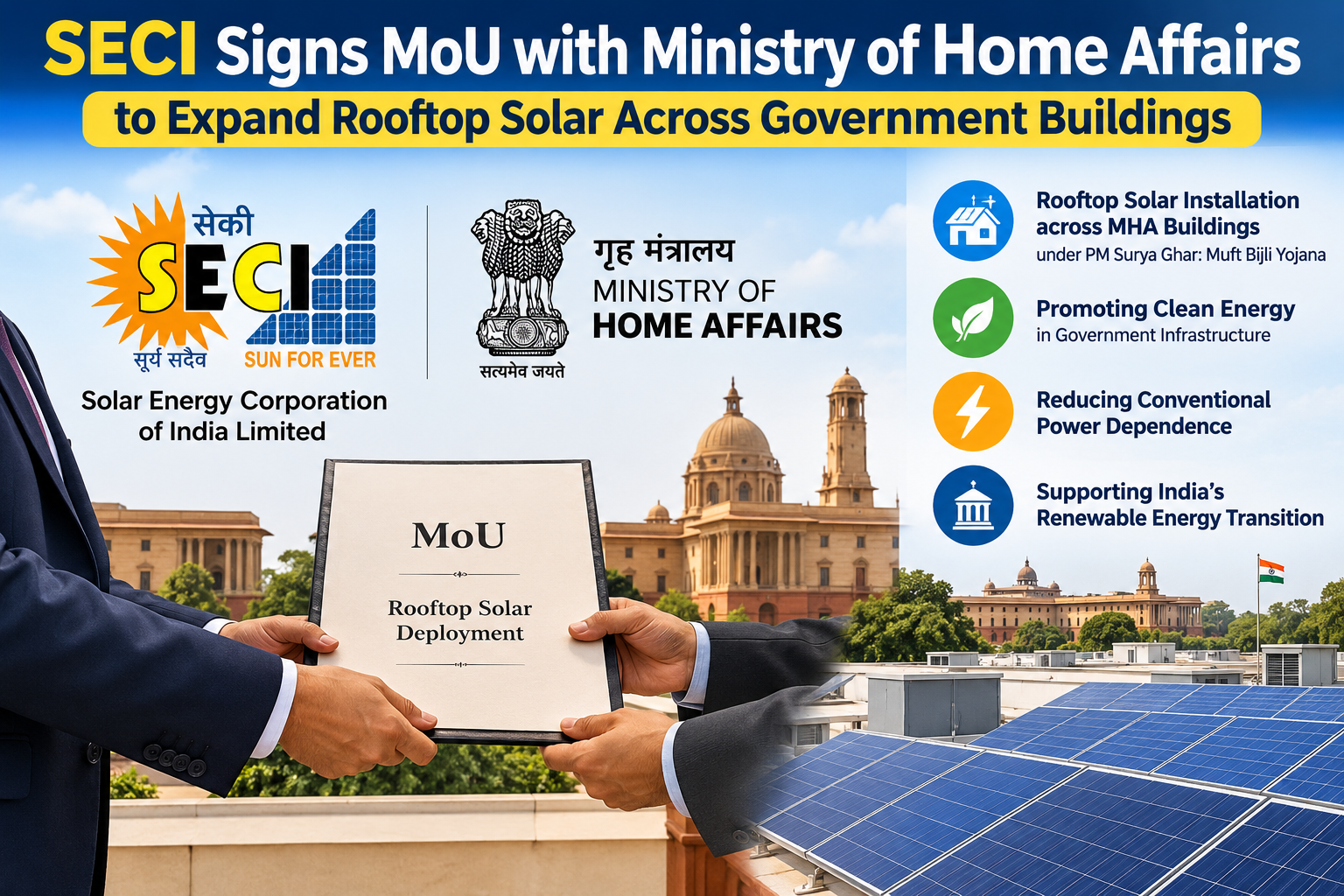
The Solar Energy Corporation of India Limited (SECI) has signed a Memorandum of Understanding (MoU) with the Ministry of Home Affairs (MHA) to facilitate the installation of grid-connected rooftop solar photovoltaic (PV) systems across MHA buildings in the country under the PM Surya Ghar: Muft Bijli Yojana.
The MoU was exchanged in New Delhi on 23 October 2026. Under the arrangement, SECI will facilitate the deployment of rooftop solar installations across eligible MHA buildings, supporting greater adoption of renewable energy within government infrastructure. Energetica USA
The initiative is significant as government buildings offer substantial potential for rooftop solar generation. By utilising available rooftop space, public institutions can reduce dependence on conventional electricity and contribute to India’s clean-energy transition.
For SECI, the initiative also reinforces its expanding role beyond utility-scale renewable projects into distributed and rooftop solar deployment. The corporation is a Navratna Central Public Sector Undertaking under the Ministry of New and Renewable Energy (MNRE).
The development comes at a time when SECI is simultaneously advancing several large renewable-energy and energy-storage programmes. Its latest project pipeline includes a 1,000 MW solar PV project paired with 1,000 MW/4,000 MWh energy storage at Pang, Leh, while SECI has also invited bids for 800 MW/3,200 MWh standalone Battery Energy Storage Systems. seci.co.in
SECI has also issued a tender for 11,159 kW of grid-connected rooftop solar PV projects under RESCO mode, indicating a continued push towards decentralised renewable-energy capacity. seci.co.in
The MHA partnership therefore represents another step in integrating renewable energy into government infrastructure and could serve as a model for wider adoption of rooftop solar across Central Government establishments.
The Worldonomics Times Insight:
SECI’s growing involvement in rooftop solar, battery storage and firm renewable-energy supply demonstrates how India’s renewable-energy strategy is shifting from simply adding generation capacity towards creating a more reliable, decentralised and integrated clean-energy ecosystem.