An Analysis of Emotional Spending, Spousal Influence, Lifestyle Inflation and Household Financial Behaviour
Abstract
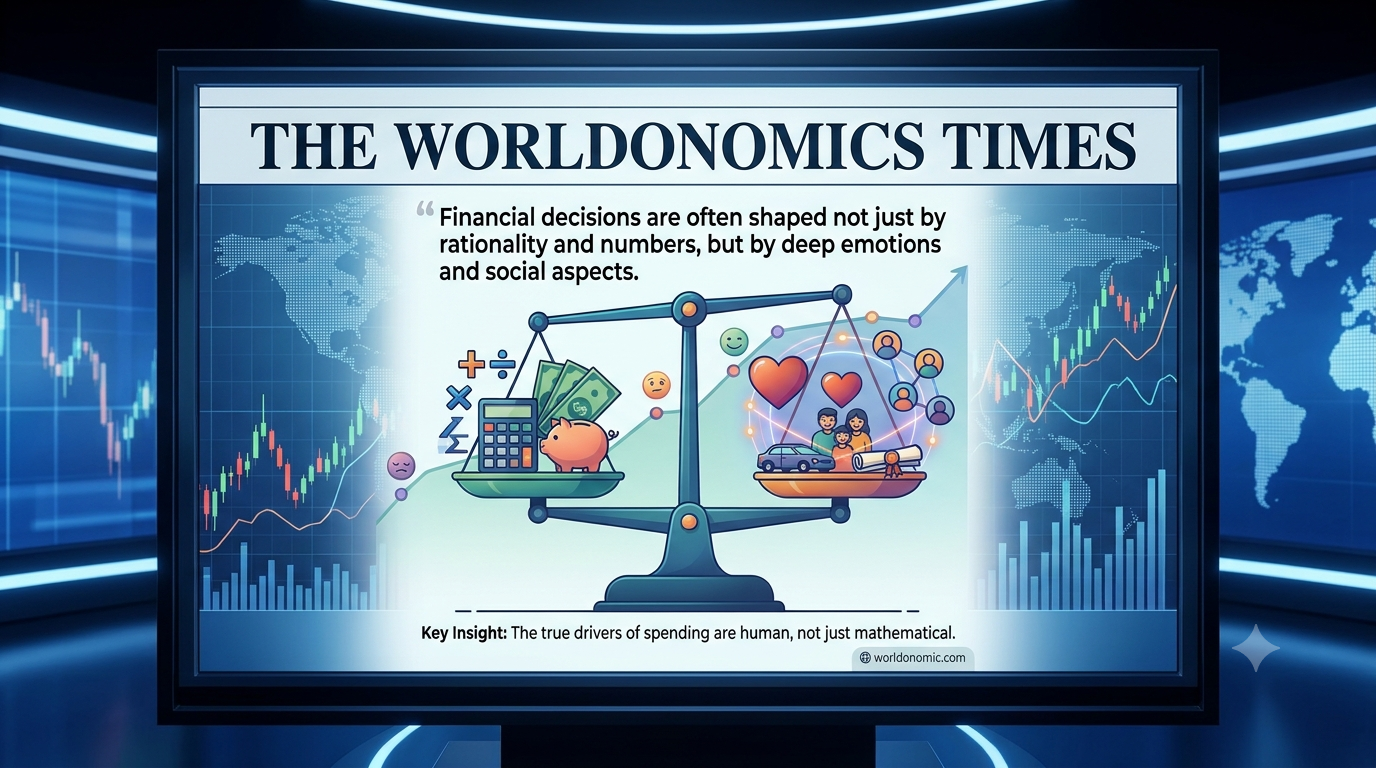
Financial decisions have always been thought of in terms of rationality. Incomes, expenditures, savings, investments, liabilities are expected to form the basis of one’s financial behaviour. However, real world household decisions do not always conform to mathematics. Emotions, relationships, expectations, social comparisons, aspirations and a desire to create better lifestyles for loved ones can often play an important role in the decisions one makes.
Thus, even a financially successful person may find himself/herself increasing expenditures when he/she already earns enough, not out of financial irresponsibility, but because financial decisions are also related to emotions and social aspects.
In this article, this phenomenon is considered through two illustrative examples of Dr. Sinha – a Senior Resident in a reputed cancer hospital and Mr. Chowdhuri – a Senior Consultant in a leading IT company. Both are financially well-off and have achieved professional success. But at the same time, decisions about spending in their households are made under the influence of preferences, expectations and aspirations in their relationships.
This article analyses such phenomena as “emotional cost of money”, the link between emotions and consumption, lifestyle inflation, social comparisons, spouse’s influence, emotional premiums, opportunity cost of lifestyle choices. Moreover, it offers an approach to take emotions into account in making financial decisions in a household, but without considering all expenditures as purely irrational.
The key idea of this article is that financial planning shouldn’t focus only on the amount of earnings and expenditures of a person, but also on the reasons behind the expenditures.
Introduction
Budget is commonly formulated using an equation:
Income – Expenditure = Savings
However, life of people doesn’t always follow such a straightforward equation.
Behind each expenditure lies a motivation.
One may buy a house because his/her family requires more comfortable accommodation. One can upgrade his/her car because he/she finds the current one insufficient for his/her wife/husband. People can travel because their family requires quality bonding time. People may buy something expensive due to the significance of the relation between them. People can dine at a restaurant due to their career success.
In all those situations people spend money because the expenditures have economical side and emotional side.
Economical side explains:
“How much does it cost?”
Emotional side explains:
“Why are we ready to pay for it?”
It is crucial for understanding how families behave economically.
A person may know that the purchase is unnecessary from the economical point of view but make it anyway. The other person may be able to resist an expenditure but accept it because it will make his/her loved one happy.
So, the economical aspect of spending can’t be analyzed using only incomes and accounts.The psychological aspect of the expenditure is as important as the expenditure itself.
Paradoxes of Being Financially Successful
One would think that a financially successful person should also have financial discipline by default.
But financial success and financial behavior are two entirely different things.
For instance, a person who earns ₹50,000 per month.
An expenditure of ₹20,000 could be very difficult for such a person.
Now let’s take the case of a person who earns ₹5 lakhs per month.
The expenditure of ₹20,000 would seem inconsequential to this person.
Though the second person has more financial power, yet he may not build wealth.
High income would bring about another problem:
With the rise of financial power comes the increase in expectations of lifestyle.
Larger house is now a norm.
Better car is expected.
Luxurious dining has become a routine.
Travelling frequently has become an expectation.
Latest technological products are necessities.
Those luxuries which were once considered unnecessary have now become a part of daily life.
This is known as ‘lifestyle inflation’.
The problem lies in the fact that lifestyle inflation is gradual in nature.There may be no single extravagant decision.
Instead, there may be hundreds of small decisions that collectively redefine what the family considers “normal”.
Case Study I – Dr. Sinha
Take for instance, the case of Dr. Sinha who is a senior resident in a renowned cancer hospital.
In his professional practice, there is need for professional dedication, long working hours and responsibility.
He is a professional and gets a decent income from it.
Financially, Dr. Sinha could live comfortably.
But household finances cannot be determined by the income of Dr. Sinha alone.
His spouse may have views on:
• family vacations;
• dining;
• family interiors;
• attire;
• festivals;
• children’s needs;
• consumer electronics;
• social gatherings; or
• other living conditions.
If Dr. Sinha considers that the expenditure is not a must.
The initial response of Dr. Sinha would be,
“We do not need it.”
The expenditure, however, could hold different significance for his spouse.
It may symbolize comfort.
It may represent a long-held family wish.
It could symbolize recognition of his professional accomplishment.
It might just represent happiness.
Dr. Sinha may agree finally.
Economically, the purchase may not be essential.
Household emotionally, however, it could mean much to them.
The difference is significant in that:
Emotional significance of the expenditure does not necessarily mean necessity of the expenditure.
Case Study II – Mr. Chowdhuri
Let us consider another case study of a professional who works as a Senior Consultant in a renowned IT organization.
He is similarly highly placed.
He earns sufficiently for his comfort and good living standard.
Let us suppose that the family of Mr. Chowdhuri wants to replace the current vehicle.
The current vehicle is in working condition.
But from the individual point of view of Mr. Chowdhuri, there might be no necessity of replacing the car immediately.
But the wife of Mr. Chowdhuri may want a new car because of:
• comfort;
• safety considerations;
• considerations of convenience;
• appearance;
• necessity for the family; or
• simply for upgrading his standards of living.
Finally, Mr. Chowdhuri agrees.
Was the above decision financially irrational?
No, it was not irrational.
Was it a purely financial decision?
Definitely, not.
It was a family decision based on financial capability and emotions.
Here lies the importance of the issue.
The main aim of behavioral finance is not to prove that emotional decisions are wrong.
The main aim is to see why the decision is taken and how sustainable its financial implications are.
The Emotional Price of Money
Every rupee has a financial value.
But its psychological value may differ according to the circumstances.
Suppose ₹50,000 is spent on a new electronic device.
The financial cost is ₹50,000.
But the emotional value may be:
- excitement;
- convenience;
- status;
- satisfaction;
- professional image; or
- family appreciation.
Similarly, ₹1 lakh spent on a holiday may generate memories that have no conventional monetary valuation.
This leads to the concept of an “Emotional Price”.
The emotional price of an expenditure can be understood as the non-financial motivation that causes an individual to accept a monetary cost.
In simple terms:
Price is what we pay.
Emotional value is why we are willing to pay it.
The problem begins when emotional value is repeatedly used to justify expenditures without considering the cumulative financial consequence.
When Love Becomes a Financial Variable
Love is not a financial transaction.
Yet, financial transactions are frequently used to express love.
A spouse may purchase a gift.
Parents may pay for expensive education.
A person may take the family on an expensive holiday.
A partner may upgrade the household’s standard of living.
The expenditure is therefore not merely consumption.
It becomes a form of emotional expression.
This creates an interesting behavioural phenomenon:
People may sometimes find it emotionally more difficult to say “no” to someone they love than financially difficult to pay for what that person wants.
For example, Dr. Sinha may be able to reject an unnecessary personal purchase without hesitation.
But if the same expenditure is strongly desired by his spouse, refusing it may create emotional discomfort.
Similarly, Mr. Chowdhuri may not personally value an expensive lifestyle upgrade, but may accept it because he values his family’s happiness.
The financial decision is therefore influenced by the emotional cost of saying no.
The Hidden Cost of Saying “Yes”
Every financial decision has an opportunity cost.
If ₹1 lakh is spent today, that ₹1 lakh cannot simultaneously be:
- invested;
- retained as an emergency reserve;
- used to repay debt;
- allocated towards education;
- saved for retirement; or
- reserved for another future objective.
Thus, the true cost of an expenditure is not merely its purchase price.
It also includes the financial opportunity forgone.
Consider:
Purchase Price + Opportunity Cost = Economic Cost
When emotions influence expenditure, the opportunity cost can become invisible.
A family may see only the immediate happiness generated by the purchase.
The future financial benefit sacrificed by the expenditure may remain unnoticed.
This is why emotional spending deserves attention in personal financial planning.
The Spouse as a Financial Influencer
In household finance, spouses are not merely co-consumers.
They are often financial influencers.
One spouse may influence:
- where the family lives;
- what vehicle is purchased;
- where the family travels;
- the type of education selected for children;
- household amenities;
- social expenditure;
- celebrations;
- investments;
- insurance;
- lifestyle choices.
This influence is not necessarily negative.
In fact, shared decision-making can improve household welfare.
The challenge arises when the financial priorities of the two spouses differ substantially.
For example:
Spouse A
“We should save more for retirement.”
Spouse B
“We should enjoy the present because we work hard.”
Both statements can be reasonable.
The problem is not the existence of different philosophies.
The problem is the absence of a common financial framework.
The Psychology of Providing the Best
One of the strongest drivers of household expenditure is the desire to provide the best for one’s family.
This is particularly relevant among professionals who have achieved financial stability after years of education and career development.
A person may think:
“I have worked hard. Why should my family compromise?”
This sentiment is understandable.
However, “the best” has no fixed definition.
The best home can become a larger home.
The best car can become a luxury car.
The best holiday can become an international holiday.
The best school can become an increasingly expensive institution.
The best phone can become the latest flagship model.
Consequently, the emotional objective remains constant while the financial threshold keeps moving.
This is one of the mechanisms through which lifestyle inflation becomes embedded in household behaviour.
Social Comparison and the Expanding Lifestyle
Emotions do not operate in isolation.
Society influences our perception of what constitutes a successful lifestyle.
A professional may observe colleagues travelling internationally.
A family may see neighbours renovating their homes.
Children may compare gadgets and experiences with their peers.
Social media may continuously expose individuals to carefully curated representations of other people’s lifestyles.
The resulting psychological effect can be summarised as:
“If others can afford it, perhaps we should have it too.”
This can transform a want into a perceived necessity.
Social comparison therefore becomes a hidden driver of household expenditure.
More importantly, comparison has no natural endpoint.
There will always be someone with a larger house, better car, more expensive holiday or more luxurious lifestyle.
If financial decisions are continuously based on comparison, income can rise without financial satisfaction ever increasing proportionately.
Emotional Spending and Impulse Spending
Emotional spending and impulsive spending are related but not identical.
Impulsive spending
A purchase is made suddenly, with limited deliberation.
Emotional spending
A purchase is influenced by an emotional state or relationship.
Emotional spending may therefore be:
- planned;
- deliberate;
- expensive;
- recurring; or
- socially influenced.
For example, an anniversary holiday may be carefully planned several months in advance.
It is still emotionally motivated.
Therefore, the objective of financial planning should not be to eliminate emotional expenditure.
Instead, it should distinguish between:
Emotionally meaningful spending
and
Emotionally uncontrolled spending.
The Family Happiness Budget
A practical solution is to recognise that happiness itself has a legitimate place in financial planning.
Instead of treating every discretionary expenditure as a financial failure, a household may create a Family Happiness Budget.
This may cover:
- holidays;
- dining;
- gifts;
- celebrations;
- entertainment;
- hobbies;
- family experiences; and
- lifestyle upgrades.
The amount should depend on the household’s income, obligations and financial goals.
The objective is simple:
Enjoy the present without borrowing from the future.
If the family has consciously allocated money for discretionary enjoyment, emotional spending becomes a planned financial category rather than an uncontrolled leakage.
The Three-Bucket Model
A practical household model may divide expenditure into three broad categories.
Bucket I – Essential Expenditure
These include:
- food;
- housing;
- utilities;
- healthcare;
- education;
- insurance; and
- essential transportation.
Bucket II – Financial Security
These include:
- emergency funds;
- debt repayment;
- retirement savings;
- investments;
- children’s future requirements; and
- other long-term financial goals.
Bucket III – Lifestyle and Emotional Expenditure
These include:
- holidays;
- dining;
- gifts;
- luxury purchases;
- entertainment;
- celebrations; and
- lifestyle upgrades.
The purpose is not to prescribe a universal percentage for each category.
Rather, the purpose is to make the third category visible.
When emotional expenditure is invisible, it can expand without control.
When it is explicitly recognised, the family can consciously decide how much it is willing to spend.
The “Pause Before Purchase” Principle
One of the simplest behavioural mechanisms is to create a cooling-off period before significant discretionary expenditure.
For a substantial purchase, the family can ask:
- Do we need it?
- Do we genuinely want it?
- Can we afford it without compromising financial goals?
- Is the expenditure recurring or one-time?
- Would we still want it if nobody else knew about it?
- Are we buying the product or the status associated with the product?
- What future financial goal could be affected by this decision?
The purpose of these questions is not to eliminate emotion.
It is to prevent emotion from becoming the sole decision-maker.
The ₹1 Lakh Test
For major discretionary expenditures, households can introduce a simple internal test.
Before spending ₹1 lakh—or any amount considered significant relative to household income—both spouses should be able to answer:
What are we buying?
Why are we buying it?
Can we afford it?
What are we giving up to purchase it?
Will this expenditure remain comfortable after three or six months?
This final question is particularly important.
A purchase may feel affordable today but become burdensome when combined with future obligations.
Therefore, affordability should be assessed not only against current income, but also against future commitments.
The Difference Between Affordability and Sustainability
A person may say:
“I can afford it.”
But affordability has two dimensions.
Immediate Affordability
Can I pay for it today?
Sustainable Affordability
Can I pay for it without compromising future financial commitments?
The second question is far more important.
An individual may be able to purchase an expensive car but may not be able to comfortably manage the resulting EMI, insurance, maintenance and other household commitments.
Similarly, an expensive holiday may be affordable from the current bank balance but may interfere with planned investments or emergency reserves.
Therefore:
Affordability is a present concept. Sustainability is a financial-planning concept.
The Emotional Cash-Flow Statement
A conventional household cash-flow statement may look like:
Income → Expenses → Savings
A behavioural approach can expand this into:
Emotion → Desire → Decision → Expenditure → Opportunity Cost → Financial Consequence
Consider Dr. Sinha:
Family aspiration → Desire to provide → Holiday → Reduced discretionary savings
Consider Mr. Chowdhuri:
Lifestyle preference → Desire for greater comfort → Vehicle upgrade → New EMI and recurring expenses
The financial transaction is only the visible end of a much longer behavioural chain.
Understanding this chain can help households identify the real drivers of expenditure.
Why Financial Literacy Alone May Not Be Enough
A person can be financially literate and still make emotional financial decisions.
A person may understand:
- compound interest;
- taxation;
- investments;
- insurance;
- inflation;
- debt management; and
- retirement planning.
Yet the same person may still spend excessively to satisfy an emotional need.
Why?
Because knowledge and behaviour are different dimensions.
Financial literacy answers:
“What should I know?”
Behavioural awareness answers:
“Why do I behave differently from what I know?”
The second question is particularly important in household finance.
Financial Communication Between Spouses
One of the most effective methods of controlling emotional expenditure is not restriction but communication.
Spouses should discuss:
- income;
- fixed expenses;
- savings;
- investments;
- debt;
- major upcoming expenses;
- lifestyle expectations;
- financial priorities; and
- discretionary spending.
The conversation should not become:
“You spend too much.”
Instead, it should become:
“What should our money achieve for us?”
This change in language is significant.
The first approach creates blame.
The second creates a common objective.
Financial planning should therefore be viewed as a joint household exercise rather than an exercise in controlling one spouse’s behaviour.
The Real Cost of Emotional Spending
The financial cost of an emotional purchase can be represented conceptually as:
Real Cost = Purchase Price + Recurring Cost + Opportunity Cost + Financing Cost
For example, a lifestyle upgrade may involve:
- initial purchase price;
- maintenance;
- insurance;
- interest or EMI;
- upgrades;
- accessories; and
- reduced investment capacity.
The emotional satisfaction may arise immediately.
The financial consequences may continue for years.
This is why recurring lifestyle commitments deserve greater attention than isolated purchases.
From Emotional Spending to Emotional Intelligence
The answer is not to become emotionally detached from money.
The answer is to become emotionally intelligent about money.
Financially mature households understand that:
- happiness matters;
- relationships matter;
- experiences matter;
- comfort matters;
- but financial security also matters.
A balanced household therefore does not ask:
“Should we spend or save?”
It asks:
“How much should we spend today while ensuring that tomorrow remains financially secure?”
This is the essence of sustainable personal finance.
What the Two Cases Demonstrate
The examples of Dr. Sinha and Mr. Chowdhuri lead to an important conclusion.
Both are financially established.
Both can afford a comfortable lifestyle.
Both have professional achievements.
Yet neither makes financial decisions in complete isolation.
Their spending behaviour is influenced by the people, relationships and expectations that form part of their lives.
This does not establish that spouses are responsible for excessive spending.
Instead, it demonstrates that:
Household financial behaviour is relational.
A person’s expenditure is often influenced by the people whose happiness, comfort and expectations matter to that person.
This is why financial planning at the household level must consider relationships as a financial variable.
A New Perspective: The Emotional Return on Expenditure
Traditional investment decisions focus on financial return.
But household expenditure sometimes generates another type of return:
Emotional Return on Expenditure (EROE)
For example:
₹50,000 spent on a family holiday may generate:
- memories;
- bonding;
- relaxation;
- happiness; and
- shared experiences.
These returns cannot be measured like interest income.
Yet they have genuine personal value.
The concept should not be used to justify unlimited expenditure.
Instead, it provides a framework for acknowledging that not all valuable returns are monetary.
The objective is therefore to maximise:
Financial Security + Meaningful Consumption
rather than simply maximising either savings or consumption.
A Practical Framework for Emotionally Intelligent Spending
Households can adopt the following five-step framework:
Step 1 – Identify the Trigger
Ask:
What emotion or requirement is driving this expenditure?
Step 2 – Quantify the Cost
Calculate the complete financial cost, including recurring expenses and financing costs.
Step 3 – Assess the Opportunity Cost
Determine what financial objective may be postponed because of the expenditure.
Step 4 – Evaluate Household Alignment
Discuss whether both spouses understand and accept the financial consequences.
Step 5 – Decide on Sustainability
Ask:
Will this decision still feel financially comfortable six months or one year from now?
If the answer is yes, the expenditure may represent a healthy lifestyle choice.
If the answer is no, the family may need to reconsider the timing or scale of the expenditure.
25. Conclusion
Money has a numerical value.
But human beings assign it emotional meaning.
We spend on our families because we love them.
We spend on experiences because we value memories.
We upgrade our lifestyle because we value comfort.
We purchase premium products because we value quality, convenience or status.
We sometimes spend because saying “no” feels emotionally difficult.
Therefore, the cost of living cannot be determined solely by inflation, income or market prices.
It is also determined by what we value and how strongly we value it.
Dr. Sinha and Mr. Chowdhuri represent two illustrative examples of financially established professionals whose household expenditure is influenced not merely by their earning capacity but also by the preferences and aspirations existing within their respective relationships.
The lesson is not that emotional expenditure is undesirable.
Nor is it that one spouse is responsible for another spouse’s spending.
The deeper lesson is that financial decisions are human decisions.
The most financially sophisticated household is not necessarily the household that spends the least.
It is the household that understands why it spends, what it is sacrificing by spending, and whether the expenditure is consistent with its long-term objectives.
Ultimately, financial maturity is not the ability to say “no” to every emotional desire.
It is the ability to say “yes” consciously.
To spend without guilt.
To save without fear.
To enjoy without compromising tomorrow.
And to understand that every financial decision carries two prices:
the price printed on the bill, and the price paid by the future.
That is the true Price of Emotions.
Author’s Note
The cases of Dr. Sinha and Mr. Chowdhuri are illustrative hypothetical cases created for analytical purposes. They are intended to demonstrate behavioural-finance principles and do not represent an assessment of the financial behaviour of any specific individual or household.
Suggested One-Line Takeaway
“Financial planning tells us where our money should go; behavioural finance helps us understand why we want to send it there.”