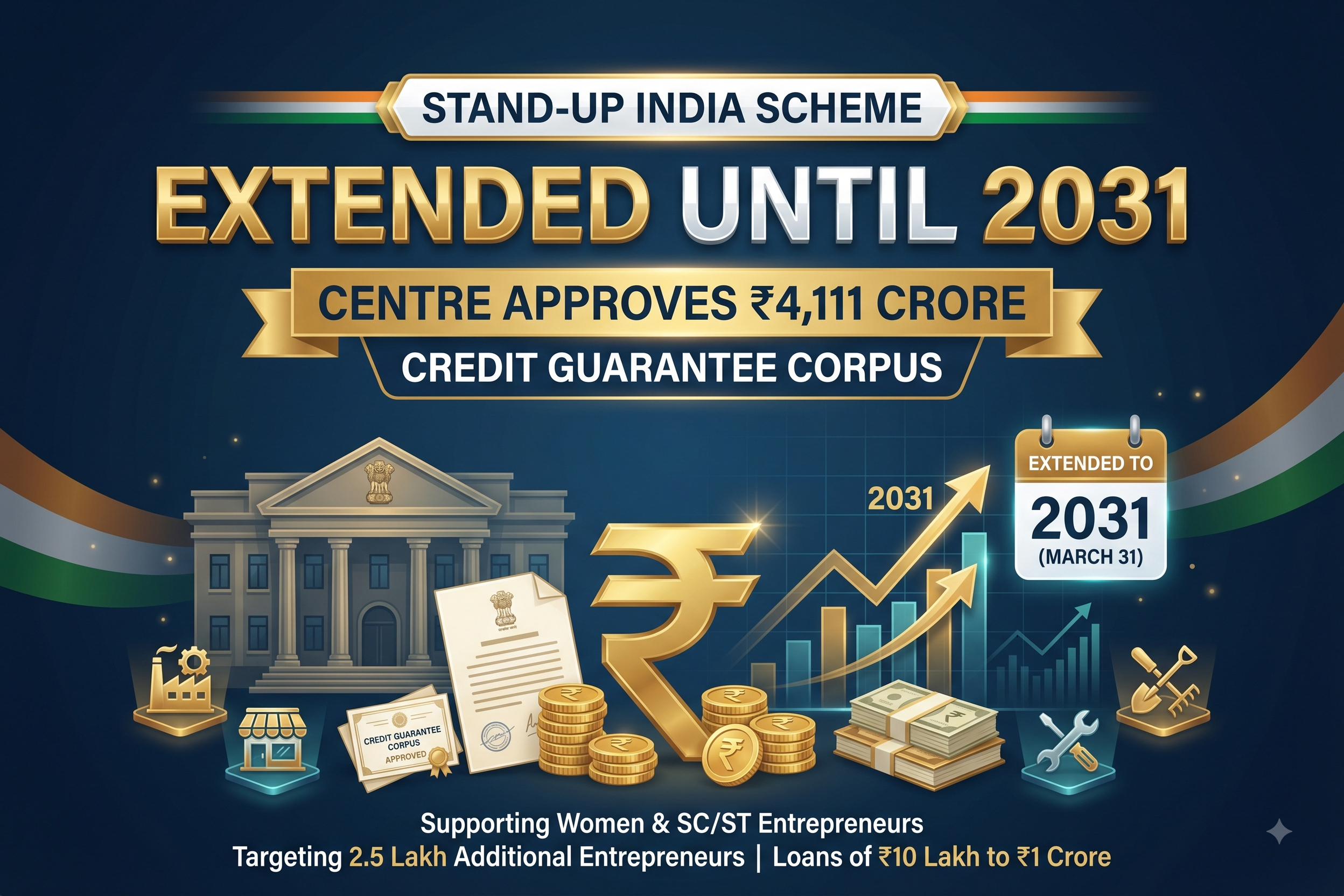
New Delhi, November 27, 2026 — The Union Cabinet has approved the continuation of the Credit Guarantee Fund for Micro Units (CGFMU) for another five years, extending the initiative until March 31, 2031. The decision, announced on November 11, 2026, includes a ₹5,000 crore credit guarantee corpus aimed at improving access to institutional finance for micro-enterprises across India.
The scheme operates under the Pradhan Mantri Mudra Yojana (PMMY) and is designed to encourage banks and other lending institutions to provide loans to eligible micro-businesses without requiring conventional collateral. The government expects the extended programme to facilitate approximately ₹12.6 lakh crore in Mudra loans over the next five years.
The continuation is intended to strengthen the financial ecosystem for small businesses, first-time entrepreneurs and self-employed individuals who often face difficulties obtaining formal credit.
Credit Guarantee Fund: Supporting Micro-Enterprise Financing
Launched in January 2016, the Credit Guarantee Fund for Micro Units provides guarantee coverage to lending institutions against the risk of default on eligible loans.
The fund operates through the National Credit Guarantee Trustee Company Limited (NCGTC), which administers the guarantee mechanism. By sharing a portion of the lending risk, the framework encourages financial institutions to extend credit to borrowers who may not have sufficient collateral or an established borrowing history.
Micro-enterprises play an important role in India’s economy by supporting local employment, manufacturing, trading, services and self-employment. However, access to finance remains a major challenge for many small business owners, particularly those operating in the informal or early-stage business segments.
The extended guarantee arrangement is expected to strengthen the flow of formal credit and help more micro-businesses establish, maintain and expand their operations.
₹5,000 Crore Corpus to Facilitate ₹12.6 Lakh Crore in Loans
The Cabinet-approved ₹5,000 crore corpus will support the guarantee mechanism over the next five years. It is expected to facilitate around ₹12.6 lakh crore in loans under the Pradhan Mantri Mudra Yojana.
It is important to distinguish between the guarantee corpus and the projected loan amount. The ₹5,000 crore represents the fund available to support credit guarantees, while the larger ₹12.6 lakh crore figure represents the expected volume of lending that the arrangement could facilitate.
This structure allows government-backed guarantees to support a significantly larger pool of institutional lending.
As of September 2026, more than 60.36 crore loans amounting to approximately ₹43.34 lakh crore had been sanctioned by lending institutions since the launch of the Pradhan Mantri Mudra Yojana.
The continuation of CGFMU is intended to maintain this credit-support framework and encourage further lending to eligible small businesses during the 2026-27 to 2030-31 period.
Which Loans Are Covered Under the Scheme?
The extended Credit Guarantee Fund for Micro Units covers specific categories of credit facilities. These include:
- Mudra loans: Loans of up to ₹20 lakh extended to eligible micro-enterprises under the Pradhan Mantri Mudra Yojana.
- Jan Dhan overdrafts: Overdraft facilities of up to ₹10,000 provided by banks through eligible Pradhan Mantri Jan Dhan Yojana accounts.
- Self-Help Group loans: Eligible loans to Self-Help Groups (SHGs) with a portfolio ranging from ₹10 lakh to ₹20 lakh.
The coverage is designed to support different types of small-scale economic activity, from individual entrepreneurs and micro-business owners to community-based self-help groups.
The guarantee amount is linked to the actual credit exposure of lending institutions. For working capital facilities, coverage is linked to the amount disbursed, while for term loans it is linked to the outstanding loan amount.
This approach is intended to align guarantee support with the financial exposure of the lender.
Reduction in Guarantee Fee to Encourage Lending
Another important change under the extended scheme is the reduction in the annual guarantee fee for eligible PMMY loans.
The guarantee fee has been reduced from 1% per annum to 0.75% per annum. This adjustment is intended to lower the cost associated with obtaining guarantee coverage and encourage greater participation by lending institutions.
The fee structure for Self-Help Group loans remains unchanged. It will continue at 0.25% for the first year and 0.50% in subsequent years.
The revised fee structure could help improve the attractiveness of the guarantee mechanism for lenders while supporting the broader objective of expanding credit access to micro-enterprises.
Five-Year Extension Until March 2031
The continued scheme will apply to eligible PMMY loans extended during the 16th Finance Commission cycle, covering financial years 2026-27 to 2030-31.
The five-year extension provides a defined period for banks and other lending institutions to expand credit delivery under the guarantee framework.
It also gives micro-enterprises greater continuity in accessing institutional financing through the Mudra ecosystem.
For businesses, access to timely credit can support several requirements, including purchasing machinery, maintaining inventory, meeting working capital needs, expanding production capacity and establishing new commercial operations.
However, the guarantee does not mean that every loan application will be automatically approved. Lending institutions will continue to assess borrower eligibility, repayment capacity and the viability of the proposed business activity.
Strengthening Financial Inclusion and Grassroots Entrepreneurship
The continuation of CGFMU is closely connected with the government’s broader financial inclusion objectives. Many small entrepreneurs operate with limited financial resources and may find it difficult to meet traditional collateral requirements.
Credit guarantee support can help reduce this barrier by sharing part of the lending risk with the guarantee institution. This may encourage banks to consider a wider range of eligible borrowers and extend formal credit to businesses that otherwise face financing constraints.
The initiative could also support employment generation and local economic development. Micro-enterprises often depend on local suppliers, workers and customers, allowing business expansion to create economic activity beyond the individual borrower.
Improved access to finance may be particularly useful for small manufacturers, retailers, service providers, artisans and self-employed individuals seeking to formalise or expand their operations.
The Worldonomics Times View
The continuation of the Credit Guarantee Fund for Micro Units with a ₹5,000 crore corpus represents an important development in India’s micro-enterprise financing framework. By supporting eligible loans through a credit guarantee mechanism, the initiative seeks to address one of the key barriers faced by small businesses: limited access to formal institutional finance.
The expected facilitation of ₹12.6 lakh crore in Mudra lending over five years highlights the potential scale of the programme. The reduction in the annual guarantee fee for PMMY loans from 1% to 0.75% may also encourage greater participation from lending institutions.
However, the effectiveness of the scheme will depend on more than the availability of guarantees. Timely loan processing, transparent eligibility assessments, responsible lending practices and effective monitoring of loan performance will be essential.
It is equally important that credit reaches viable businesses and entrepreneurs who need financing to establish or expand productive activities. Better awareness of the scheme among micro-business owners can also improve its reach.
If implemented effectively, the extended CGFMU could strengthen grassroots entrepreneurship, support self-employment and improve the integration of micro-enterprises into India’s formal financial system. Its continuation until March 2031 provides an opportunity to expand access to institutional credit while supporting the long-term development of the country’s small-business sector.