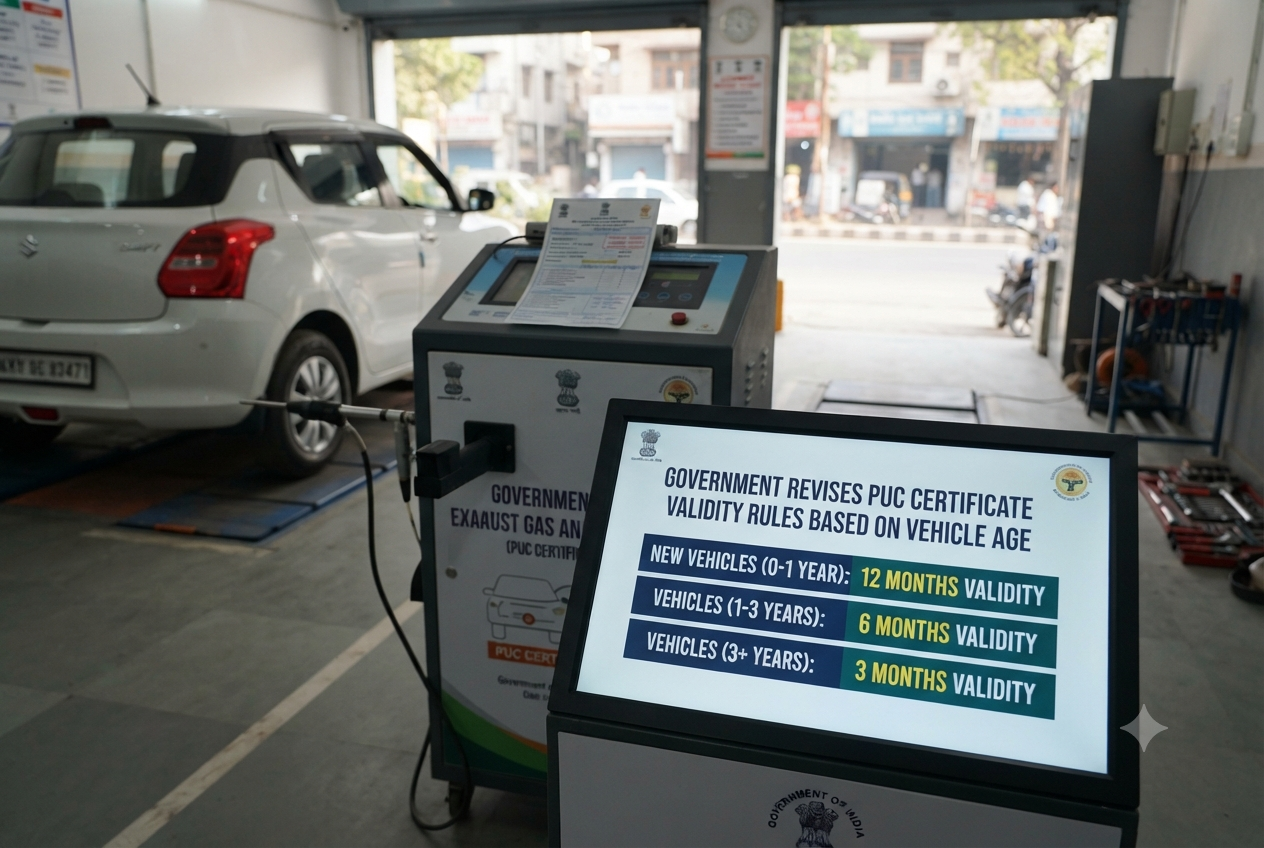
India has introduced a revised framework for Pollution Under Control (PUC) certificate validity, linking the frequency of mandatory emission testing to vehicle age, emission standards and vehicle category. The Ministry of Road Transport and Highways (MoRTH) has amended the Central Motor Vehicles Rules, 1989, to establish different renewal periods for vehicles complying with Bharat Stage (BS) emission norms.
Notified under the Central Motor Vehicles (Sixteenth Amendment) Rules, 2026, the changes aim to reduce the compliance burden on owners of newer, cleaner vehicles while maintaining more frequent pollution monitoring for older vehicles. The revised framework was notified on November 13, 2026, and came into force upon publication in the Official Gazette.
New PUC Certificate Validity Periods
Under the revised rules, certificate validity will depend on the vehicle’s emission standard and, for BS-VI vehicles, its age from the date of first registration.
The updated schedule is as follows:
| Vehicle category | PUC certificate validity |
|---|---|
| BS-I, BS-II and BS-III vehicles | 3 months |
| BS-IV vehicles | 6 months |
| BS-VI non-transport vehicles up to 6 years old | 3 years |
| BS-VI non-transport vehicles over 6 and up to 10 years old | 1 year |
| BS-VI non-transport vehicles over 10 years old | 6 months |
| BS-VI transport vehicles up to 6 years old | 2 years |
| BS-VI transport vehicles over 6 and up to 10 years old | 1 year |
| BS-VI transport vehicles over 10 years old | 6 months |
The revised schedule introduces a graded approach to emission testing. Vehicles meeting older emission standards retain shorter certificate validity, while newer BS-VI vehicles receive longer renewal intervals during their initial years of operation.
Longer Validity for Newer BS-VI Vehicles
One of the most significant changes concerns private and other non-transport vehicles complying with BS-VI emission standards.
Under the new framework, these vehicles will require a PUC certificate once every three years during the first six years from their date of first registration. Once a vehicle becomes more than six years old, the certificate must be renewed annually.
For vehicles exceeding ten years of age, the validity period reduces to six months.
This approach recognises the role of vehicle age in determining emission-testing requirements. It also reduces the frequency of mandatory certification for newer vehicles while retaining more regular checks as vehicles get older.
For private vehicle owners, the extended validity during the first six years could reduce the time and expense associated with repeated PUC testing, provided the vehicle continues to meet applicable emission requirements.
Separate Rules for Transport Vehicles
The amendment also establishes a distinct validity schedule for BS-VI transport vehicles, which includes vehicles used for commercial and passenger or goods transportation.
BS-VI transport vehicles up to six years old will receive PUC certificates valid for two years. Vehicles more than six years old but not exceeding ten years will require annual renewal.
Once these vehicles cross ten years from their first registration, the certificate validity will be reduced to six months.
The shorter initial validity compared with non-transport vehicles reflects the separate treatment of transport and non-transport categories under the amended rules.
Commercial vehicles often operate for longer periods and may accumulate higher usage than privately operated vehicles. The revised schedule therefore maintains a different testing frequency for these categories.
Older Emission Standard Vehicles Retain Shorter Validity
Vehicles complying with BS-I, BS-II and BS-III emission standards will continue to have a PUC certificate validity of three months. Vehicles meeting BS-IV standards will receive certificates valid for six months.
This means that owners of older emission-standard vehicles will continue to undergo relatively frequent emission checks, irrespective of the longer renewal intervals available to newer BS-VI vehicles.
The approach is intended to maintain closer monitoring of vehicles operating under earlier emission standards, which may require more frequent assessment during their service life.
The distinction also highlights the government’s broader effort to align compliance requirements with the emission category of vehicles on Indian roads.
What Happens to Existing PUC Certificates?
The amended rules include transitional provisions for certificates issued before the new framework commenced.
Existing PUC certificates will not automatically receive the revised validity period. Instead, the new schedule will apply when an existing certificate undergoes its first renewal after the amendment comes into force.
The rules also clarify how the effective date of a renewed certificate will be determined:
- Renewal within the final 10 days: If the certificate is renewed within the ten days immediately preceding its expiry, the new certificate will take effect from the expiry date of the existing certificate.
- Renewal after expiry: If the vehicle owner seeks renewal after the existing certificate has expired, the renewed certificate will take effect from the actual date of renewal.
These provisions are intended to provide clarity on certificate continuity and prevent confusion over the validity period during the transition to the revised system.
Implications for Vehicle Owners and the Automobile Sector
The revised PUC framework will affect vehicle owners differently depending on their vehicle’s emission category, age and usage.
Owners of newer BS-VI private vehicles stand to benefit from fewer mandatory renewal visits during the initial years. Commercial vehicle operators will also have longer renewal intervals during the first six years, although these will remain shorter than those for non-transport vehicles.
For older vehicles and those complying with earlier emission standards, frequent testing will remain an important compliance requirement.
The changes may also influence the operations of authorised PUC testing centres. With different validity periods across vehicle categories, testing centres will need to communicate the applicable requirements clearly and maintain accurate certification records.
Vehicle owners should check their vehicle’s emission category, first registration date and certificate expiry date before planning their next renewal. The applicable validity should be determined by the amended rules rather than assuming that all vehicles receive the same certificate duration.
Supporting Cleaner Transportation and Pollution Monitoring
Vehicle emissions remain an important concern for urban air quality, particularly in cities experiencing high traffic density and growing vehicle populations.
Regular emission testing helps identify vehicles that do not meet prescribed pollution standards and encourages owners to maintain their vehicles properly.
By linking PUC validity to vehicle age and emission standards, the revised framework seeks to balance administrative convenience with continued environmental monitoring.
However, the effectiveness of the policy will depend on the reliability of testing equipment, consistent enforcement and the availability of accessible testing facilities. Accurate emission measurements and action against vehicles that fail prescribed standards will remain essential.
The Worldonomics Times View
The revised PUC certificate framework introduces a more differentiated approach to vehicle emission compliance in India. Longer validity for newer BS-VI vehicles reduces repetitive certification requirements, while shorter renewal periods for older vehicles maintain more frequent monitoring.
The distinction between transport and non-transport vehicles also recognises that different categories have different operating patterns and compliance requirements.
The success of the amendment will ultimately depend on effective implementation. Vehicle owners must understand the new renewal schedule, while testing centres and enforcement authorities must ensure that certification remains reliable and consistent.
Conclusion: The Ministry of Road Transport and Highways’ revision of PUC certificate validity rules marks an important change in India’s vehicle emission compliance framework. By linking renewal periods to vehicle age, emission standards and transport category, the government aims to simplify certification for newer vehicles while maintaining closer monitoring of older ones. Clear communication, reliable testing and consistent enforcement will be essential to ensure that the revised system supports both vehicle-owner convenience and cleaner transportation.