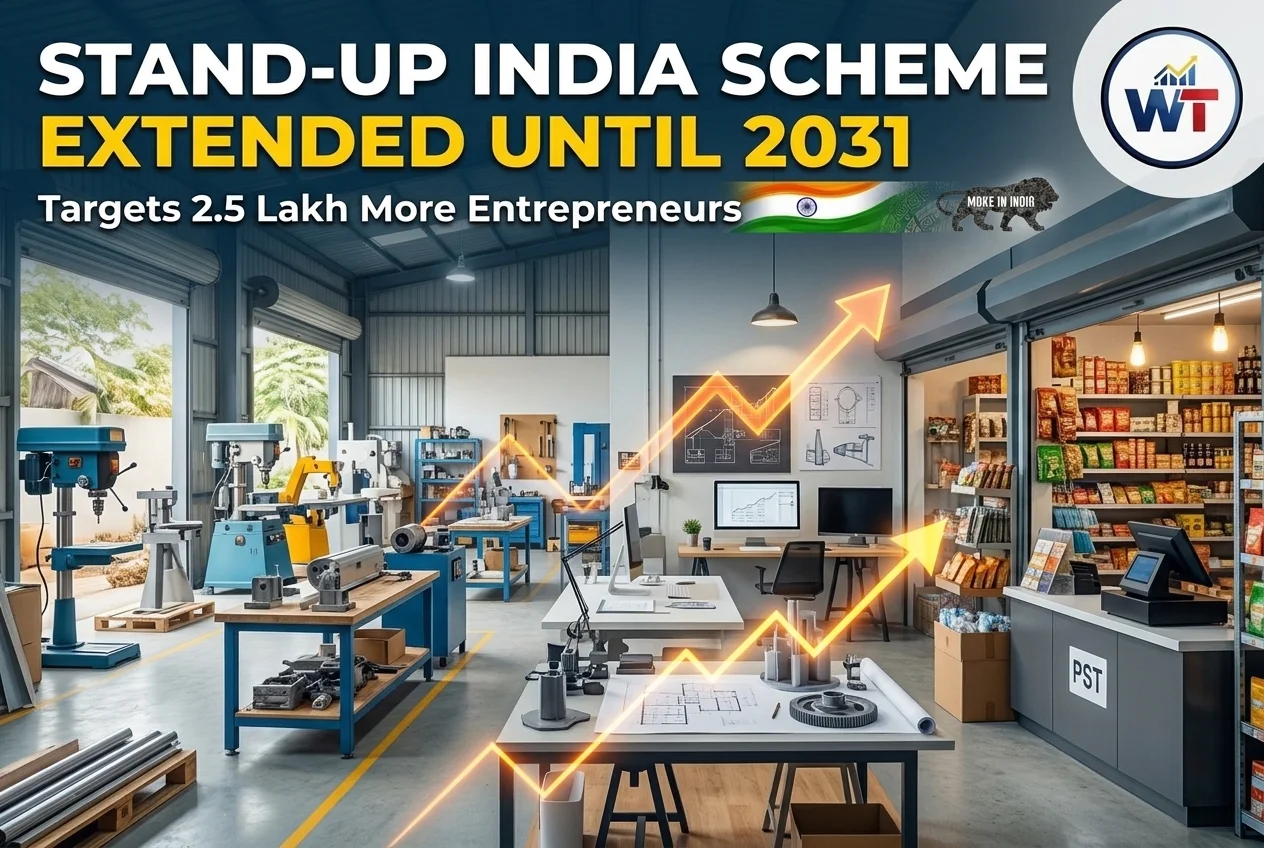
New Delhi, November 27, 2026 — The Union Cabinet has approved the continuation of the Stand-Up India Scheme for another five years, extending the programme until March 31, 2031. The decision, announced on November 11, 2026, aims to expand access to institutional finance for women and entrepreneurs belonging to Scheduled Castes (SCs) and Scheduled Tribes (STs).
Under the extended programme, the government aims to provide financial assistance to at least 2.5 lakh additional entrepreneurs over the next five years. A credit guarantee corpus of ₹4,111 crore has also been approved to support lending institutions and improve access to loans for eligible applicants.
The extension reinforces the government’s efforts to promote entrepreneurship among underserved communities, encourage new business creation and strengthen financial inclusion across India’s economy.
Stand-Up India Scheme: A Push for Inclusive Entrepreneurship
Launched in April 2016, the Stand-Up India Scheme was designed to encourage women and SC/ST entrepreneurs to establish new enterprises. It seeks to address one of the major challenges faced by aspiring business owners: access to formal bank finance.
The scheme facilitates loans through scheduled commercial banks for setting up greenfield enterprises, meaning businesses established for the first time by the eligible borrower. It covers manufacturing, services, trading and activities allied to agriculture.
Since its launch, the programme has facilitated loans to more than 2.75 lakh women and SC/ST entrepreneurs, according to the government. The latest extension is intended to build on this progress by bringing another 2.5 lakh beneficiaries into the formal credit system by March 2031.
The programme also encourages banks to widen their outreach to potential entrepreneurs who may face difficulties accessing conventional business finance.
Loans Between ₹10 Lakh and ₹1 Crore
A key feature of the Stand-Up India Scheme is its loan facility for eligible entrepreneurs. Applicants can access loans above ₹10 lakh and up to ₹1 crore for establishing new enterprises.
The financial assistance can be structured in either of two ways:
- Composite loan: A combination of working capital and term loan to meet different business financing requirements.
- Term loan: Financing primarily intended for capital expenditure and establishing the enterprise.
The loan can cover up to 85% of the eligible project cost, subject to the scheme’s conditions and the bank’s assessment.
The facility is particularly relevant for entrepreneurs planning to establish manufacturing units, service businesses, trading enterprises or agricultural-allied ventures. Such businesses often require substantial initial investment in equipment, premises, technology, inventory and other operating requirements.
By facilitating access to formal banking channels, the scheme aims to help eligible entrepreneurs move from business planning to actual enterprise establishment.
₹4,111 Crore Credit Guarantee Corpus Approved
The continuation of the scheme includes a credit guarantee corpus of ₹4,111 crore. This provision is intended to reduce the lending risks faced by banks and encourage them to extend credit to eligible entrepreneurs.
Under the approved framework, credit guarantee coverage will be available for 85% of the loan amount. The standard guarantee fee has been set at 0.50%, without an additional risk premium, according to the government’s announcement.
Credit guarantees play an important role in improving the availability of institutional finance. By providing protection against a specified portion of potential loan losses, the arrangement can encourage lending institutions to consider applicants who may have limited business track records or collateral.
For entrepreneurs, improved lender confidence could translate into better access to formal credit, although loan approval will continue to depend on eligibility, project viability and the bank’s assessment.
Focus on Women, SC and ST Entrepreneurs
The scheme places particular emphasis on women and entrepreneurs from Scheduled Castes and Scheduled Tribes. These groups may encounter financial and institutional barriers when attempting to establish and expand businesses.
By creating a dedicated credit-access framework, the programme seeks to widen participation in India’s entrepreneurial ecosystem.
The government’s implementation approach also aims to encourage lending through bank branches, with an average target of two loans per branch: one to a woman entrepreneur and another to an SC/ST entrepreneur.
The focus is not limited to providing finance. The scheme also envisages handholding support to help beneficiaries navigate the loan process and different stages of business development.
Such assistance can be important for first-time entrepreneurs who may need guidance in preparing project proposals, understanding banking requirements and managing their businesses after receiving finance.
Supporting Manufacturing, Services and Agricultural Enterprises
The scheme’s coverage across manufacturing, services, trading and agriculture-allied activities creates opportunities for businesses in different segments of the economy.
In manufacturing, eligible entrepreneurs may establish small production units, processing facilities or specialised workshops. In the services sector, the programme can support ventures in areas such as professional services, repair, hospitality and other business activities.
Trading enterprises can also benefit from access to finance for establishing new commercial operations, while agriculture-allied activities offer opportunities in food processing, storage, livestock-related businesses and other eligible ventures.
The availability of formal credit can help these enterprises invest in equipment, infrastructure and working capital, supporting their ability to operate and grow.
Potential Impact on Employment and Economic Participation
The creation of new enterprises can contribute to employment generation, local economic activity and the development of business networks.
Small businesses often create opportunities for workers, suppliers, service providers and local distributors. As more entrepreneurs establish operations, the benefits of business activity can extend beyond individual borrowers to the communities in which they operate.
The extended scheme could also encourage greater participation of women and SC/ST entrepreneurs in sectors where access to finance has traditionally been a constraint.
However, the impact will depend on the quality of projects financed, the availability of business support and the ability of enterprises to remain financially sustainable after receiving loans.
The Worldonomics Times View
The five-year extension of the Stand-Up India Scheme provides continuity to a programme focused on expanding entrepreneurship and formal credit access among women and SC/ST communities. The target of 2.5 lakh additional beneficiaries, supported by a ₹4,111 crore credit guarantee corpus, places access to finance at the centre of the government’s inclusive enterprise-development approach.
The loan facility can help eligible entrepreneurs establish businesses across manufacturing, services, trading and agriculture-allied activities. The 85% credit guarantee coverage may also encourage banks to extend finance to applicants who face difficulties accessing conventional business loans.
Nevertheless, the success of the programme should not be measured only by the number of loans sanctioned. The long-term performance of beneficiary enterprises, repayment capacity, employment generation and business survival will be equally important indicators.
Effective implementation will require timely loan processing, transparent eligibility assessments, practical guidance for first-time entrepreneurs and continued support during the early stages of business operations.
If these elements are addressed, the extended Stand-Up India Scheme could contribute to a broader entrepreneurial base and greater participation in India’s formal economy. Its continuation until March 2031 offers an opportunity to convert access to finance into sustainable businesses, stronger local economies and wider economic participation.